
Breaking China’s Grip: Korea Zinc Ships Antimony to U.S. Defense Giants
Korea Zinc’s Bold Antimony Shipment Signals a New Era in U.S.-Korea Resource Security
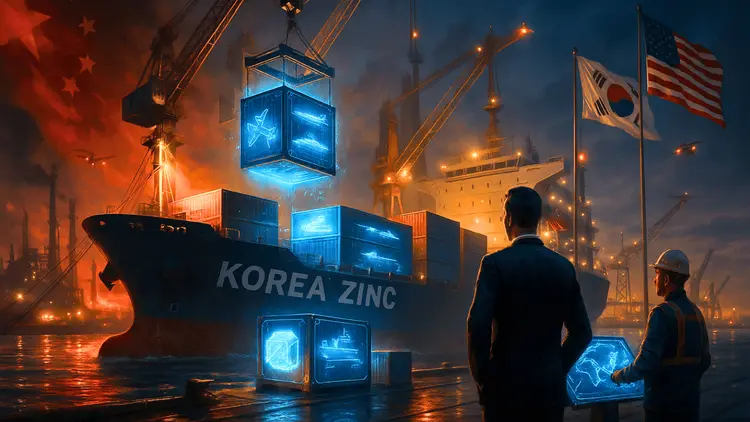
In a bold move that’s got the global minerals market buzzing, Korea Zinc has become the first to ship antimony—a critical component in everything from F-35 stealth fighters to submarine ballasts—directly to the United States. This isn’t just a cargo ship sailing from Busan to Baltimore; it’s a strategic jab at China’s iron grip on the antimony supply chain. With prices skyrocketing and geopolitical tensions simmering, Korea Zinc’s timing couldn’t be sharper. Let’s unpack this game-changer, shall we?
A Historic Shipment with Big Implications
On June 15, 2025, Korea Zinc loaded 20 tons of antimony onto a cargo ship at Busan Port, bound for Baltimore, where it’s set to arrive next month (1). This marks the first direct antimony shipment to the U.S., destined for roughly 10 American companies, including heavy-hitting defense contractors. It’s not just a delivery; it’s a lifeline for U.S. efforts to loosen China’s chokehold on critical minerals.
Korea Zinc isn’t stopping at a one-off flex. The company plans to export 100 tons of antimony to the U.S. this year, with ambitions to ramp up to 240 tons annually by 2026, shipping 20 tons monthly (1). As a company spokesperson put it, “We’re strengthening efforts to build a strategic supply chain hub between Korea and the United States” (1). Translation? They’re ready to play ball in the big leagues of global resource security.
Why Antimony Matters (Hint: It’s Not Just for Fancy Alloys)
Antimony isn’t your average rock. It’s a strategic mineral classified as critical by the U.S., China, and the European Union (1). From alloy production for chip-making equipment to armor-piercing ammo and infrared sensors in F-35 jets, this mineral is the unsung hero of modern warfare and tech. U.S. defense contractor Govini reports it’s used in a staggering 6,355 weapon components (1). Submarine ballasts? Check. High-durability batteries? Double check. Antimony’s the VIP of military hardware.
But here’s the rub: the U.S. relies on China for over 60% of its antimony imports (1). When Beijing slapped export controls on key minerals in September 2023, the market went haywire. Antimony prices surged from $15,000 per ton in the first half of 2024 to a jaw-dropping $57,000 in Q1 2025 (1). Ouch. Enter Korea Zinc, stage right, with a plan to help the U.S. dodge this dependency trap.
Korea Zinc: The Antimony Ace You Didn’t See Coming
Korea Zinc isn’t new to the antimony game—they’ve been at it since 2014 and are Korea’s only producer of 99.95% pure antimony (1). Last year, they churned out 3,500 tons, selling 70% domestically and exporting the rest (1). In Q1 2025, they hit record sales of 971 tons, proving they’ve got the chops to scale up (1). With plans to boost capacity this year, Korea Zinc is positioning itself as a reliable partner for the U.S. in a market where trust is as scarce as affordable antimony.
“We hope to contribute to the U.S. strategy for building a resource supply chain independent from China,” a Korea Zinc spokesperson said, with a nod to the new U.S. administration’s economic diplomacy (1). It’s not just talk—Korea Zinc’s $85 million investment in TMC’s Stibnite project, the only identified antimony reserve in the U.S., shows they’re putting money where their minerals are (2).
The Bigger Picture: A Global Supply Chain Shake-Up
China’s export controls didn’t just spike prices; they exposed the fragility of global supply chains. The U.S. isn’t alone in scrambling for alternatives—the Minerals Security Partnership (MSP), a 23-country alliance led by South Korea in 2025, is pushing for diversified sourcing (3). Korea Zinc’s shipment aligns perfectly with this mission, and South Korea’s MSP chairmanship gives it extra clout to shape the agenda.
The global antimony market is heating up, too. Valued at $2.17 billion in 2023, it’s projected to hit $3.17 billion by 2030, with a 6.1% CAGR (4). Volume-wise, it’s expected to grow from 98.17 kilotons in 2025 to 105.76 kilotons by 2030 (5). But with recycling rates languishing at 1-10% globally, primary sources like Korea Zinc’s are critical (6).
What’s Next? More Than Just Minerals
Korea Zinc’s move is a masterclass in timing and strategy. By stepping up as a key supplier, they’re not just shipping antimony—they’re shipping stability to a U.S. market rattled by supply risks. But challenges loom: geopolitical tensions, environmental concerns, and the hunt for substitutes could complicate things. Still, with initiatives like the MSP and bilateral deals—like Korea’s critical minerals pact with Canada (7)—the future looks promising.
So, here’s to Korea Zinc, rewriting the rules of the mineral game with a 20-ton shipment and a whole lot of swagger. China’s monopoly just got a reality check, and the U.S. defense industry is breathing a little easier. Stay tuned—this supply chain saga is just getting started.
Sources:
- Korea Zinc becomes first to ship antimony to United States
- TMC secures $85m investment from Korea Zinc amid US minerals push
- Minerals Security Partnership Under South Korean Leadership
- Antimony Market Size, Share, Growth Trends Report
- Antimony Market Outlook
- UNEP Global Material Flows Database
- Critical Minerals Supply Chain Cooperation MOUs