
Why Can’t Canada Fund Its Own Critical Minerals Supply Chain?
Despite holding the geological keys to the green energy transition, a historical obsession with gold and a severe lack of downstream investment are costing Canada the global race for battery metals.
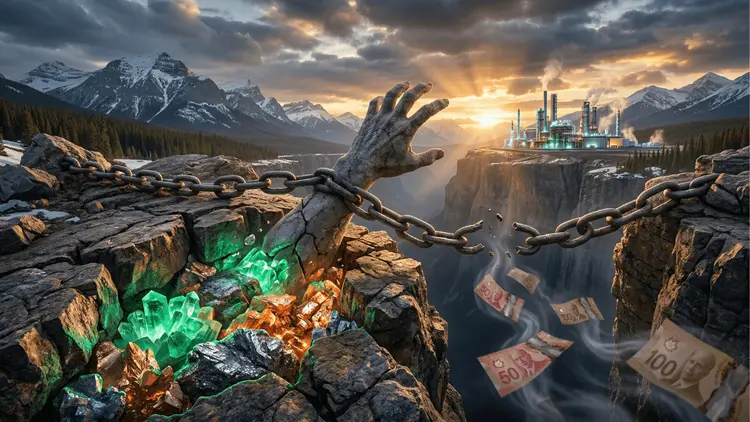
Canada has a classic "water, water everywhere, but not a drop to drink" problem, only instead of oceans, the country is drowning in lithium, copper, and graphite. Despite sitting on some of the world's most coveted geological real estate for the green energy transition, the Great White North is struggling to find the cash to actually dig it up and refine it.
According to a sobering new report from RBC, Canada has funnelled a mere 11% of its mining capital into critical minerals over the past 25 years. Where did the rest go? Exactly where you would expect: the glittering allure of gold and precious metals, which gobbled up 70% of the more than C$700 billion raised in mining equity and M&A since the turn of the millennium. The result is a widening chasm between Canada and global peers like Australia, who have aggressively lapped the Canadian market by directing more than twice as much capital toward battery metals over the exact same period.
The structural barriers keeping Canada anchored as a "mine-and-ship" jurisdiction are steep. The country currently boasts just a single active copper smelter, owned by Glencore (LON: GLEN) in Quebec, forcing domestic producers to export raw concentrates primarily to China, which happily controls roughly 70% of global refining capacity for the most critical minerals. Junior miners in Canada also face a notorious "missing middle" financing cliff. The country's flow-through share regime brilliantly incentivizes early-stage exploration, but when it comes time to find the C$20 million to C$30 million needed to bridge feasibility studies, permitting, and construction, the capital well runs dry.
This frustrating reality is heavily echoed by the executives actually trying to build the mines of the future. George Burns, CEO of Eldorado Gold (TSX: ELD) (NYSE: EGO), perfectly encapsulated the disconnect, noting that while precious metals might be flying high, the broader mining ecosystem is starved for development cash. "Although gold's at a record price today, funding for junior exploration companies that are going to find the deposits of the future and the mines of the future is virtually unavailable," Burns stated during a World Gold Council industry panel. "And with a lack of development and exploration, there's going to be challenges coming forward."
Burns is clearly taking matters into his own hands to bridge the gap between gold and green energy. He recently spearheaded a massive $3.8 billion acquisition of Foran Mining (TSX: FOM) to give Eldorado Gold immediate, high-quality exposure to copper and critical minerals alongside its legacy gold portfolio.
Meanwhile, leaders in the battery materials space are battling the realities of a shifting geopolitical landscape while trying to secure that elusive capital. Eric Desaulniers, Founder and CEO of Nouveau Monde Graphite (NYSE: NMG) (TSX: NMG), is intimately familiar with the hurdles of building domestic processing capacity. "Resource nationalism, tariffs, policy headwinds, and shifting global alliances are creating uncertainty in global supply chains and investment planning," Desaulniers recently observed. Still, he emphasized that companies like his remain entirely focused on developing a responsible and resilient North American value chain to counteract these exact vulnerabilities.
RBC's report makes it clear that free-market forces alone will not fix Canada's capital gap. The bank is calling for a heavy dose of public-private strategy centered on sovereign co-investment, shared mineral corridors, and massive infrastructure funding. Building roads, transmission lines, and grid connections to remote, mineral-rich areas like Ontario's Ring of Fire could slash project break-even prices by nearly a quarter.
If Canada can successfully pivot and execute on these strategies, the federal government estimates the country could grow its share of global output for six key critical minerals from just 2% today to a dominant 14% over the next 15 years. But unless patient risk capital steps up to fund the messy, expensive middle stages of mine development and processing, Canada risks remaining nothing more than a wealthy quarry for the rest of the world’s value-added supply chains.
Sources:
- RBC Report via MINING.COM: Canada’s critical minerals push faces capital gap (February 27, 2026)
- World Gold Council / Unearthed Podcast: Critical Minerals and the Case for Gold ft. George Burns * Nouveau Monde Graphite (NMG) Press Releases: Updates on Advancement of Phase-2 Projects and Market Conditions