
Friedland’s Vault: Unlocking the US Treasury with African Keys
From the White House to Cape Town: How the Ivanhoe founder is turning African geology into American security with a $12 billion strategic play.
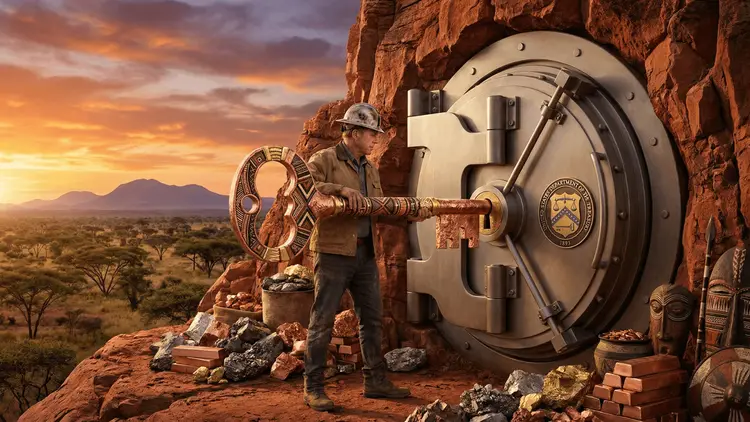
If there were a crown for the King of Cape Town this week, Robert Friedland would likely have melted it down to assay its copper content before considering wearing it. The founder of Ivanhoe Mines (TSX: IVN) did not merely arrive at Mining Indaba 2026 to exchange pleasantries; he touched down as the newly anointed broker between the White House and the mineral-rich soil of the Congo, effectively declaring that the road to the global energy transition is paved with African ore.
Fresh off a plane from Washington, D.C., where he met with U.S. President Donald Trump on February 2, Friedland brought more than just his signature showmanship to the keynote stage. He arrived with the geopolitical weight of "Project Vault," a staggering $12 billion initiative aimed at establishing a strategic critical minerals stockpile for the United States. For years, mining executives have whispered about the West needing to counter supply chain vulnerabilities. Friedland did not just whisper; he seemingly sold the American government the solution, backed by a proposed $10 billion from the U.S. Export-Import Bank.
His message to the delegates in Cape Town was unequivocal: "The answer is Africa." While analysts wring their hands over aging infrastructure and declining ore grades in established jurisdictions, Friedland took a pointed swipe at the "geriatric" copper assets in Latin America, he posited that Africa’s youthful demographics and unparalleled geology are the only things standing between humanity and a successful green transition. He framed this moment as the dawn of the continent's era, asserting that the evolution of human enterprise now rests squarely on African bedrock.
The economic philosophy driving this shift is what Friedland describes as the end of "just-in-time" efficiency and the beginning of "just-in-case" resilience. In this new world order, nations are scrambling to hoard resources against instability, and Ivanhoe Mines (TSX: IVN) is positioning itself to fill the vaults. Friedland revealed that his company is in advanced talks to supply the U.S. stockpile with materials from its historic Kipushi Mine in the Democratic Republic of Congo. The target list goes beyond the usual copper and zinc; the deal highlights strategic byproducts like germanium and gallium. These metals are essential for semiconductors and optics, sectors where the supply chain has historically been strangled by Chinese dominance. By offering a non-Chinese source for these tech-critical elements, Friedland has effectively vertically integrated his operations into American national security.
He also offered a compelling narrative for his hosts, dubbing the coming decades "The Hydrogen Century." With South Africa holding the lion's share of the world’s Platinum Group Metals (PGMs), Friedland argued that the country holds the keys to the hydrogen fuel cell kingdom. It was a strategic nod that validated the long-term potential of Ivanhoe’s massive Platreef project, suggesting that the local geology is as vital to future energy systems as the lithium fields of the Americas.
As the conference wraps up, the industry is left digesting a new reality. The mining game is no longer just about extracting rock; it is about geopolitical leverage. Robert Friedland has managed to position himself as the indispensable conduit between Western capital and African resources, proving that in 2026, the future doesn't just belong to those who find the metal, but to those who can navigate the corridors of power to sell it.
Sources:
- Mining Magazine: "Indaba 2026: it's Friedland's future" (February 11, 2026)
- Contextual references regarding Project Vault, the February 2 White House meeting, and Ivanhoe Mines' strategic asset portfolio (Kipushi, Platreef).