
Is the White House AI Power Mandate Creating the Biggest Commodities Squeeze of the Century?
The administration is forcing tech giants off the public power grid, sparking a frenzied, multi-billion-dollar scramble for copper, uranium, and heavy machinery that will fundamentally rewrite the global commodities market.
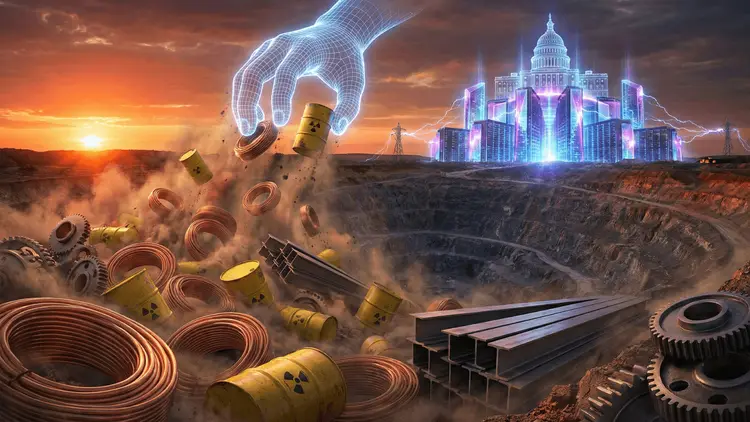
Silicon Valley executives are abruptly learning that you cannot run an artificial intelligence empire on good vibes and carbon credits. The White House is scheduled to host leadership from Microsoft (NASDAQ: MSFT), Meta Platforms (NASDAQ: META), and artificial intelligence startup Anthropic in early March to formalize a deal shielding everyday consumers from skyrocketing utility bills. This impending summit advances a stark State of the Union directive from President Donald Trump, who explicitly told major technology firms they must build their own power plants to fuel their rapidly expanding fleet of data centers.
Brad Smith, Vice Chair and President of Microsoft (NASDAQ: MSFT), publicly stated that the company appreciates the administration’s work to ensure that data centers do not contribute to higher electricity prices for consumers. While corporate attendance details for the March meeting remain fluid, the implications of this pledge are already rippling through global markets. By forcing the world's most valuable tech companies to moonlight as utility providers and take their infrastructure off the public grid, Washington is inadvertently triggering a colossal heavy-industrial land grab.
To understand the physical footprint of this mandate, you have to look inside the walls of a modern server facility. A single hyperscale data center requires tens of thousands of tons of copper to support the heavy busbars, liquid cooling systems, and specialized power distribution units needed for next-generation hardware from designers like NVIDIA (NASDAQ: NVDA). Because tech giants must now construct actual power generation facilities alongside these data centers to satisfy the White House's demands, their copper requirements effectively double. This unyielding appetite is pushing the global copper market into unchartered territory, threatening to trigger demand destruction and price shocks in traditional sectors like residential construction and appliance manufacturing.
Natural gas serves as the immediate stopgap for tech companies needing firm baseload power today, but the long-term play is decidedly radioactive. To meet colossal energy demands without violating their own climate pledges, hyperscalers like Amazon (NASDAQ: AMZN) and Microsoft (NASDAQ: MSFT) are underwriting a nuclear renaissance. They are bypassing the public grid entirely, entering into direct multi-gigawatt power purchase agreements with integrated power companies like Vistra Corp. (NYSE: VST), and aggressively backing factory-built Small Modular Reactors. This pivot has fundamentally altered the uranium market, with tech giants now negotiating directly with mining companies to secure fissile material decades in advance.
Even with unlimited capital, Big Tech cannot simply wish power plants into existence. The intermediate supply chain is currently buckling under the weight of this sudden infrastructure boom. The lead times for heavy electrical equipment, specifically large power transformers, high-voltage switchgear, and commercial gas turbines, have extended from a matter of months to several years. Manufacturers of heavy electrical hardware are operating at maximum capacity, constrained by their own labor shortages and the scarcity of industrial metals.
Ultimately, the White House's push to make tech giants pay for their own power is a politically savvy move that protects the average voter's utility bill during a crucial election year. However, physics and economics dictate that this massive energy demand does not just vanish. It is being transferred violently into the commodities and industrial manufacturing sectors, proving that in the new era of computing, the most critical metric is no longer lines of code, but tons of raw ore.
Sources:
- Reuters: "White House to host Big Tech in pledge to rein in power costs" by Jarrett Renshaw and Laila Kearney (Feb 25, 2026)
- J.P. Morgan Global Research: "Copper Market Outlook" (November 2025)
- Crux Investor: "Copper To Become the Global Economy's Most Critical Asset in 2026" (January 2026)
- Goldman Sachs Research: "Accelerating Power Demand from Data Centers Is Poised to Boost New Energy Technologies" (December 2025)
- Investing.com: "Radioactive Returns: Geopolitics and AI Fuel a Nuclear Supercycle" (February 2026)