SPONSORED

Trump Adds Copper and Met Coal to America’s Critical Minerals Arsenal

A major shift in U.S. resource strategy as Washington elevates copper and metallurgical coal to national security priority status.
•• 2 Min
Trump Adds Copper and Met Coal to America’s Critical Minerals Arsenal

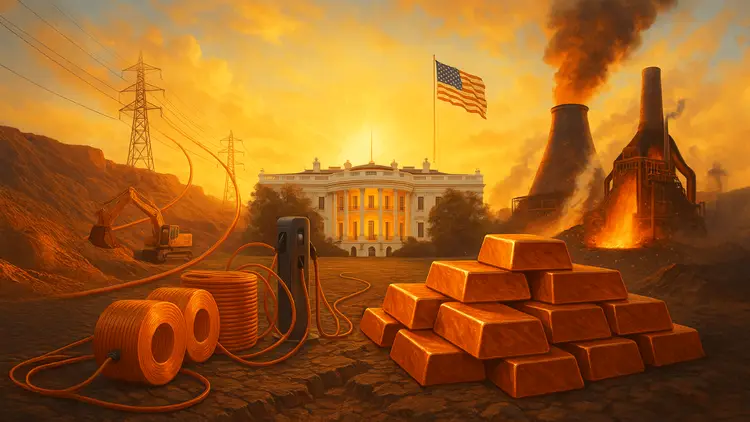
The United States marked a major shift in its resource strategy this week as the Trump administration officially expanded the nation’s critical minerals list to include copper and metallurgical coal. Presented as an essential step toward strengthening national security, reshoring industrial capacity, and reducing reliance on foreign suppliers, the move signals a renewed push to supercharge domestic mining.

The decision adds copper, one of the most universally needed industrial metals, and metallurgical coal, the carbon dense fuel required to make steel, to a roster that guides federal investments, permitting pathways, stockpiling priorities, and incentives for private developers. With geopolitical competition rising and global supply chains strained, the administration says the updated list will serve as a blueprint for protecting the country’s long term economic and industrial backbone.

Why Copper Is Now Considered Critical

Copper’s inclusion is widely considered the most consequential change. The metal is used in nearly every electrical system on earth and is indispensable to electric vehicles, wind and solar installations, advanced electronics, power transmission lines, and data centers. As the digital economy expands and electrification accelerates, demand for copper has surged to levels that experts warn may outpace supply for years.

The United States relies heavily on imports at a time when China controls a dominant share of the world’s refining capacity. That reality, combined with the Biden era incentives under the Inflation Reduction Act, set the stage for an industry push. Freeport McMoRan, America’s largest copper miner, had long advocated for the designation, arguing that lower ore grades in US deposits sharply increase production costs, making federal support essential to maintaining competitiveness.

Kathleen Quirk, Freeport’s CEO, made the case earlier this year that the country’s copper resources are too important to overlook. She noted that the company could generate more than five hundred million dollars annually in IRA related tax credits if copper received critical status. With the new designation now in place, the company’s US operations may finally see the economic stability and investment incentives needed to compete with global producers.

Metallurgical Coal’s Inclusion Signals Washington’s Commitment To Steel

While copper attracts the headlines, the addition of metallurgical coal carries deep industrial significance. The fuel is indispensable for producing coke, the heat rich carbon material used in steelmaking. Without it, steel mills cannot reach the temperatures required to transform iron ore into the structural metal that underpins construction, manufacturing, defense equipment, and heavy industry.

President Trump has long emphasized the importance of traditional energy and resource sectors to national security. Bringing metallurgical coal under the critical minerals umbrella reflects the administration’s willingness to reinforce steel production capacity at a time when some US mines have closed due to weakened export markets and China’s imposition of new tariffs on American coal.

Industry groups applauded the decision. Rich Nolan, president and CEO of the National Mining Association, said the designation is part of a broader plan to ensure the United States has access to the raw materials it needs when global markets become unstable. As geopolitical pressures rise, Washington is increasingly sensitive to China’s ability to impose export restrictions that choke off supplies of vital ingredients for American industry.

The Strategic Weight Of A Critical Minerals Designation

The critical minerals list is far more than a symbolic register. It shapes which mining projects qualify for federal incentives, accelerates environmental reviews under certain programs, guides Department of Defense stockpiling decisions, and influences long term funding for geological research. It also sends a strong signal to private investors about where Washington sees strategic value.

The Interior Department emphasized that minerals on the list support innovation, infrastructure, and energy security. By adding copper and metallurgical coal, the administration is effectively declaring that America cannot afford to outsource materials that form the backbone of electricity systems, steelmaking, and advanced manufacturing.

Domestic miners hope the update will lead to expanded investment in exploration, processing, and smelting, sectors where the US has dramatically fallen behind global competitors. The country has only a handful of copper smelters and limited cokemaking capacity compared to Asian and South American producers. Federal support could help reverse decades of underinvestment and revive regions historically dependent on resource industries.

A Path Toward Greater Resource Independence

The expansion of the critical minerals list is part of a broader US strategy to reduce vulnerability across global supply chains. Both political parties have acknowledged the risks that arise when the country depends heavily on minerals and metals from geopolitical rivals. The Trump administration has now elevated copper and metallurgical coal to the same strategic level as rare earths, lithium, and cobalt, underscoring their growing importance in a world powered by electricity and fortified by steel.

Whether the move translates into rapid development remains to be seen. Mining projects face long permitting timelines, complex environmental reviews, and community opposition in some regions. Yet the designation marks a significant policy shift that could influence the direction of American industry for decades.

What is clear is that the United States is entering a new era in which minerals are recognized not just as commodities but as strategic assets essential to the country’s economic resilience and national security. Copper will power the electrified world. Metallurgical coal will shape the steel that builds it. And Washington is now making sure both remain firmly within reach.

Conclusion

America’s decision to add copper and metallurgical coal to its critical minerals list represents a pivotal moment in the country’s industrial and geopolitical strategy. It acknowledges the growing urgency to secure materials that power modern infrastructure, fuel advanced technologies, and support domestic manufacturing. With global competition rising, the move strengthens America’s pursuit of resource independence and sets the stage for new investment in mining, processing, and national security.

Most Popular News

  1. SpaceX’s $8B Spectrum Deal Sends AT&T, Verizon, and T-Mobile Plummeting
  2. Is Project Vault Securing America’s Supply Chain or Squeezing It to the Breaking Point?
  3. Why Gautam Lohia Shifted from Global Consulting to Reboot a $20M Tech Micro-Cap
  4. Everyday Luxury, Unstoppable Scale: Aritzia Delivers 44% Net Revenue Growth
  5. Can Navy SEAL Leadership and Big Tech Scale Revolutionize Airborne Threat Detection?

Disclaimer


This report should not be viewed as investment advice or as an offer to buy or sell any securities or as an invitation or solicitation of an offer to buy or sell any securities. Neither the author of this report, its publisher, nor any other person associated with the publication of this report, are registered brokers, investment dealers, investment advisers, or financial advisers. The information in this report has not been tailored to the particular needs or circumstances of readers and should not be relied upon as investment advice or recommendations to purchase or sell any of the securities presented in this report. Readers seeking investment advice should contact qualified and registered brokers, investment dealers, investment advisers, or financial advisers prior to making any decision to buy or sell any of the securities referred to in this report. The information in this report should not be construed as investment, legal, or tax advice. No recommendation is made as to whether an investment in the presented securities is suitable for any reader in light of the reader’s particular circumstances.

Readers are cautioned that the publisher of this report covers exclusively securities that carry a high degree of volatility. Investing in such securities is highly speculative and carries a high degree of risk. Investors in such securities could lose all or a substantial portion of their investment. Only those investors who can afford to lose all or a substantial portion of their investment should consider investing in the securities referred to in this report.

This report may include information obtained from publicly available sources, including third-party reports or analysis. Neither the author nor publisher of this report, nor www.juniorstocks.com or its owners, have undertaken any independent investigation into the factual information used in this report, and the information in this report is provided without any warranty of any kind. No representations or warranties are provided regarding the accuracy or completeness of the information provided in this report. Statements of opinion or belief are those of the authors and/or publisher of this report. These statements of opinion or belief are expressions of the author’s and/or publisher’s judgment, and there is no guarantee that those judgments will turn out to be correct. No inference should be drawn that the author and/or publisher have any special or greater knowledge about the presented companies or their securities, or any particular expertise in the industries or markets in which the company operates. Readers should conduct their own due diligence and seek professional advice prior to investing in any securities presented on Juniorstocks.com.

Certain statements in this report constitute “forward-looking” statements. Forward-looking statements often, but not always, are identified by the use of words such as “seek,” “anticipate,” “believe,” “plan,” “estimate,” “expect,” “targeting,” and “intend” and statements that an event or result “may,” “will,” “should,” “could,” or “might” occur or be achieved and other similar expressions. Forward-looking statements express or involve discussions with respect to predictions, expectations, beliefs, plans, projections, objectives, goals, assumptions, or future events or performance; they are not statements of historical facts and should not be viewed as any guarantee of any future result. Forward-looking statements are based on expectations, estimates, and projections at the time the statements are made that involve a number of risks and uncertainties which could cause actual results or events to differ materially from those presently anticipated. The author and/or publisher of this report disclaims any obligation to update the forward-looking statements in this report, whether as a result of new information, future events, or results or otherwise. There is no assurance that forward-looking statements will prove to be accurate, as actual results and future events could differ materially from those anticipated in such statements. Accordingly, readers should not place undue reliance on forward-looking statements.

The information provided in this report is not intended for distribution to, or use by, any person or entity in any jurisdiction or country where such distribution or use would be contrary to applicable law or regulation, or would subject the author or publisher of this report to any registration requirement in such jurisdiction or country.

Information about the editor of this publication:
Juniorstocks.com is a service provided by Piccadilly Capital Group, Office 66, 101 Clapham High Street, London, SW4 7TB, UK. Piccadilly Capital Group is not the publisher of this report and was not paid for the publication of this report. Piccadilly Capital Group seeks to generate web traffic and a growing number of followers through the publication of articles or reports. Directors, officers, and other insiders of the publisher own an interest in Piccadilly Capital Group. Piccadilly Capital Group does not endorse or recommend the business, products, services, or securities of any company mentioned on www.juniorstocks.com. Piccadilly Capital Group will not share your information with any outside third parties. Due to the new data protection basic regulation, we ask you to read our data protection declaration carefully.

Note on copyright:
The contents published on this website and on connected media (e.g., e-mail, X, Facebook) are subject to applicable copyright and ancillary copyright laws. Any use not permitted by applicable copyright and ancillary copyright laws requires the prior written consent of the provider or the respective rights holder. In particular, this applies to the duplication, editing, translation, storage, processing, or reproduction of content in databases or other electronic media and systems. Contents and rights of third parties are marked as such. Unauthorized reproduction or transmission of individual contents or complete pages is not permitted and is punishable by law. Only the production of copies and downloads for personal, private, and non-commercial use is permitted. Links to the provider's website are always welcome and do not require the consent of the provider of the website. Photos and images on the website may not be shared unless the publisher itself has acquired the initial rights from authorized sources. The presentation of this website in external frames is only allowed with written permission. If you notice any violations, please inform us. Please note: The content of our articles, emails, or other publications or social networks such as X, LinkedIn or Facebook is exclusively intended for the designated addressee(s). If you are not the addressee of these articles, emails, or other publications in the market letter or social networks such as Twitter or Facebook or his or her legal representative, please note that any form of publication, reproduction, or distribution of the content of these articles, emails, or other publications in the market letter or social networks such as X, LinkedIn or Facebook is prohibited. Falsifications of the original content of this message during data transmission cannot be excluded in principle.