
New US-Australia Pact Challenges China’s Control of Critical Minerals
Washington and Canberra forge an $8.5 billion alliance to secure rare earths and critical minerals, reshaping global supply chains and countering China’s resource dominance.
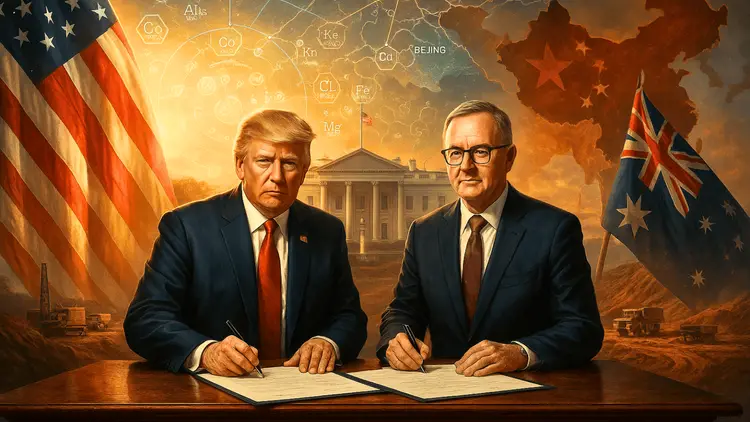
In a move that could redefine global supply chains, President Donald Trump and Australian Prime Minister Anthony Albanese signed an $8.5 billion critical minerals agreement at the White House on Monday. The deal signals a deepening alliance between two resource-rich democracies determined to break China’s stranglehold on the world’s supply of rare earths and critical minerals.
Trump described the pact as a “massive leap forward,” emphasizing that within a year the United States would have access to “so much critical mineral and rare earth that you won’t know what to do with them.” Albanese echoed the sentiment, calling the deal a “next-level partnership” that binds Washington and Canberra closer than ever before.
A Strategic Partnership in a Shifting World
The timing of the agreement couldn’t be more strategic. Earlier this month, Beijing announced new export controls requiring government approval for any magnets containing trace amounts of rare earth materials sourced or refined in China. The move has alarmed Western policymakers who see it as a thinly veiled attempt to weaponize the supply chain.
For Washington, Australia represents both a friend and a formidable mining powerhouse. With vast deposits of lithium, cobalt, and rare earth elements, the continent is uniquely positioned to help reduce global dependence on China’s production dominance. Kevin Hassett, director of the White House National Economic Council, praised Australia’s “world-class mining economy,” calling it “a cornerstone in America’s effort to make the global economy less risky and less exposed.”
Rare Earths: The Modern Oil
Rare earths are the invisible backbone of the modern economy. They’re found in everything from smartphones and laptops to fighter jets and electric vehicles. Yet, for decades, China has controlled nearly 90 percent of their global supply—an imbalance that has given Beijing immense geopolitical leverage.
The U.S.-Australia deal aims to change that. It could provide American companies with direct access to Australian production and refining capacity, strengthening North America’s energy and tech supply chains. However, experts caution that it will take years, even decades, to build enough non-Chinese supply to make a measurable dent in Beijing’s dominance.
Breaking China’s Market Grip
Pini Althaus, CEO of Cove Capital and founder of USA Rare Earth, warned that Western miners will only thrive if contracts include price floors to protect against Chinese market manipulation. “For decades, China has dumped excess minerals onto the market to drive competitors out of business,” Althaus said. “Removing that arrow from their quiver is essential if we’re going to build sustainable supply chains.”
The tactic has long been part of China’s economic playbook: flood the market, crush foreign producers, and reassert control once competitors fold. Washington’s new approach—anchored by the Australian partnership—aims to counter that by guaranteeing stable pricing and long-term purchasing agreements.
The $8.5 Billion Commitment
The agreement’s $8.5 billion investment plan includes a joint $3 billion allocation in the next six months for new exploration, refining, and processing projects. Gracelin Baskaran, director of the Critical Minerals Security Program at the Center for Strategic and International Studies, called the speed “unprecedented” and a clear sign of the urgency both nations feel.
“This isn’t just about mining,” Baskaran said. “It’s about securing the technologies that will define the next generation—AI, defense, clean energy, and advanced manufacturing. Whoever controls the minerals, controls the future.”
Australia’s Expanding Role
Australia is already home to dozens of projects producing lithium, nickel, and rare earths essential to green energy and defense. With this new deal, many of those operations could soon supply U.S. manufacturers directly.
Albanese’s government has framed the agreement as part of a broader push to modernize Australia’s industrial base. Ministers overseeing resources, industry, and science joined him in Washington to finalize the pact. “This is not just about exporting rocks,” Albanese said. “It’s about building resilient industries together.”
Central Asia: The Next Frontier
While the U.S.-Australia deal marks a milestone, experts like Althaus caution that Canberra can’t carry the entire load. He argues that investment must also flow into Central Asia, a region rich in untapped reserves of rare earths and critical minerals.
“The Soviets already did much of the groundwork,” Althaus explained. “That legacy means we could develop new mines in Kazakhstan and Uzbekistan faster than starting from scratch.” His firm, Cove Capital, is already exploring opportunities there, seeing Central Asia as a crucial piece of the global diversification puzzle.
Catching Up After Four Decades
China’s head start in the rare earth race is nearly 40 years long. Since the 1980s, Beijing has systematically built an integrated ecosystem—from mining to processing to manufacturing—that dominates the global supply chain.
“We’ve got at least a couple of decades to catch up,” Althaus admitted. But with Washington and Canberra aligned, and new projects sprouting across the Western world, the balance of power may finally begin to shift.
Economic Power Meets National Security
The critical minerals pact isn’t just about economics—it’s about security. Rare earths are indispensable to missile guidance systems, radar, and electric propulsion. A shortage could paralyze industries and militaries alike.
Treasury Secretary Scott Bessent underscored this point last week, declaring, “China is a command-and-control economy. We and our allies will neither be commanded nor controlled.” His words reflect a broader Trump administration push to ensure that U.S. national security is no longer hostage to foreign supply chains.
AUKUS and the Geopolitical Chessboard
The agreement also comes alongside renewed discussions around AUKUS, the defense pact linking Australia, the U.S., and the U.K. Originally signed under the Biden administration, AUKUS aims to help Australia acquire nuclear-powered submarines and deepen military integration among the allies.
Trump described AUKUS as “moving along very rapidly,” while Albanese reaffirmed its significance, calling it “essential to our defense and security partnership.” U.S. Navy Secretary John Phelan added that revisions to AUKUS would “clarify ambiguity” and ensure mutual benefits for all three nations.
Meanwhile, Beijing’s response was swift and predictable. Chinese Foreign Ministry spokesperson Guo Jiakun condemned the pact, accusing the allies of “creating bloc confrontation and increasing nuclear proliferation risks.”
A Defining Moment in the Global Supply Chain War
The U.S.-Australia minerals deal marks more than just an economic alliance. It is a statement of intent—a declaration that the era of Chinese monopoly over the world’s critical minerals is nearing its end.
For decades, Western nations underestimated the strategic value of these materials. Now, with AI, electric vehicles, and defense tech driving unprecedented demand, the cost of inaction has become clear.
Trump, never one to understate, summed it up in characteristic fashion: “In a year from now, we’ll have so much critical mineral, you won’t know what to do with it.” Whether that proves prophetic or premature, the signing in Washington may be remembered as the moment the West decided to mine its own future.
Conclusion
The critical minerals pact between the United States and Australia is more than a trade agreement—it’s a cornerstone of a new geopolitical era. It represents economic resilience, technological independence, and the resolve of democratic nations to control their own destinies. While challenges remain and China’s advantage endures, the direction is clear: the race for resource security has begun in earnest, and this time, the West intends to win.