
“They Can’t Be Trusted with the Global Supply Chain,” Says Bessent
U.S. Treasury Secretary Scott Bessent blasts Beijing’s sweeping export curbs on rare earth minerals, warning they threaten the stability of global supply chains and signal a new phase in the economic power struggle between China and the West.
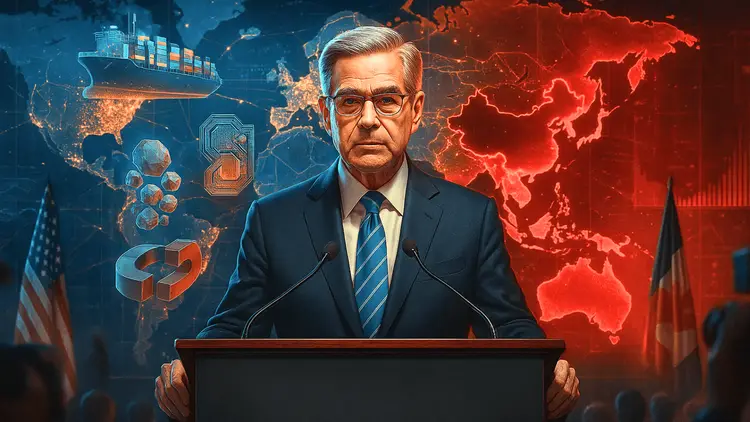
In a stark rebuke that underscored deepening U.S.-China tensions, Treasury Secretary Scott Bessent condemned Beijing’s sweeping new export controls on rare earth minerals — a move that sent ripples through global markets already on edge. Speaking alongside U.S. Trade Representative Jamieson Greer, Bessent warned that China’s decision to tighten the flow of these critical materials was not simply an act of economic protectionism, but a direct challenge to the world’s industrial supply chain.
At the heart of the dispute lies a new rule that effectively gives Beijing veto power over any product containing even a trace amount of Chinese-mined or processed rare earths. That threshold, a mere 0.1%, covers everything from semiconductors and batteries to magnets in electric vehicles and fighter jets. It’s an expansive grip that threatens to hold the global tech economy hostage.
Bessent’s tone was measured but firm. He stressed that while the U.S. seeks stability and open dialogue, China’s latest measures represent a deliberate act of economic coercion — not just toward America but toward every nation reliant on advanced technology. “This is not proportional retaliation,” Bessent declared. “It is an exercise in economic coercion on every country in the world.”
The implications are vast. Rare earths are the invisible backbone of the modern economy, powering smartphones, wind turbines, data centers, and military systems. With over 80% of the world’s refining capacity based in China, any disruption threatens to paralyze production lines from Silicon Valley to Stuttgart. As Bessent pointed out, the rule effectively hands Beijing a lever over global innovation.
Jamieson Greer echoed the concern but added a note of diplomacy. He emphasized that the United States does not seek confrontation, repeating President Trump’s stance that America “wants to help China, not hurt it.” Yet, Greer warned, if Beijing insists on weaponizing trade, it risks isolating itself from the very global economy it helped build. “Make no mistake,” he said, “this is China versus the world.”
That phrase struck a chord. It captured the mood not only in Washington but in capitals across Europe and Asia, where officials are scrambling to assess the fallout. For years, the West has talked about “de-risking” from China — reducing dependence without cutting ties. But Beijing’s move, some analysts say, could accelerate the shift toward full “decoupling,” something neither side publicly claims to want.
Still, Greer struck a hopeful note. He suggested that dialogue remains possible, pointing to ongoing trade negotiations and the personal rapport between President Trump and President Xi. “While there are substantial actions we could take,” he said, “we’d rather not. I believe China is open to discussion, and I am optimistic this can be de-escalated.”
Behind the scenes, however, policymakers are bracing for impact. Semiconductor firms and automakers are already revising supply chain strategies, fearing tighter export approvals could delay key components. Analysts at major banks warned that even a short-term disruption could push up prices for electric vehicles and consumer electronics. Investors responded swiftly, with shares of rare earth producers outside China — particularly in Australia and the U.S. — surging on speculation of new government incentives.
Bessent’s condemnation marks one of the strongest statements yet from the Biden administration on economic security. It reflects a growing consensus in Washington that critical minerals are not just a trade issue but a national security imperative. The message is clear: control over rare earths equals control over the future of technology, defense, and energy.
China’s strategy, meanwhile, appears to blend economic signaling with geopolitical calculus. By tightening exports, Beijing reminds the world of its dominance in the mineral sector — even as it faces mounting pressure from slowing growth and an exodus of foreign capital. Yet the move may backfire. As one senior official put it, “They can’t be trusted with the global supply chain.” That sentiment is already fueling fresh cooperation among Western allies, from the U.S. and Canada to Japan and the EU, to develop alternative sources.
As the world watches, both sides are walking a fine line between pressure and diplomacy. Bessent and Greer’s remarks signal a unified front but also a willingness to keep communication channels open. “The world does not want to decouple,” Greer said. “We want to de-risk.” It’s a subtle but important distinction — one that may define the next decade of global trade.
For now, markets remain tense, supply chains uncertain, and the geopolitical chessboard increasingly complex. Whether Beijing will retreat or double down remains to be seen, but one thing is clear: the battle for control over the minerals that power modern civilization has officially entered a new phase.
Conclusion
The rare earth showdown is more than a trade dispute — it’s a reckoning over who controls the foundation of the global economy. Bessent’s condemnation is not just rhetoric; it’s a declaration that economic freedom and technological leadership are now matters of security and sovereignty. As nations rally to secure their supply chains, the world edges closer to a new era where minerals, not money, define power.