
The Transatlantic Counterweight: Inside Canada and the EU's Strategic Defense Pivot
As trade friction with Washington intensifies, Ottawa and Brussels prepare an unprecedented alliance built on defense procurement, supply chain security, and critical minerals.
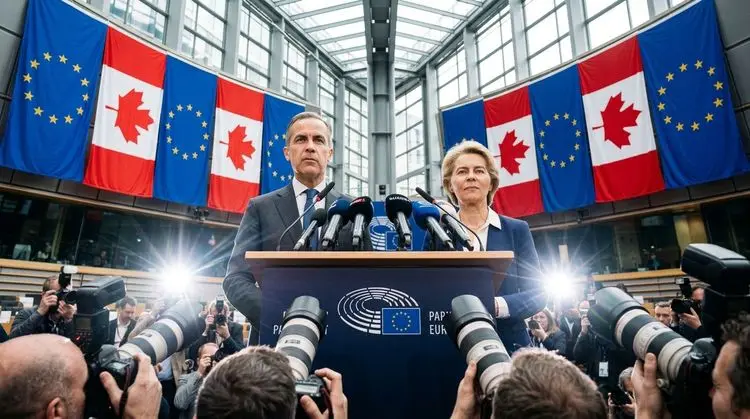
When North American trade negotiations dissolved into tariff-fueled theater, Ottawa did not simply lick its wounds, it packed its bags for Brussels.
Facing escalating economic friction with Washington and a fragmenting rules-based international order, Canadian Prime Minister Mark Carney and European Commission President Ursula von der Leyen are preparing to formalize a broad, far-reaching strategic alliance designed to insulate both powers from great-power pressure.
The pivot represents the most ambitious realignment of Canadian foreign policy in generations. Ahead of von der Leyen’s annual State of the Union address in Strasbourg, where Carney is scheduled to address European lawmakers, negotiators are hammering out arrangements aimed at getting as close to full European Union integration as legally possible without formal membership.
The proposed framework spans critical raw materials, supply chain resiliency, scientific research, and defense procurement.
This strategic alignment is already reshaping military procurement. Canada’s decision to join the EU's €150 billion defense procurement fund, making it the first non-EU nation to do so, has opened new avenues for European defense giants like Airbus SE (EURONEXT: AIR). It also followed Ottawa's selection of Swedish manufacturer Saab AB (NASDAQ OMX: SAAB B) for its new airborne early warning aircraft, signaling a willingness to bypass traditional defense contractors like Lockheed Martin Corp. (NYSE: LMT) when North American supply chains grow unpredictable.
If this transatlantic coalition requires a practical test case in supply chain security, critical minerals offer the clearest frontline. Junior explorers like Military Metals Corp. (CSE: MILI | OTCQB: MILIF) sit directly at this nexus, pursuing defense-essential minerals like antimony, a key component in night-vision optics, armor-piercing munitions, and military storage batteries. With Beijing restricting exports and Moscow cut off by sanctions, the company's efforts to secure assets both in Nova Scotia and within the European Union highlight how Canadian mining expertise and European strategic initiatives are coalescing to reduce reliance on foreign adversaries.
Yet policy realists urge caution against assuming Europe can seamlessly replace North American trade integration. In a sharp analysis for the Macdonald-Laurier Institute, former Canadian International Trade Minister Ed Fast and defense scholar Richard Shimooka warned that geographic distance and regulatory divergence pose formidable hurdles. They noted that the EU remains heavily protectionist toward internal suppliers and argued that an overemphasis on transatlantic diplomacy risks diverting valuable attention from faster-growing markets across the Indo-Pacific region.
Regardless of institutional friction, the political tailwinds in Ottawa are formidable. Public research from polling firm spark*insights reveals that an unprecedented 80 percent of Canadians support using hardball economic measures to defend domestic interests amidst ongoing tariff disputes. As Carney prepares for a joint summit in Canada, his government’s wager is clear: in an era dominated by unilateral pressure tactics, middle powers must forge their own economic armor, even if building it requires crossing an ocean.
Sources
- Bloomberg News – "EU and Canada Plan Far-Reaching Alliance to Strengthen Partnership" (September 8, 2026)
- The Logic – "Von der Leyen to highlight Canada relationship in state of the EU speech" (September 8, 2026)
- Macdonald-Laurier Institute – "Don't count on Europe to save us, Canada" by Ed Fast and Richard Shimooka (September 4, 2026)
- Kalkine Media – "Military Metals (CN:MILI) Drills Nova Scotia Antimony While Fighting to Save Its Slovak Flagship Licence" (July 29, 2026)
- Investing.com – "EU and Canada plan broad alliance to counter U.S.-China dominance" (September 8, 2026)
Disclaimer
JuniorStocks and/or the author of this article hold equity positions in Military Metals Corp. (CSE: MILI; OTCQB: MILIF; FSE: QN90). Neither JuniorStocks nor the author holds equity, stock options, or any other financial positions in Airbus SE (EURONEXT: AIR), Saab AB (NASDAQ OMX: SAAB B), Lockheed Martin Corp. (NYSE: LMT), or any other companies mentioned in this publication. This content is published by JuniorStocks strictly for informational purposes, was prepared independently without company compensation, and utilized AI assistance for text editing, formatting, and generating accompanying media. While critical minerals and defense supply chain security represent a compelling strategic priority within the EU-Canada framework, this article does not constitute investment or financial advice. Investors are strongly advised to conduct their own thorough, independent due diligence and consult with a qualified financial professional before making any investment decisions.