
Is Washington Underestimating Canada’s Control Over Critical Mineral Markets?
As trade tensions flare, Ottawa is decoupling its critical mineral and uranium stockpiles from American demand, reclaiming energy sovereignty and turning cross-border supply chains into economic bargaining chips.
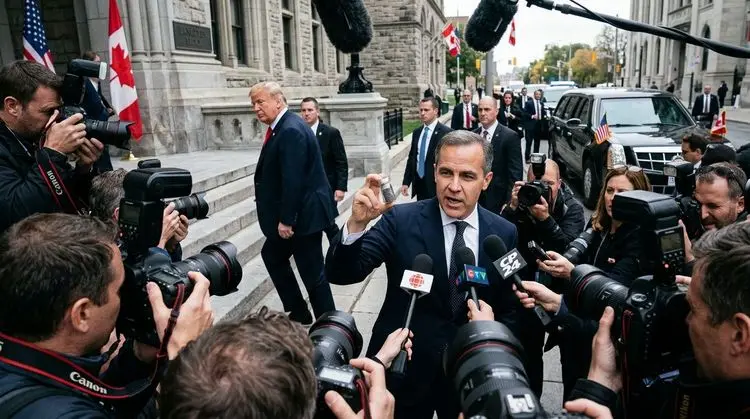
When Washington dialed up the trade pressure on its northern neighbor, Ottawa decided against polite hand-wringing and went straight for the light switch.
Canada is officially recasting its vast reserves of critical minerals and clean energy from friendly cross-border assets into potent geopolitical leverage against the Trump administration. As the trade war between Washington and Canadian Prime Minister Mark Carney’s government intensifies, Ottawa is making it clear that the era of treating Canadian energy and resource sharing as an automatic entitlement for the United States is officially over.
Energy and Natural Resources Minister Tim Hodgson, a former executive at Goldman Sachs (NYSE: GS), made that posture unmistakable during a cross-country tour highlighting new mines and energy infrastructure. Breaking ground in Prince George, British Columbia, on the North Coast Transmission Line, a grid expansion managed by provincial power utility BC Hydro, Hodgson openly mused about keeping Canadian power strictly within Canadian borders. Rather than feeding American power grids, British Columbia plans to use its doubled electrical capacity to run domestic processing facilities, extract critical minerals near the Alaskan border, and ship liquefied natural gas across the Pacific to Asian markets.
That aggressive stance hits Washington where it hurts most.
Despite political claims to the contrary, the U.S. remains heavily dependent on Canadian natural wealth. According to the Canada Energy Regulator, Canada supplied over 80 percent of U.S. electricity imports in 2025, while American officials continue to signal an urgent need for Canadian potash, copper, and the rare elements essential for artificial intelligence, quantum computing, and defense hardware. Washington long viewed Canadian stockpiles as a natural shield against Chinese market dominance, but Canadian leaders are no longer willing to hand over easy access without substantial trade concessions.
Nowhere is that tactical leverage more potent than in the nuclear sector. Canada supplies roughly one-third of the uranium purchased by U.S. nuclear power plants, leaving the American energy grid acutely exposed at a time when Washington is actively seeking to decouple from foreign enriched fuel. By threatening to redirect high-grade uranium exports managed by industry heavyweights like Cameco Corporation (TSX: CCO | NYSE: CCJ) toward European and Asian G7 allies, Ottawa holds a formidable card over trade negotiations. Without laying down an outright embargo, Canada can effectively squeeze American utilities simply by locking up long-term supply contracts elsewhere.
The hardball rhetoric is spreading across Canada’s provinces.
Ontario Premier Doug Ford has warned that cutting off critical mineral and electricity exports to the U.S. remains firmly on the table, while British Columbia Premier David Eby criticized Washington for insulting Canadian trade partners while relying on their power. Meanwhile, Canadian resource developers are racing to get domestic processing capacity online. In Saskatchewan, the McIlvenna Bay copper and zinc mine, developed by Foran Mining Corporation (TSX: FOM) and integrated into Eldorado Gold Corporation (TSX: ELD, NYSE: EGO), delivered its first yield, serving as a prime example of Canada's push for domestic resource sovereignty.
Instead of capitulating to tariff threats, Ottawa is diversifying its trade portfolio.
Carney recently highlighted nearly C$50 billion in international resource transactions over the past year and extended priority access offers to G7 partners, while explicitly rejecting any American demand for exclusive access. While security analysts at the Transition Security Project warn that aggressive economic pressure risks turning Canada into a mere resource extraction outpost for the U.S. defense sector, Ottawa appears determined to hold its ground, keeping its minerals, processing plants, and power grid firmly under Canadian control.
Source & Fact Match:
This article is based on reporting by POLITICO (Canada turns its critical minerals into leverage against Trump, September 5, 2026, by Mike Blanchfield), featuring official statements from Prime Minister Mark Carney, Energy Minister Tim Hodgson, Ontario Premier Doug Ford, B.C. Premier David Eby, data from the Canada Energy Regulator and Natural Resources Canada, research from the Transition Security Project, and market filings for Goldman Sachs Group Inc. (NYSE: GS), BC Hydro, Cameco Corporation (TSX: CCO, NYSE: CCJ), Foran Mining Corporation (TSX: FOM), and Eldorado Gold Corporation (TSX: ELD, NYSE:
Disclaimer:
Neither the author of this article nor JuniorStocks.com holds equity, stock options, or any other financial positions in Goldman Sachs Group Inc. (NYSE: GS), Cameco Corporation (TSX: CCO; NYSE: CCJ), Foran Mining Corporation (TSX: FOM), Eldorado Gold Corporation (TSX: ELD; NYSE: EGO), or any other companies or state entities mentioned in this publication. This content is published by JuniorStocks.com strictly for informational purposes, was prepared independently without company compensation, and utilized AI assistance for text editing, formatting, and generating accompanying media. While Canada’s critical minerals, uranium sector, and energy trade dynamics represent a compelling geopolitical and macroeconomic story, this article does not constitute investment or financial advice. Investors are strongly advised to conduct their own thorough, independent due diligence and consult with a qualified financial professional before making any investment decisions.