
China Restricts U.S. Rare Earth Shipments Ahead of High-Stakes Washington Summit
As Chinese suppliers freeze shipments over regulatory compliance fears, North American critical mineral producers rush to fill domestic supply gaps ahead of high-stakes Washington talks.
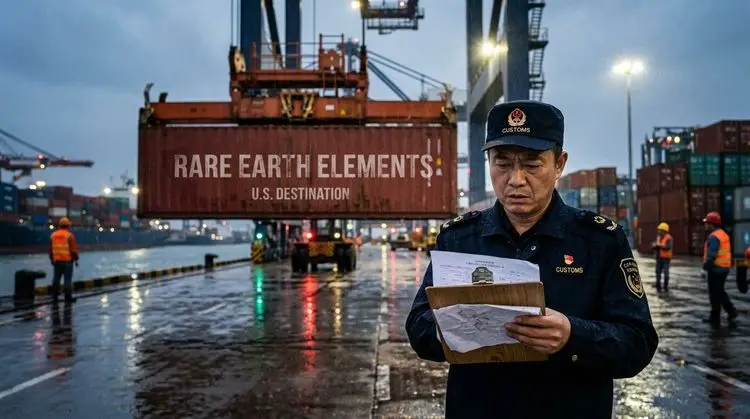
Beijing’s geopolitical chess match just claimed its latest pawn: the global critical minerals pipeline. Chinese rare earth suppliers have abruptly begun declining shipments to American buyers, turning an already fragile trade relationship into a high-stakes game of regulatory dodgeball just weeks before President Xi Jinping visits Washington on September 24.
The sudden friction traces back to Beijing's decision to sanction the U.S.-based supply chain monitor Responsible Business Alliance and its auditing arm, the Responsible Minerals Initiative. Chinese exporters now find themselves caught in a regulatory vice: comply with Western supply chain auditing standards and face harsh penalties under China's Anti-Foreign Sanctions Law, or refuse U.S. orders altogether. To avoid state retribution or secondary accusations of selling materials that might be resold to blacklisted users, several Chinese suppliers are simply walking away from American contracts.
For U.S. industrial and defense manufacturers, the fallout is getting harder to ignore. Wait times for export licenses have stretched beyond six months for crucial materials such as yttrium, gallium, and tungsten, vital inputs for aerospace systems, semiconductor chipmaking, and medical devices. Chinese customs data reveals that U.S.-bound yttrium imports have plunged to roughly half of their 2024 levels, while gallium shipments fell 65 percent. U.S. officials maintain that Beijing is failing to honor commitments made in Busan to ensure smooth licensing, though Chinese officials counter that recent U.S. Federal Communications Commission trade restrictions violated those agreements first.
While short-term supply chokepoints create immediate friction for buyers, the freeze offers a massive tailwind for Western producers rushing to fill the domestic void. Mining and processing operator MP Materials (NYSE: MP) stands directly in line to benefit as domestic refining and magnet manufacturing become urgent national priorities. Development-stage players such as USA Rare Earth (NASDAQ: USAR) and heavy mineral processor Energy Fuels (NYSE: UUUU) are seeing heightened strategic relevance as commercial end-users scramble for non-Chinese processing capacity.
At the same time, specialized mineral plays are gaining leverage. U.S. Antimony (NYSE American: UAMY) is positioning its processing network to absorb shifting critical metal demand, while American Resources (NASDAQ: AREC) is leveraging its rare earth recycling technologies to bypass foreign raw material bottlenecks entirely. Although analysts expect Beijing may moderately ease license approvals around the September summit to defuse diplomatic allegations, this latest freeze reinforces a permanent reality: reliance on overseas critical mineral refining is a liability Western supply chains can no longer afford.
Sources
- Reuters, Ministry of Commerce of the People's Republic of China (MOFCOM Order No. 2), Rhodium Group Geopolitical Analysis, General Administration of Customs of the People's Republic of China.
Disclaimer
Neither the author of this article nor JuniorStocks holds equity, stock options, or any other financial positions in MP Materials Corp. (NYSE: MP), USA Rare Earth Inc. (NASDAQ: USAR), Energy Fuels Inc. (NYSE American: UUUU), U.S. Antimony Corp. (NYSE American: UAMY), American Resources Corp. (NASDAQ: AREC), or any other companies mentioned in this publication. This content is published by JuniorStocks strictly for informational purposes, was prepared independently without company compensation, and utilized AI assistance for text editing, research, and formatting. While rare earth elements and domestic critical mineral supply chains represent significant strategic developments, this article does not constitute investment or financial advice. Investors are strongly advised to conduct their own thorough, independent due diligence and consult with a qualified financial professional before making any investment decisions.