SPONSORED

Terry Lynch’s Millionaire Thesis: Why Mining Will Outpace AI in the Next Five Years

Why the physical constraints of copper, uranium, and heavy infrastructure are about to outpace the valuation of Silicon Valley's digital gold rush.
•• 1 Min
Terry Lynch’s Millionaire Thesis: Why Mining Will Outpace AI in the Next Five Years

For years, the collective financial imagination has been captured by the illusion of a weightless digital future, a world where wealth is generated by silent code floating in a pristine cloud.

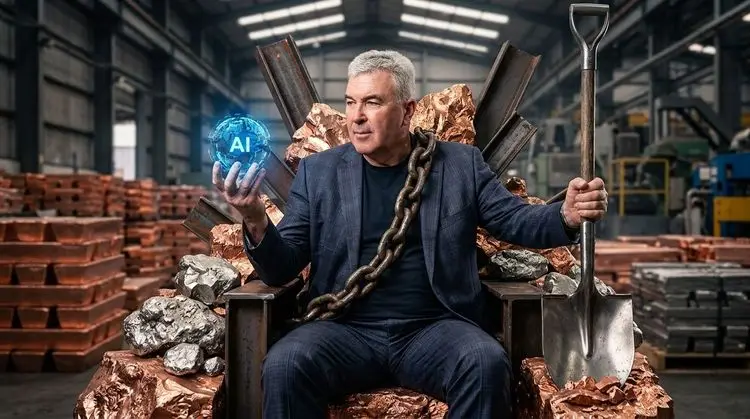
Yet, if you peel back the slick interfaces of modern artificial intelligence, you do not find digital magic; you find an aggressively industrial appetite for raw metal, heavy infrastructure, and massive voltage. As Terry Lynch, the CEO of Power Metallic Mines (TSXV: PNPN), bluntly summarizes it, the entire virtual revolution is fundamentally tethered to the earth. Lynch points out that AI is delivered on copper cable, meaning that if you don't have copper, you won't have AI.

It is a stark reminder that while software giants command the headlines, the virtual world is entirely bound by the physical constraints of the commodities sector.

This structural reality is reviving one of the oldest wealth-creation plays in financial history. During a classic gold rush, the most reliable fortunes rarely belonged to the miners staring into the mud; they belonged to the shopkeepers selling the picks and shovels. Lynch eagerly applies this philosophy to the modern technology landscape, noting that while individual AI firms face intense competition and the risk of burning out, the commodities sector sits in a envious position because the copper producers will sell to all of them. This massive structural leverage is why he makes an investment claim that sounds downright heretical to the Silicon Valley crowd, stating his firm belief that over the next five years, more millionaires will be made in mining investment than in AI or any other sector.

The math behind this bold thesis lies in a severe timeline asymmetry between software development and resource extraction. A tech company can iterate a highly advanced large language model and scale it to millions of users over a weekend, but bringing a major new copper or nickel mine from initial geological discovery to commercial production takes an average of 17 years. This inelastic supply curve is triggering a desperate scramble for high-grade assets. When Lynch’s team drilled a wildcard 200-meter hole in Quebec, they struck a massive, high-grade copper and platinum-group element discovery that instantly transformed the company into a top market performer. The sheer anomaly of the find even drew the attention of legendary mining billionaire Robert Friedland, who joked to Lynch that they had either salted the core or discovered a "duck-bill platypus", mining shorthand for a phenomenon so rare it shouldn't exist, but when it does, it fundamentally alters the economics of the industry.

Despite these glaring structural deficits and soaring physical demand, mainstream institutional portfolios remain completely blind to the tangible world. US public pensions hold an average of just 4% in commodities, while a recent UBS survey of over 300 family offices revealed less than a 1% allocation to real assets. It is a staggering historical anomaly; in the mid-1970s, the S&P 500 was roughly 11% mining companies, whereas today it sits at less than 1%. This systemic underweighting means an immense wall of global capital is currently trapped outside a very narrow sector. When institutional fund managers inevitably try to force their way into critical minerals to protect their technology supply chains, the price action through that narrow capital pipe is likely to be explosive.

The material bottleneck extends far beyond physical wiring and deep into the global energy grid, where data center electricity consumption is projected to double by the end of the decade, matching the total energy footprint of major industrial nations. Hyperscalers require clean, 24/7 baseline power that traditional renewables cannot reliably provide without massive battery storage. This multi-gigawatt crisis has forced tech giants to look toward nuclear energy, sparking a powerful structural bull market for uranium. Industry leaders like Cameco (TSX: CCO) and developers like NexGen Energy (TSX: NXE) are finding themselves at the center of tech infrastructure discussions, while private entities like OpenAI openly advocate for rapid nuclear expansion to keep pace with computing demands.

Ironically, the very technology threatening to overwhelm the material world is becoming the mining sector's greatest tool for survival. Advanced exploration outfits are now using artificial intelligence to solve the timeline problem, deploying tech from firms like Fleet Space Technologies to process passive seismic data and map underground structures in real time. Others are utilizing cosmic rays through companies like ION to reverse-engineer rock density based on how subatomic particles slow down through the earth, a cutting-edge exploration technique leveraged by majors like Rio Tinto (NYSE: RIO) and juniors like Fireweed Metals (TSXV: FWZ) alike.

Ultimately, the digital revolution is learning that software can scale exponentially, but the infrastructure required to run it scales materially. Investors hunting for generational returns might find that while the algorithms capture the public imagination, the real wealth belongs to the raw earth that powers them.

Sources

  • In-depth interview with Terry Lynch, CEO of Power Metallic Mines, on commodity supercycles, AI infrastructure constraints, and the Nisk deposit discovery metrics (youtube.com/watch?v=m2mb7S1YT94).
  • International Energy Agency (IEA) 2026 Report: "Key Questions on Energy and AI" detailing data center capital expenditures, energy consumption growth, and nuclear energy pipeline agreements.
  • S&P Global 2026 Commodity Insights Study outlining the 17-year average timeline from mineral discovery to production, alongside long-term copper demand projections.
  • J.P. Morgan Global Research 2026 Market Outlook detailing refined copper supply shortfalls, data center infrastructure intensity, and institutional portfolio allocation trends.

Most Popular News

  1. SpaceX’s $8B Spectrum Deal Sends AT&T, Verizon, and T-Mobile Plummeting
  2. Is Project Vault Securing America’s Supply Chain or Squeezing It to the Breaking Point?
  3. Why Gautam Lohia Shifted from Global Consulting to Reboot a $20M Tech Micro-Cap
  4. Everyday Luxury, Unstoppable Scale: Aritzia Delivers 44% Net Revenue Growth
  5. Can Navy SEAL Leadership and Big Tech Scale Revolutionize Airborne Threat Detection?

Disclaimer


This report should not be viewed as investment advice or as an offer to buy or sell any securities or as an invitation or solicitation of an offer to buy or sell any securities. Neither the author of this report, its publisher, nor any other person associated with the publication of this report, are registered brokers, investment dealers, investment advisers, or financial advisers. The information in this report has not been tailored to the particular needs or circumstances of readers and should not be relied upon as investment advice or recommendations to purchase or sell any of the securities presented in this report. Readers seeking investment advice should contact qualified and registered brokers, investment dealers, investment advisers, or financial advisers prior to making any decision to buy or sell any of the securities referred to in this report. The information in this report should not be construed as investment, legal, or tax advice. No recommendation is made as to whether an investment in the presented securities is suitable for any reader in light of the reader’s particular circumstances.

Readers are cautioned that the publisher of this report covers exclusively securities that carry a high degree of volatility. Investing in such securities is highly speculative and carries a high degree of risk. Investors in such securities could lose all or a substantial portion of their investment. Only those investors who can afford to lose all or a substantial portion of their investment should consider investing in the securities referred to in this report.

This report may include information obtained from publicly available sources, including third-party reports or analysis. Neither the author nor publisher of this report, nor www.juniorstocks.com or its owners, have undertaken any independent investigation into the factual information used in this report, and the information in this report is provided without any warranty of any kind. No representations or warranties are provided regarding the accuracy or completeness of the information provided in this report. Statements of opinion or belief are those of the authors and/or publisher of this report. These statements of opinion or belief are expressions of the author’s and/or publisher’s judgment, and there is no guarantee that those judgments will turn out to be correct. No inference should be drawn that the author and/or publisher have any special or greater knowledge about the presented companies or their securities, or any particular expertise in the industries or markets in which the company operates. Readers should conduct their own due diligence and seek professional advice prior to investing in any securities presented on Juniorstocks.com.

Certain statements in this report constitute “forward-looking” statements. Forward-looking statements often, but not always, are identified by the use of words such as “seek,” “anticipate,” “believe,” “plan,” “estimate,” “expect,” “targeting,” and “intend” and statements that an event or result “may,” “will,” “should,” “could,” or “might” occur or be achieved and other similar expressions. Forward-looking statements express or involve discussions with respect to predictions, expectations, beliefs, plans, projections, objectives, goals, assumptions, or future events or performance; they are not statements of historical facts and should not be viewed as any guarantee of any future result. Forward-looking statements are based on expectations, estimates, and projections at the time the statements are made that involve a number of risks and uncertainties which could cause actual results or events to differ materially from those presently anticipated. The author and/or publisher of this report disclaims any obligation to update the forward-looking statements in this report, whether as a result of new information, future events, or results or otherwise. There is no assurance that forward-looking statements will prove to be accurate, as actual results and future events could differ materially from those anticipated in such statements. Accordingly, readers should not place undue reliance on forward-looking statements.

The information provided in this report is not intended for distribution to, or use by, any person or entity in any jurisdiction or country where such distribution or use would be contrary to applicable law or regulation, or would subject the author or publisher of this report to any registration requirement in such jurisdiction or country.

Information about the editor of this publication:
Juniorstocks.com is a service provided by Piccadilly Capital Group, Office 66, 101 Clapham High Street, London, SW4 7TB, UK. Piccadilly Capital Group is not the publisher of this report and was not paid for the publication of this report. Piccadilly Capital Group seeks to generate web traffic and a growing number of followers through the publication of articles or reports. Directors, officers, and other insiders of the publisher own an interest in Piccadilly Capital Group. Piccadilly Capital Group does not endorse or recommend the business, products, services, or securities of any company mentioned on www.juniorstocks.com. Piccadilly Capital Group will not share your information with any outside third parties. Due to the new data protection basic regulation, we ask you to read our data protection declaration carefully.

Note on copyright:
The contents published on this website and on connected media (e.g., e-mail, X, Facebook) are subject to applicable copyright and ancillary copyright laws. Any use not permitted by applicable copyright and ancillary copyright laws requires the prior written consent of the provider or the respective rights holder. In particular, this applies to the duplication, editing, translation, storage, processing, or reproduction of content in databases or other electronic media and systems. Contents and rights of third parties are marked as such. Unauthorized reproduction or transmission of individual contents or complete pages is not permitted and is punishable by law. Only the production of copies and downloads for personal, private, and non-commercial use is permitted. Links to the provider's website are always welcome and do not require the consent of the provider of the website. Photos and images on the website may not be shared unless the publisher itself has acquired the initial rights from authorized sources. The presentation of this website in external frames is only allowed with written permission. If you notice any violations, please inform us. Please note: The content of our articles, emails, or other publications or social networks such as X, LinkedIn or Facebook is exclusively intended for the designated addressee(s). If you are not the addressee of these articles, emails, or other publications in the market letter or social networks such as Twitter or Facebook or his or her legal representative, please note that any form of publication, reproduction, or distribution of the content of these articles, emails, or other publications in the market letter or social networks such as X, LinkedIn or Facebook is prohibited. Falsifications of the original content of this message during data transmission cannot be excluded in principle.