
Why is it Costing $1,500 a Day Just to Keep Two Tractors Running?
From $90 to $700 a ton for fertilizer, record-breaking input inflation is turning the Heartland harvest into a high-stakes financial gamble.
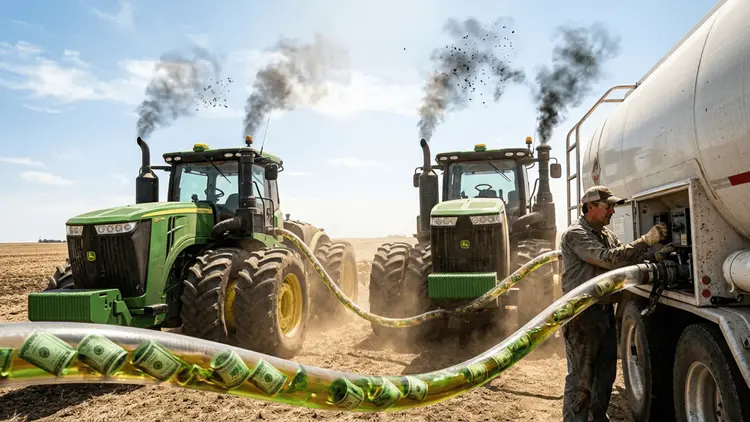
The American supermarket aisle looks stable enough, but out in the Heartland, the financial machinery that keeps the nation fed is grinding through a brutally expensive gear. For the modern farmer, stepping into a tractor cab has transformed from a labor of generational pride into a high-stakes daily roll of the economic dice. It is a world where running just a pair of heavy-duty tractors can quickly burn through fifteen hundred dollars of cash a day in diesel and upkeep alone, forcing producers to watch their liquid capital evaporate long before a single crop hits the market.
This isn't a temporary dip in the ledger; it is what agricultural economists are now calling a full-scale structural downturn. While global supply chain headlines have largely faded from prime-time news, the sticky inflation on essential inputs has refused to leave the field. Take potash, for instance, a critical potassium fertilizer required for crop root strength and yield. For decades, a farmer could reliably anchor their budget around ninety dollars a ton for the nutrient. Today, that exact same ton commands a staggering six hundred seventy to seven hundred dollars, turning a foundational farming necessity into an absolute luxury.
The raw data behind this economic pressure tells a stark story. According to the latest forecasts from the U.S. Department of Agriculture, total farm production expenses across the United States are projected to climb to a record-breaking $477.7 billion. To put that into perspective, aggregate net farm income has plummeted roughly forty-eight billion dollars below the historic peaks achieved just a few years ago in 2022, effectively wiping out the financial cushion many family operations spent years building.
Danny Munch, a prominent economist with the American Farm Bureau Federation, has been candid about the escalating severity of the situation. He recently emphasized that farmers and ranchers are staring down a bona fide generational downturn rather than a minor seasonal speedbump. The core of the problem lies in an aggressive cost-price mismatch. Producers are routinely forced to purchase their baseline operational inputs at highly inflated rates, yet the global commodity prices they receive for critical row crops like corn, wheat, and soybeans are hovering stubbornly below their actual break-even costs. The consequences of this financial friction are becoming visibly painful, with data compiled by agricultural advocacy organizations revealing that Chapter 12 family farm bankruptcies surged by forty-six percent over the recent annual cycle, indicating that the multi-year accumulation of elevated operating costs is pushing highly leveraged operations to the absolute brink.
This field-level economic anxiety is sending undeniable shockwaves straight up the agricultural supply chain, affecting major equipment manufacturers and chemical providers alike. When a tractor part costs twice what it did a decade ago and interest rates on short-term operating loans remain painfully high, farmers stop buying new steel and start patching up their old fleets. Manufacturing heavyweight Deere & Co (NYSE: DE) recently noted a pronounced agricultural slump in its quarterly performance, leaning heavily on its construction and forestry divisions to offset a significant slowdown in large farm machinery sales. It is a clear reflection of a broader trend: when margins turn negative, the purchase of a new half-million-dollar combine is the first line item to get crossed off the budget.
Similarly, global input titans are navigating a highly volatile marketplace where demand remains urgent but purchasing power is severely constrained. Companies supplying the essential nutrients and crop protection formulas that maximize American soil yield, such as fertilizer giants Nutrien (NYSE: NTR) and CF Industries (NYSE: CF), alongside agricultural seed and chemical specialist Corteva (NYSE: CTVA), are operating in a market where international trade policy swings and global supply disruptions dictate domestic retail pricing. When global tensions flare, the retail price of inputs like that seven-hundred-dollar potash spikes instantly at the local co-op, leaving the domestic farmer to absorb the shock regardless of whether the eventual harvest revenue covers the bill.
The lingering weight of these operating expenses has deeply soured the psychological outlook of rural America, turning optimism into a rare commodity. The widely monitored Purdue University and CME Group Ag Economy Barometer, which regularly gauges the confidence of hundreds of agricultural producers nationwide, highlights a persistent slide in future expectations. Dr. Michael Langemeier, the associate director of Purdue University's Center for Commercial Agriculture, points out that a staggering two-thirds of surveyed producers now anticipate their net income to experience notable declines. The primary driver of this pessimism is not a lack of productivity, American fields remain as fertile and high-yielding as ever, but rather the sheer financial risk required to initiate a crop cycle.
With profitability per acre trending firmly into negative territory for baseline commodities like cotton, wheat, and corn, the entire rural economy is feeling the squeeze. Farmers are actively calling on policymakers for durable economic safety nets, including a modernized Farm Bill and targeted regulatory relief, to stabilize a system that is currently asking them to absorb massive global market shocks entirely on their own balance sheets. Until those structural adjustments arrive, the daily calculation for the American farmer remains a stressful balance of high-cost inputs and hope.
Sources
- American Farm Bureau Federation Economic Analysis (Market Intel Report on Net Farm Income and Production Expenses)
- U.S. Department of Agriculture (USDA) Economic Research Service Farm Income Forecast
- Farm Aid Annual Agricultural Economy and Bankruptcy Tracking Assessment
- Purdue University / CME Group Ag Economy Barometer Monthly Sentiment Index