
Sippy Cups and Share Certificates: Why Every American Kid Might Get a Piece of SpaceX
A direct-equity giveaway bypasses traditional philanthropy, but handing Wall Street shares to 72 million minors faces unprecedented regulatory and custodial hurdles.
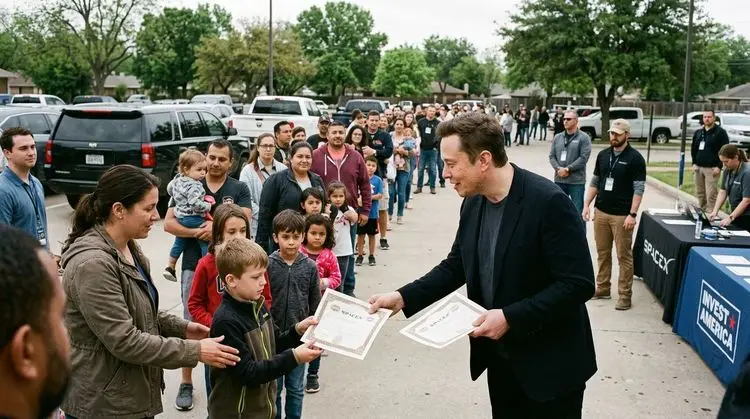
Billionaires typically celebrate corporate milestones with megayachts, naming rights, or sprawling philanthropic endowments, but Elon Musk has proposed turning approximately 72 million American minors into Wall Street shareholders overnight.
The chief executive of SpaceX (NASDAQ: SPCX) publicly announced on Monday that he plans to gift one share of his aerospace company to every child in the United States next year, dangling a collective corporate windfall valued at roughly $10.5 billion. While the promise immediately ignited imaginations across the country, it also left financial planners, tax attorneys, and parents asking the same fundamental question: how does someone actually hand individual equity certificates to millions of toddlers?
The arithmetic behind Musk’s ambitious giveaway is staggering yet straightforward. According to official U.S. Census estimates from mid-2025, there are roughly 72 million Americans under the age of 18. Following the space venture's landmark market debut earlier this year, shares of SpaceX closed at $146.03 on Friday, making a one-to-one grant equal to a $10.51 billion personal divestment. Fortunately for Musk, his personal balance sheet can comfortably absorb the hit. August regulatory filings show Musk holds about 4.8 billion shares of SpaceX, a figure expanding to 6.4 billion when factoring in unvested equity awards and options, representing a 48.4% beneficial stake in the company. Surrendering 72 million shares would amount to less than 1.5% of his personal holdings.
The idea itself took shape as a sharp philosophical rebuttal to an artificial intelligence competitor. Over the weekend, frontier AI developer Anthropic revealed plans to commit 5% of its shares to a new public benefit fund, creating an institutional structure designed to explore large charitable donations and study workforce displacement caused by automation. Musk, who also leads electric automaker Tesla (NASDAQ: TSLA) and frequently bristles at institutional bureaucracy, publicly took issue with the model. Rather than locking capital inside traditional foundation boards, Musk argued that tech firms should distribute equity directly to ordinary citizens, asserting that he would put his own portfolio behind the principle.
While Musk promised that this giveaway would merely be the first of many, he bypassed explaining the logistical nuts and bolts. Because American minors cannot legally hold standard brokerage accounts in their own names, distributing dozens of millions of individual shares poses a massive regulatory and clearing hurdle. Brad Gerstner, founder of investment firm Altimeter Capital and the Invest America advocacy group, quickly suggested an alternative route: leveraging newly introduced government-backed child investment vehicles known as "Trump Accounts". Gerstner hailed the concept as potentially the largest single philanthropic gift in history, though financial analysts note that millions of accounts would still need to be manually claimed and verified by parents before any equity could clear.
Seasoned market observers, however, are tempering their expectations with a healthy dose of historical reality. Musk has a well-documented habit of broadcasting grand charitable commitments that never quite materialize. In 2021, he challenged the United Nations World Food Program to provide a detailed roadmap to eradicate world hunger in exchange for $6 billion in donated stock; the agency delivered a formal plan, but the donation never followed. Years earlier, Musk pledged up to $1 billion to research lab OpenAI, only to freeze contributions at roughly $38 million during a governance rift with its leadership. Tax records have also repeatedly shown that his private foundation has struggled to meet mandatory annual payout thresholds while directing much of its funding toward initiatives tied closely to his commercial ecosystem.
The sudden populist pledge also arrives amid a historic surge in Musk's political outlays. The entrepreneur has already channeled more than $276 million toward Republican campaigns ahead of the 2026 midterms, making him the cycle’s top individual political donor. Whether tens of millions of American children will actually wake up next year as registered owners of a space conglomerate remains an open question, and representatives for both SpaceX (NASDAQ: SPCX) and Musk’s family office have not shared further operational details. For now, the declaration stands as a quintessential Musk dispatch: part visionary disruption, part corporate gamesmanship, and a massive challenge to conventional philanthropy.
Source
- CNBC (Reporting by Kai Nicol-Schwarz and Lora Kolodny; with contributions from Jennifer Liu)
Disclaimer
Neither the author of this article nor JuniorStocks holds equity, stock options, or any other financial positions in SpaceX (NASDAQ: SPCX), Tesla, Inc. (NASDAQ: TSLA), or any other companies mentioned in this publication. This content is published by JuniorStocks strictly for informational and educational purposes, was prepared independently without corporate compensation, and utilized AI assistance for research, text editing, and formatting. While private space commercialization and emerging child investment structures represent notable market themes, this publication does not constitute investment, tax, legal, or financial advice. Readers and prospective investors are strongly urged to conduct their own thorough, independent due diligence and consult with a licensed financial advisor before making any investment decisions.