
Super Copper Logs Successful Visual Proof of Concept for CUPRIX Technology
Bench trials in São Paulo turn acidic process streams into metallic beads, offering a single-step biopolymer fix for copper recovery and mining water treatment.
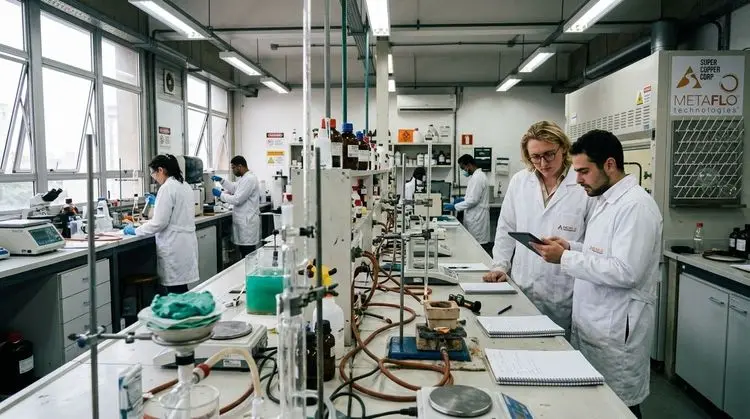
Extracting valuable metal from a flask of strongly acidic fluid sounds a bit like medieval alchemy, but a laboratory in São Paulo is demonstrating that modern biopolymer chemistry can deliver actual metallurgical results.
Super Copper Corp. (CSE: CUPR / OTCQB: CUPPF) and strategic development partner MetaFLO Technologies Inc. have logged the successful first bench demonstration of CUPRIX, a proprietary biopolymer formulation engineered to recover copper while simultaneously treating industrial process water.
Conducted at the joint laboratory facility in Brazil, the initial trial provided a clear visual proof of concept for the technology's underlying logic. When introduced to a strongly acidic solution laden with copper, the CUPRIX biopolymer triggered the formation of a settleable solid that was recovered via vacuum filtration as an emerald-green wet cake. Subsequent thermal reduction in a refractory crucible transformed that recovered cake into small, reddish beads featuring a distinct metallic lustre. While formal quantitative assays remain to be conducted in the upcoming testing phase, the visual outcome aligns directly with copper separation principles.
The central promise of CUPRIX lies in its potential to solve two costly operational challenges in a single step. Traditional oxide copper operations rely heavily on expensive sulphuric acid to leach metal from crushed ore, while turning to heavy lime treatments to raise pH and settle out dissolved metals before recycling process water. CUPRIX aims to streamline this workflow: capture dissolved copper that would otherwise go to waste, while purifying process water for potential reuse or compliant discharge. If the biopolymer proves selective, efficient, and economical compared to conventional lime treatment, it could trim reagent expenses while delivering cleaner recycle streams.
Executive leadership views the milestone as a pivotal transition from abstract theory to tangible reality. Super Copper Chief Executive Officer Zachary Dolesky noted that the program represents an opportunity to build technology with utility extending far beyond any single mining asset. Chief Scientist Laurent Serra emphasized that the objective now shifts toward rigorous numerical validation, focusing on measuring exact copper recovery percentages, reaction kinetics, reagent consumption, selectivity against competing ions, and total operational cost per cubic metre. To maintain strict scientific integrity, all upcoming test workstreams will be executed in triplicate at the joint facility, accompanied by check assays from an independent accredited laboratory.
The timing of the breakthrough coincides with escalating structural pressures across the global copper sector. World copper mine production reached approximately 23.2 million tonnes in 2025, yet long-term forecasts from energy agencies point toward a prospective 25 percent supply deficit by 2035. As high-grade ore reserves deplete globally, miners are forced to process lower-grade material requiring higher acid volumes and generating vast quantities of tailings, currently estimated at 13 billion tonnes annually. Simultaneously, water scarcity presents a critical bottleneck in key mining jurisdictions like Chile, where seawater is expected to fulfill roughly 68 percent of copper mining water requirements by 2034. A reagent capable of squeezing extra metal out of existing leach circuits while preserving recycled water touches the three most expensive pain points on a modern mine's balance sheet.
As metallurgical validation advances, Super Copper Corp. (CSE: CUPR / OTCQB: CUPPF) continues to push forward its core mineral exploration portfolio in the Atacama region of Chile. In corporate updates, the company confirmed that its investor communications engagement with Emerging Markets Consulting, LLC will continue through October 15, 2026, under previously disclosed terms.
Sources
- International Copper Study Group (ICSG), World Copper Mine Production 2025 (Table 1, Monthly Copper Bulletin, 2026).
- International Energy Agency (IEA), Global Critical Minerals Outlook 2026 — Executive Summary (July 2026).
- International Council on Mining and Metals (ICMM), GISTM Tailings Progress Report (December 2025).
- Comisión Chilena del Cobre (Cochilco), Proyección del Consumo de Agua en la Minería del Cobre 2025–2034 (2026).
- Nature Sustainability, Global copper tailings distribution and projection (2026).
Disclaimer
Neither the author of this article nor JuniorStocks holds equity, stock options, or any other financial positions in Super Copper Corp. (CSE: CUPR; OTCQB: CUPPF; FSE: N60) or any other companies mentioned in this publication. This content is published by JuniorStocks strictly for informational purposes, was prepared independently without company compensation, and utilized AI assistance for text editing, formatting, and generating accompanying media. While biopolymer-based copper recovery and process-water treatment represent a compelling new frontier in sustainable mining technology, this article does not constitute investment or financial advice. Investors are strongly advised to conduct their own thorough, independent due diligence and consult with a qualified financial professional before making any investment decisions.