
Rock Solid Strategy: America Goes Global in the Critical Mineral Hunt
America Charts a New Path in Global Resource Diplomacy with the Finding ORE Act
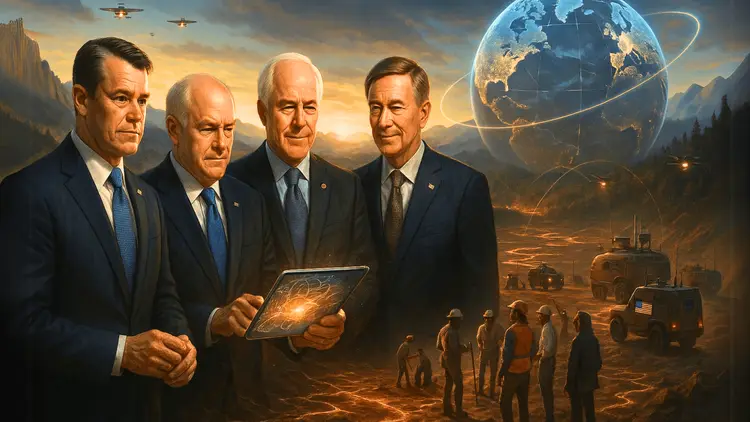
In a bold bipartisan move that could reshape America’s position in the global race for mineral dominance, U.S. Senators Todd Young (R-Ind.) and Chris Coons (D-Del.) have introduced the Finding Opportunities for Resource Exploration (ORE) Act. Joining forces with Senators John Cornyn (R-Texas) and John Hickenlooper (D-Colo.), the bill marks a significant step in countering Chinese dominance in the supply and processing of critical minerals.
Critical minerals like lithium, cobalt, rare earth elements, and antimony power the very foundation of modern industry. From the chips in our smartphones to the batteries in electric vehicles, they are essential for economic innovation, defense capabilities, and energy independence. Yet the U.S., despite sitting on an abundance of natural resources, remains dangerously dependent on Chinese supply chains.
The Finding ORE Act aims to flip that script.
At its core, the legislation empowers the U.S. Geological Survey (USGS) to team up with allied nations to conduct detailed geological surveys in mineral-rich but poorly mapped regions. Think of it as a diplomatic mining mission — but instead of prospectors with pickaxes, it’s American geologists wielding satellite data, hyperspectral imaging, and decades of mapping expertise. Senator Young didn’t mince words. He pointed out that countless countries still rely on decades-old, incomplete surveys. By offering U.S. technical support to these nations in updating their geological data, the ORE Act creates what could be a diplomatic gold mine — new partnerships, new discoveries, and crucially, the first crack at developing the finds for American and allied companies.
Senator Coons emphasized the stakes: innovation, growth, and national security. Critical minerals aren’t just about economics — they’re about survival in a world increasingly defined by high-tech warfare and energy transition. If the U.S. wants to keep pace, access to reliable, ethical, and geopolitically safe mineral supply chains is non-negotiable.
The bill outlines four clear objectives for memoranda of understanding (MOUs) between the USGS and partner countries. First, to provide technical assistance in surveying and mapping critical minerals. Second, to give U.S.-based or allied companies a “right of first refusal” for development — meaning the opportunity to stake claims and invest ahead of competitors. Third, to unlock financial support from agencies like the U.S. International Development Finance Corporation and the Export-Import Bank. And fourth, to ensure that sensitive mapping data stays out of the hands of non-allied nations, namely China.
This isn’t just about rocks in the ground. It’s about where influence, investment, and industry flow tomorrow.
Senator Cornyn underscored the defense implications, stressing that every missile, every jet, every advanced piece of technology the U.S. military deploys relies on a steady flow of critical minerals. Without a secure pipeline, national security is compromised. This legislation, he argued, helps build that pipeline — not just at home, but abroad with trusted partners.
Senator Hickenlooper framed the issue around climate and energy. You can’t build solar panels or electric vehicles without rare earths and lithium. You can’t hit net-zero goals if you’re stuck waiting on minerals from unstable or adversarial nations. Accurate, modern mapping is the key that unlocks a future of safe, ethical, and domestic-aligned supply.
The House of Representatives is set to introduce a companion bill, co-sponsored by Representatives Rob Wittman (R-VA-1) and Kathy Castor (D-FL-14), indicating strong bipartisan momentum across both chambers.
Industry leaders have been quick to voice support. Abigail Hunter from SAFE’s Center for Critical Minerals Strategy hailed the bill as a long-overdue shift in American engagement. She said the U.S. has been too passive for too long, watching from the sidelines as adversaries secure tomorrow’s mineral reserves. The Finding ORE Act, she argued, is a declaration that America intends to lead the next chapter of mineral development.
Sarah Venuto, Executive Director of the American Critical Minerals Association, echoed that sentiment. She sees this bill as a gateway to deeper alliances, better data, and a more competitive U.S. critical minerals sector. It’s about building bridges that extend from Washington D.C. to resource-rich capitals worldwide.
Academic institutions are lining up in support too. Colorado School of Mines, long considered a hub of geoscience excellence, sees this bill as a call to action. According to Dr. John Bradford, their Vice President for Global Initiatives, it’s time to put America’s technical knowledge and research capabilities to work in service of responsible global exploration.
Michele Stockwell of BPC Action called the ORE Act a smart strategy to fortify supply chains and reduce the risk of adversary control. That’s code for China — the elephant in every room when critical minerals are mentioned.
Meanwhile, the private sector is already eyeing opportunity. Terra AI, a mineral exploration technology firm, described the bill as “a winning playbook.” CEO John Mern praised the act’s alignment of diplomacy, industry, and technology. For companies like his — which use artificial intelligence to locate untapped deposits — the ability to work hand-in-hand with the U.S. government abroad represents an unprecedented chance to lead the charge in mineral exploration.
Mern sees the ORE Act as more than just policy. He sees it as a blueprint for global mineral dominance, one that places American firms at the tip of the spear in a rapidly shifting geopolitical landscape. In his view, mineral exploration is no longer just geology — it’s a race, and the stakes are generational.
What makes this legislation particularly unique is its blend of diplomacy, science, finance, and strategic foresight. It doesn’t just say “drill here.” It says “work together,” “map better,” “invest smarter,” and “stay ahead.” That kind of comprehensive vision is what it takes to lead in the 21st-century mineral economy.
The Finding ORE Act is, in essence, a declaration that America won’t be left behind. That it’s ready to put its unmatched scientific institutions, private sector innovation, and diplomatic relationships to work for a cause that touches every corner of modern life.
From smartphones to satellites, tanks to turbines, the materials that shape our world are in the ground — somewhere. This bill is how the U.S. plans to find them first.
Conclusion
The Finding ORE Act is more than legislation — it’s a strategy for mineral supremacy in a world where resources equate to power. With bipartisan backing, industry enthusiasm, and academic endorsement, the bill marks a pivotal shift in how America approaches mineral mapping and global resource diplomacy. As competition with China intensifies and global demand for critical minerals skyrockets, the U.S. is finally stepping off the sidelines — maps in hand, allies in reach, and the mineral future within grasp.