
Soy Long, China: Trump Turns Up the Heat in the Trade Kitchen
Soybean fields meet global politics as Trump fires back at China’s crop boycott—turning America’s heartland into the latest front in the trade war.
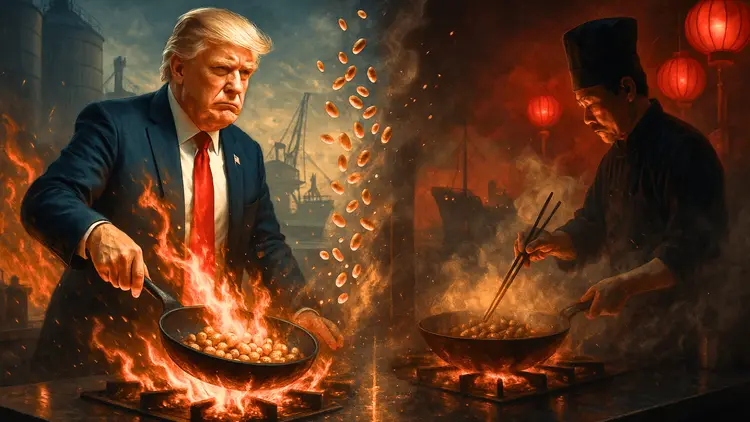
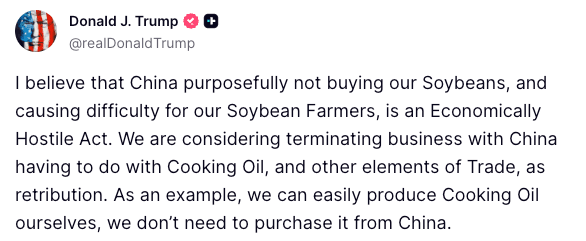
In the heartland's amber waves of grain, where soybeans reign as the unsung hero of American exports, a familiar storm is brewing. President Donald Trump has fired off a bold declaration, labeling China's abrupt halt on U.S. soybean purchases an "economically hostile act" and hinting at retaliation through severed ties on cooking oil and beyond. It's a punchy escalation in a trade war that's already left Midwestern farmers nursing wounds deeper than a bad harvest, with storage bins overflowing and prices plummeting like a combine in neutral. As of October 2025, this isn't just rhetoric—it's a high-stakes poker game where the chips are bushels, and the pot includes billions in lost revenue.
Let's cut through the chaff: China, the world's voracious soybean vacuum cleaner, snapped up over half of U.S. exports in recent years, funneling some $12.6 billion into farm coffers annually. But since May, they've gone radio silent, zeroing out purchases in retaliation for Trump's tariffs on Chinese goods—starting at 10% in February and climbing to an average 55% by summer. The result? U.S. soybean exports to Beijing plunged 51% through July compared to last year, with overall ag shipments down a gut-wrenching 53% in the first seven months of 2025. Farmers in powerhouse states like Illinois, Iowa, Minnesota, and North Dakota are staring at a $10 billion to $15 billion hole this season, per USDA tallies and American Soybean Association estimates. One North Dakota operation, a 76-year-old family spread spanning 2,300 acres, is projecting a $400,000 shortfall alone—enough to make even the sturdiest silo weep.
The math tells a stark tale. Pre-trade war, China guzzled 60% of America's soybean bounty, turning those golden pods into feed for its massive hog herds and beyond. Now, with Beijing's 20% retaliatory levy making U.S. beans pricier than a Beltway steak, they've pivoted hard to Brazil and Argentina, ramping imports there by 25% to 30%. U.S. futures for the November contract have skidded to around $9.85 per bushel, a $0.74 to $2 drop that erodes profits faster than drought. "We're being used as a bargaining chip in a fight that's not ours," laments Caleb Ragland, president of the American Soybean Association, echoing the desperation rippling through rural America. Storage woes compound the crisis: Grain elevators are balking at accepting more beans without export outlets, risking a logjam that could idle combines and spike foreclosures. Farm bankruptcies, already up 55% last year, are trending higher, with experts warning of a "trade and financial precipice" if no deal materializes by November.
Trump's riposte? A vow to redirect tariff windfalls into farmer aid—potentially $10 billion to $14 billion, building on the $12 billion lifeline from his first-term tussle—and a cheeky jab at cooking oil as payback. Here's where it gets saucy: The U.S. isn't exactly pining for Chinese canola in the pantry. America crushes over 25 million metric tons of soybean oil yearly, covering 90% of domestic needs for everything from french fries to biofuels. Imports from China? Mostly used cooking oil (UCO), clocking in at $600 million to $1.1 billion last year, funneled into renewable diesel plants. But Trump's April tariffs jacked duties on that to 125%, slashing volumes by 70% to 80% and rerouting Chinese shipments to Europe. Fraud suspicions—whispers of "virgin" oils masquerading as used—have even sparked EPA probes, turning what was a minor trade trickle into a vulnerability ripe for the squeezing.
Terminating those UCO flows wouldn't ruffle grocery aisles; domestic alternatives from peanuts to palm blends stand ready, and biofuel barons like Bunge might high-five the move. Yet it's a savvy signal: We're self-sufficient here, Beijing—your turn to blink. Broader "elements of trade" could lasso Chinese fruits, seafood, or processed goods worth $2 billion to $3 billion, low-hanging fruit for escalation without torching the $300 billion overall deficit. Treasury Secretary Scott Bessent calls it "holding soybean farmers hostage," a nod to the political calculus as midterms loom. Rural voters, 60% of whom back "tough on China" postures, are Trump's base; this boycott stings where it counts, in red-state breadbaskets.
Still, wit aside, this isn't a sitcom subplot—it's economic trench warfare with real casualties. The first Trump-China clash cost $27 billion in ag exports from 2018 onward, subsidies notwithstanding. Today's standoff risks a repeat, with no Phase One-style $50 billion purchase pledge in sight. Negotiators eye a Xi-Trump huddle at month's end in South Korea, where soybeans could headline alongside rare earth curbs and tech spats. A thaw might rebound prices 10% to 15%; stalemate means more bailouts, but as one Iowa co-op veteran quips, "Government checks don't plant seeds—they just delay the weeding."
For farmers like Ryan Mackenthun in Minnesota, whose great-great-grandpa broke sod in 1887, the plea is simple: Markets, not Band-Aids. Diversifying to Vietnam, Nigeria, or even domestic crush facilities offers scraps, not salvation. As combines rumble into the fray, the question lingers: Will this harvest yield a deal, or just more dirt under the nails? In trade wars, as in farming, timing is everything—and October's looking perilously dry.
Sources
- Reuters, "Trump says China's Xi using soy as negotiation tactic ahead of talks," October 1, 2025.
- POLITICO, "Trump threatens to hit China with 100 percent tariff starting in November," October 10, 2025.
- The Guardian, "US farmers caught in Trump-China trade war – who’ll buy the soybeans?" October 10, 2025.
- NBC News, "Trump's trade agenda has a new flashpoint: The humble soybean," October 7, 2025.
- Ohio Ag Net, "Trump says soybeans will be key topic in China talks," October 1, 2025.
- Agriculture.com, "Trump Says He and Xi to Meet in Four Weeks, Discuss Soy," October 1, 2025.
- World Grain, "Trump urges China to purchase more US soybeans," August 11, 2025.
- NPR, "'We're not doing well': U.S.-China trade war taking a toll on American soybean farms," October 9, 2025.
- Forbes, "China Appears To Be Shutting Down Purchases Of U.S. Soybeans," September 30, 2025.
- POLITICO, "China weaponizes ag imports to target Trump and US farmers," September 28, 2025.
- Reuters, "US soybean farmers, deserted by big buyer China, scramble for other importers," October 3, 2025.
- The New York Times, "China’s Snub of U.S. Soybeans Is a Crisis for American Farmers," September 15, 2025.
- Farm Policy News, "Soybean Farmers Warn they ‘Cannot Survive’ China Trade War," August 20, 2025.
- The Columbus Dispatch, "Trump's China trade war hitting Ohio's soybean farmers as other costs also rise," October 3, 2025.
- The New York Times, "Soybeans Were America’s Biggest Export to China. Now, Sales Are Down to Zero," September 25, 2025.
- The New York Times, "In Tariff Standoff With Trump, China Boycotts American Soybeans," September 4, 2025.
- Fortune, "If there isn't a China trade deal soon, U.S. soybean farmer warns 'they’re going to bypass us altogether'," October 5, 2025.
- Asia Times, "China halts US soybean imports to hit Trump’s MAGA supporters," October 10, 2025.
- ABC News, "Soybean farmers caught in looming crisis as US trade war with China cripples sales," September 28, 2025.
- Bloomberg, "Soybean Futures Extend Losses as US-China Trade Issues Linger," October 10, 2025.
- Bloomberg, "China Seeks Trade Edge, Shunning US Soy in First Since 1990s," September 19, 2025.
- Reuters, "China pivots to Europe for used cooking oil exports as tariffs hit shipments to US," April 30, 2025.
- Energy News, "China shifts its focus to Europe to export used cooking oil as US tariffs impact shipments," April 30, 2025.
- Advanced BioFuels USA, "China Pivots to Europe for Used Cooking Oil Exports as Tariffs Hit Shipments to US," April 30, 2025.
- Farm Policy News, "Traders Speculate China Tariffs to Include Used Cooking Oil," May 13, 2024 (contextual for ongoing policy).
- Fortune Asia, "Used cooking oil imports from China pushed as next target for U.S. tariffs," May 14, 2024 (updated implications for 2025).
- Wikipedia, "Tariffs in the second Trump administration," October 14, 2025.
- Bloomberg, "Flood of China’s used cooking oil spurs call to hike US levies," May 13, 2024 (2025 extensions).
- Senator Roger Marshall Press Release, "Senator Marshall Leads Letter Addressing Concerns on Used Cooking Oil Imports from China," June 20, 2024 (fraud context).
- Reuters, "US imports of Chinese used cooking oil set for new record, future uncertain," August 28, 2024 (pre-tariff surge).
- South China Morning Post, "Flood of China’s used cooking oil spurs call to hike US levies," May 13, 2024.
- The New York Times, "“The further into the autumn we get without reaching an agreement with China on soybeans, the worse the impacts will be on U.S. soybean farmers”," September 4, 2025.
- Milwaukee Journal Sentinel, "Wisconsin soybean farmers hit hard by China soybean boycott," October 1, 2025.
- KCUR, "China won't buy American soybeans anymore, leaving farmers with limited options," September 25, 2025.
- The New York Times, "Through July, China bought 51 percent fewer American soybeans than during the same period last year," September 25, 2025.
- POLITICO, "All agriculture exports to China were down 53 percent in the first seven months of 2025," September 28, 2025.
- Farm Action, "After halting U.S. soybean purchases in May 2025, China quickly replaced American supplies," October 13, 2025.
- PBS News Weekend, "Minnesota farmers struggle to stay afloat as China boycotts U.S. soybeans," October 13, 2025.
- Des Moines Register, "Iowa farmers face losses, given high costs, China's soybean boycott," October 8, 2025.