
Kazakhstan’s 2050 Nuclear Strategy: The End of Cheap Global Uranium
Astana’s pivot to domestic nuclear power and strategic reserves is cutting off the West’s cheap fuel supply, igniting a scramble for secure North American uranium assets.
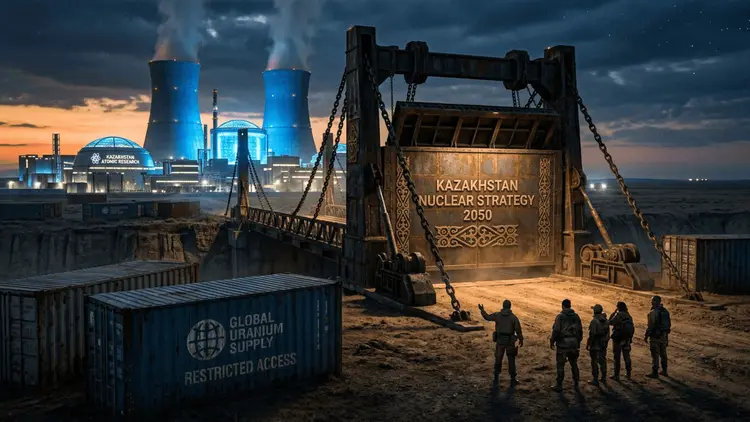
For decades, the global nuclear sector treated the steppes of Central Asia as an infinite, low-cost vending machine for nuclear fuel. If a Western utility needed cheap uranium to balance its books, Astana was always there to deliver. But the era of boundless, discounted Kazakh supply is officially over. On April 17, Kazakhstan abruptly shifted from an obliging global quarry to a self-interested, vertically integrated nuclear powerhouse by publishing its comprehensive Nuclear Industry Development Strategy through 2050. The message is loud and clear: the world’s largest uranium producer is locking down its domestic supply, and the global availability calculus will never be the same.
The core driver behind this monumental policy shift is a looming domestic energy crisis. Driven by economic growth and decaying Soviet-era grid infrastructure, Kazakhstan is staring down a massive 2,660-megawatt electricity shortfall by 2032. To plug this gap, the government has mandated the phased construction of at least three large-scale nuclear power plants, alongside a heavy investment in grid logistics like high-voltage transmission lines and substations. Furthermore, the strategy outlines feasibility studies for deploying Small Modular Reactors (SMRs) in energy-deficient regions and as direct replacements for aging, heavily polluting coal plants.
To ensure these new reactors actually have fuel to burn, Astana is taking no chances. The newly minted strategy mandates the creation of a strategic natural uranium reserve. By redirecting its world-class uranium deposits to feed a domestic nuclear cluster, which integrates power generation, scientific research, applied nuclear technologies, and waste management, Kazakhstan is effectively pulling millions of pounds off the global free float. The decree even insists on prioritizing domestic processing facilities regardless of existing joint-venture equity structures, a direct warning shot to foreign partners who assumed their offtake agreements were sacred.
This legislative pivot rapidly accelerates the East-West bifurcation of the global nuclear fuel supply chain. Kazakhstan currently produces roughly 40 percent of the world’s uranium, and recent geopolitical alignments show that Astana’s remaining export capacity is increasingly gravitating East. For Western utilities, the safety net is gone. They can no longer rely on a flood of Kazakh material to suppress global spot prices or bail out their energy grids, forcing a frantic scramble toward secure, Tier-1 North American supply.
This structural deficit creates a highly lucrative environment for Western-aligned nuclear equities. As the undisputed premier Western producer, Cameco (NYSE: CCJ) becomes the unavoidable cornerstone for North American and European utilities desperate to secure long-term, reliable supply outside the Russian and Chinese spheres of influence. Similarly, with the premium on secure, United States-based production skyrocketing, established domestic millers like Energy Fuels (NYSEAMERICAN: UUUU) are perfectly positioned to command premium pricing for their output while leveraging alternative supply chain capabilities.
The global race for advanced reactor fuel also puts specific advanced nuclear players in the spotlight. Because Kazakhstan is pushing heavily into SMRs and closed-loop nuclear clusters, the necessity for next-generation fuel enrichment has never been more apparent. Centrus Energy (NYSEAMERICAN: LEU), a critical Western player in High-Assay Low-Enriched Uranium (HALEU) production, stands to benefit as the global urgency to build out independent, Western SMR supply chains intensifies. Naturally, a permanent reduction in the availability of cheap global pounds drives incentive pricing much higher across the board. For investors looking to capture the broader macro shift without picking individual winners, the Sprott Uranium Miners ETF (NYSEARCA: URNM) offers direct exposure to the rising tide that will inevitably lift the entire basket of Western developers and explorers.
The days of treating Central Asia as an inexhaustible clearance aisle for uranium are squarely in the rearview mirror. Kazakhstan is securing its own energy future first, leaving global utilities scrambling to adapt to a much tighter, more expensive reality.
Sources:
- Qazinform News Agency: Kazakhstan adopts 2050 Nuclear Industry Development Strategy (Published April 17, 2026)
- Interfax: Kazakhstan plans to intensify uranium exploration to create strategic reserve (Published April 17, 2026)