
Prime Minister Carney’s $1 Trillion Bet on Canada’s Nuclear Renaissance
How Ottawa is leveraging sovereign wealth, fast-tracked permitting, and the Athabasca Basin to secure the West’s clean energy future and trigger a historic resource boom.
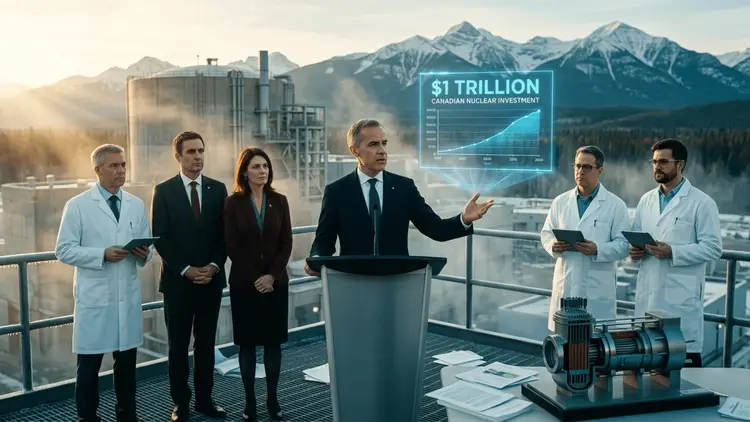
It is not every day that a federal government puts its resource sector on a wartime footing, but that is exactly what the newly minted Canada Investment Summit represents. Scheduled for September 2026, the strategy is designed to unlock $1 trillion in capital over the next five years. As Minister of International Trade Maninder Sidhu notes, this bold mission aims to send a definitive signal that “Canada is a serious economic partner on the global stage” amid an era of unprecedented trade disruption. This goes far beyond standard political posturing. By explicitly tying the federal Major Projects Office to institutional behemoths like CPP Investments and PSP Investments, Ottawa has transformed from a passive regulator into a highly aggressive, sovereign-backed co-pilot. CPP Investments CEO John Graham framed this alignment perfectly, noting that the nation is at its best when it “brings together public and private sector leaders to showcase the country’s strengths, deepen commercial relationships, and catalyse lasting economic value.” It is a strategic pivot echoed by PSP Investments CEO Deborah K. Orida, who views the initiative as a powerful engine to drive international capital directly into domestic infrastructure. The mission is unambiguous: mine the critical minerals, refine the uranium, and build the nuclear reactors needed to power the Western world’s clean energy transition.
For decades, the Canadian resource extraction narrative was plagued by a reputation for sluggish, multi-jurisdictional red tape that stranded capital. That era appears to be effectively dead. The revamped federal strategy has already fast-tracked 15 nation-building projects representing over $126 billion in potential investment. At the core of this pipeline is the Darlington New Nuclear Project operated by Ontario Power Generation, which is backed by a massive $2 billion equity commitment from the Canada Growth Fund to deploy four first-of-a-kind small modular reactors. But you cannot power next-generation reactors without the raw fuel, which brings the geopolitical spotlight directly onto the notoriously harsh, fiercely remote, and unbelievably resource-rich Athabasca Basin.
Northern Saskatchewan is officially ground zero for this macroeconomic pivot. The Athabasca Basin holds the highest-grade uranium deposits on the planet, and under the new accelerated regulatory framework, its premier mega-projects are transitioning from paper to production at a dizzying pace. The recent milestones and licensing advancements achieved by NexGen Energy (TSX: NXE) for its colossal Rook I project and Denison Mines (TSX: DML) for its Wheeler River in-situ recovery operation signal a monumental de-risking of the northern supply chain. These are not merely mines; they are strategic geopolitical assets capable of supplying a massive percentage of global fuel demand, effectively offering the West a secure, allied alternative to the Kazakhstan-Russia supply axis.
When the government publicly guarantees downstream demand while simultaneously cutting midstream permitting bottlenecks, private capital aggressively rushes upstream. This dynamic has ignited a junior exploration super-cycle in the Basin. Pure-play explorers like IsoEnergy (TSXV: ISO) and massive prospect generators like Skyharbour Resources (TSXV: SYH) are operating in an environment supercharged by $280 billion in federal incentives, flow-through shares, and critical mineral tax credits. For a company like Skyharbour Resources, which holds one of the largest strategic land banks in the region at over 600,000 hectares, this institutional capital influx means deep-pocketed joint venture partners are eager to fund the drilling across their portfolio, while they aggressively advance their own high-grade flagship assets like Moore and Russell Lake. The infusion of capital is not just funding the drills; it is paving the way for the vital infrastructure, roads, powerlines, and community partnerships required to pull this high-grade ore out of the frozen earth.
Canada is effectively pitching a closed-loop, symbiotic economy to global investors. The pitch is compelling: the nation will extract the raw materials required for a localized, advanced manufacturing revolution, all powered by the reliable, low-carbon baseload electricity generated by its own expanding nuclear fleet. “Canada has what the world wants,” declared Prime Minister Mark Carney, emphasizing the nation's rock-solid fiscal strength and highly educated workforce. “The first-ever Canada Investment Summit will capitalise on those advantages to help drive billions in new investments into Canada.” With top-tier banking stability, a AAA credit rating, and the newly implemented Productivity Super-Deduction, the Great White North is no longer just selling its resources. It is selling geopolitical security, and the price tag starts at one trillion dollars.
Sources:
- Prime Minister’s Office Press Release (April 17, 2026) – "Prime Minister Carney announces first-ever Canada Investment Summit"
- Canadian Nuclear Safety Commission (CNSC) – Project Licensing Updates (Rook I & Wheeler River)
- Major Projects Office – Accelerated Review Pipeline Data
- Ontario Power Generation – Darlington New Nuclear Project Corporate Disclosures
- NexGen Energy Ltd. / Denison Mines Corp. – Regulatory and Development Updates
- Skyharbour Resources Ltd. / IsoEnergy Ltd. – Corporate Disclosures and Project Portfolios