
Helium Joins the U.S. Critical Materials List Amid Global Supply Pressures
From AI Chips to Quantum Fridges: Why the Department of Energy’s Newest Critical Material Designation Exposes America’s Purest Supply Chain Paradox
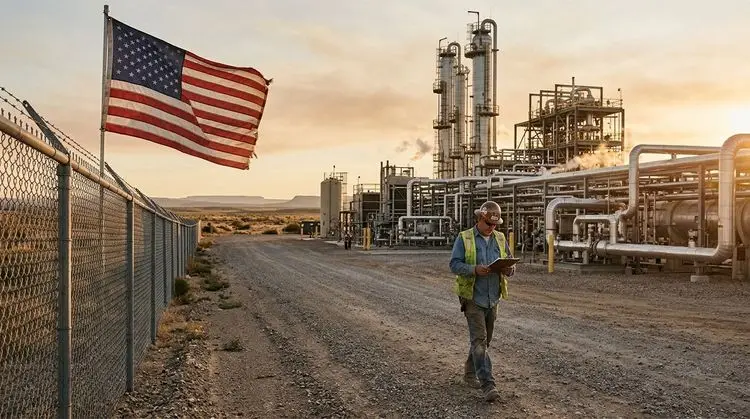
Squeaky voices and party balloons are a notoriously bad camouflage for one of the most vital strategic resources on the planet.
For decades, the general public has viewed helium as a cheap novelty, entirely unaware that the modern technological frontier, from leading-edge semiconductor fabrication to the sub-zero realms of quantum computing, would grind to an absolute halt without it.
Recognizing this invisible, odorless reality, the U.S. Department of Energy officially slapped a "Critical Material" label on helium this October 23. By making it the twentieth material on this exclusive list, Washington is finally saying the quiet part out loud: holding the keys to artificial intelligence and aerospace dominance requires securing the gas that keeps it all from melting down.
Geopolitics, as always, is the invisible hand forcing the issue. Global helium supplies are facing an escalating barrage of disruptions. With maritime transit routes out of major producers like Qatar under constant threat and Western sanctions actively choking off Russian exports from state-backed processing giants like Gazprom, the global supply chain is looking precariously thin.
You might think the United States would be immune to this panic. After all, America is the undisputed heavyweight champion of helium production, projecting an output of roughly 81 million cubic meters in 2025, which accounts for a massive forty-three percent of the global supply. Yet, having the gas trapped beneath the dirt means absolutely nothing if you lack the plumbing to process it. Domestic production has essentially flatlined since 2021. With the historic federal helium reserve entirely phased out, commercial extraction facilities operated by industrial gas heavyweights like Air Products and Chemicals, Inc. (NYSE: APD) and Linde plc (NASDAQ: LIN) are running uncomfortably close to maximum capacity.
The bottleneck is not geology; it is pure infrastructure. Extracting crude helium as a byproduct of natural gas deposits is only step one. Refining it to the ultra-high purity levels demanded by tech manufacturers requires staggering investments in complex cryogenic distillation plants, and those facilities take years to build.
This is exactly where the true gravity of the situation hits home for the tech sector. David Isaacs of the Semiconductor Industry Association has routinely highlighted that modern microelectronics are entirely reliant on helium. It is the ultimate thermal manager, used for vital heat transfer during silicon wafer manufacturing, extreme ultraviolet photolithography, and micro-leak detection. Without it, the multi-billion dollar fabrication plants being built across the American Sunbelt by global semiconductor titans are little more than expensive paperweights. Furthermore, the burgeoning quantum computing sector relies heavily on helium isotopes for dilution refrigerators, which are required to cool superconducting processors down to a fraction of a degree above absolute zero.
Upstream resource developers are already cheering the regulatory shift. Chris Bakker, chief executive of Avanti Helium Corp. (TSXV: ENVI), recently noted that while the U.S. has the natural reserves to remain completely self-sufficient, unlocking those resources requires serious capital for exploration and infrastructure. That is exactly what the Department of Energy designation is designed to trigger.
Being named a critical material does not automatically green-light construction permits or instantly pump cash into the ground. However, it effectively opens the vault. Facilities that process helium can now qualify for lucrative federal loan guarantees through the Department of Energy’s Loan Programs Office and potentially tap into powerful critical minerals tax incentives.
As the United States aggressively scales its defense, artificial intelligence, and quantum sectors, overlooking the physical supply chains that support them is no longer a viable strategy. The universe might be teeming with helium, but capturing enough of it on Earth to keep our most advanced industries running is proving to be a highly lucrative, highly critical challenge.
Sources
The foundational data for this report includes the October 23 critical materials designation announcement by the U.S. Department of Energy and Assistant Secretary of Energy Audrey Robertson. Supply chain metrics and production statistics (including the 2025 U.S. production estimate of 81 million cubic meters) rely on industry supply chain research and historical U.S. Geological Survey data. Technical applications for semiconductor manufacturing and quantum computing were informed by statements from the Semiconductor Industry Association and independent supply chain analysts. Commentary regarding domestic infrastructure and exploration incentives was sourced from public statements by industry executives, including the leadership of Avanti Helium Corp. (TSXV: ENVI).
Disclaimer
Neither the author of this article nor JuniorStocks holds equity, stock options, or any other financial positions in Air Products and Chemicals, Inc. (NYSE: APD), Linde plc (NASDAQ: LIN), Avanti Helium Corp. (TSXV: ENVI), or any other companies mentioned in this publication. This content is published by JuniorStocks strictly for informational purposes, was prepared independently without company compensation, and utilized AI assistance for text editing, formatting, and generating accompanying media. While helium exploration and its recent designation as a U.S. critical material represent a compelling new frontier in the tech and energy supply chains, this article does not constitute investment or financial advice. Investors are strongly advised to conduct their own thorough, independent due diligence and consult with a qualified financial professional before making any investment decisions.