
Gold Digger’s Guide to the Galaxy: The $700 Quintillion Asteroid
Unveiling the Truth Behind the Cosmic Gold Rush Hype
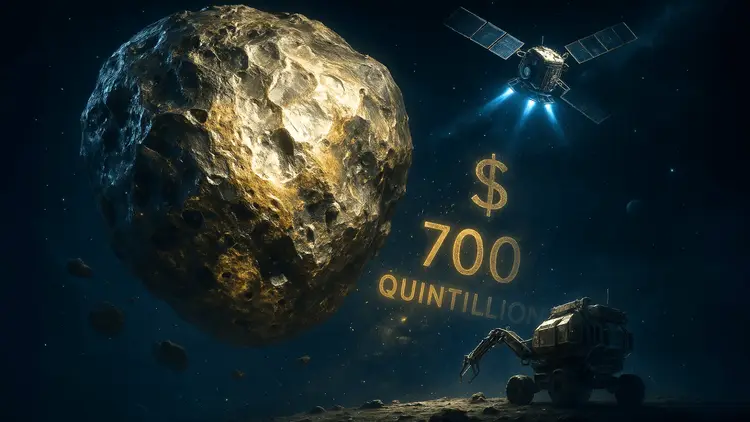
Imagine a cosmic treasure chest so vast it could turn every human into a billionaire. That’s the tantalizing promise of Asteroid Psyche 16, a metallic marvel orbiting between Mars and Jupiter, rumored to hold gold reserves worth a staggering $700 quintillion. But before you start dreaming of interplanetary riches, let’s unpack the facts, sprinkle in a bit of skepticism, and see if this asteroid is truly the golden ticket it’s hyped to be.
Discovered in 1852 by Italian astronomer Annibale de Gasparis, Psyche 16 is one of the largest M-type asteroids in the asteroid belt, spanning roughly 140 to 220 kilometers in diameter. For years, scientists speculated it might be the exposed core of a protoplanet, packed with precious metals like gold, platinum, and cobalt. In 2019, early estimates pegged its value at $700 quintillion—enough to theoretically give every person on Earth about $93 billion. The figure sparked headlines, fueling visions of a space-age gold rush. But recent research suggests this cosmic jackpot might be more fool’s gold than Midas touch.
NASA’s latest data, as of July 2025, paints a more nuanced picture. Psyche is likely a mix of metal and silicate, with metal making up 30% to 60% of its volume. Studies from Brown and Purdue University have raised doubts about earlier claims, noting that Psyche’s density is lower than expected for a solid iron core, suggesting a rocky mantle beneath a metallic coating. This challenges the idea of a pure metal behemoth brimming with gold. Some sources now estimate its value closer to $10 quintillion, still astronomical but a far cry from the original hype. The truth? We won’t know for sure until NASA’s Psyche mission, launched in October 2023, reaches the asteroid in summer 2029.
Even if Psyche is loaded with gold, there’s a catch. Flooding Earth’s markets with such vast quantities of precious metals would likely crash their value faster than a meteor hitting the ocean. Basic economics—supply and demand—means that gold’s rarity drives its price. Dump quintillions’ worth into circulation, and suddenly your billion-dollar dreams are worth pennies. So, the idea of making every human a billionaire? It’s a cosmic pipe dream, not a financial plan.
The Psyche mission itself is a scientific marvel, not a mining expedition. Launched from Kennedy Space Center, the spacecraft uses electric ion thrusters and will perform a Mars flyby in 2026 before orbiting Psyche for 26 months. Equipped with a multispectral imager, gamma-ray and neutron spectrometer, magnetometer, and radio instrument, it will map the asteroid’s surface, measure its gravity, and probe its magnetic field. By 2029, we’ll have a clearer picture of whether Psyche is a metallic treasure trove or a fascinating but less lucrative mix of rock and metal.
The buzz around Psyche’s $700 quintillion valuation highlights our fascination with space and wealth, but it also underscores the need for hard data. Scientists caution that earlier estimates were speculative, based on market prices that don’t account for economic realities. As we await NASA’s findings, Psyche remains a symbol of cosmic potential—less about making billionaires and more about unlocking secrets of planet formation.
So, is Asteroid Psyche 16 a golden ticket to universal wealth? Not likely. Its true value lies in the knowledge it will yield, not in dreams of galactic billionaires. Stay tuned for 2029, when this celestial enigma might just rewrite the story of our solar system—without padding your bank account.