
EU Eyes Canada’s Mineral Riches to Secure Energy and Defense Future
How European demand for defense and energy security could finally unlock Canada's untapped critical mineral wealth
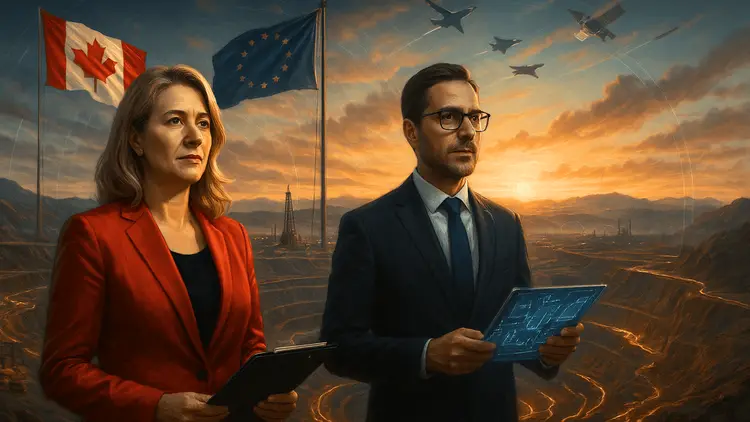
In a move that could finally shake loose the inertia gripping Canada's critical minerals sector, Industry Minister Mélanie Joly has announced a transatlantic policy initiative that positions the European Union as a potential catalyst for Canadian development. Speaking from Ottawa during a high-level press briefing, Joly introduced the New Canada-EU Industry Policy Dialogue, a sweeping cooperative framework that ties Europe’s defense and energy needs to Canada’s underutilized resource wealth. At the heart of this new agreement lies a simple but powerful idea: European demand could be the financial spark Canada has been waiting for.
Canada’s critical minerals portfolio is nothing short of world-class. From lithium and cobalt to rare earth elements and tungsten, the country boasts an enviable stockpile of the raw materials essential to clean energy, battery technology and advanced military systems. Yet despite the riches buried beneath its soil, Canada has largely failed to capitalize on this strategic advantage. Projects have stalled, financing has been elusive and domestic supply chains remain fragmented at best. Now, according to Joly, European interest might be the accelerant needed to finally unlock these dormant reserves.
Critical minerals are no longer just a green energy story. They're now central to military modernization and defense strategy. The tungsten that lines the casings of armor-piercing munitions, the neodymium that powers guidance systems in missiles, and the lithium that keeps battlefield electronics running all stem from a supply chain that has, for far too long, been dominated by a single geopolitical player: China. With mounting global tension and economic dependencies exposed by recent crises, Europe is clearly done playing defense. It wants partnerships, and it wants them now.
That urgency was echoed by Stéphane Séjourné, the European Commission’s executive vice-president for prosperity and industrial strategy, who joined Joly in the announcement. Séjourné emphasized that the EU is actively seeking to diversify away from China and sees Canada as a stable, democratic, resource-rich ally capable of supporting Europe’s dual imperatives: rearming its military and transitioning its economy to low-carbon infrastructure. In his words, the new dialogue is about building a trade bridge grounded in security and conviction.
What makes this moment different is that Europe isn’t just offering rhetoric. With the ink still drying on the New EU-Canada Strategic Partnership of the Future, a sweeping agreement that covers everything from trade and digital policy to climate and defense, the groundwork is already in place for action. This includes Canada’s participation in Security Action for Europe, a key pillar of the EU’s Readiness 2030 rearmament initiative. Tying Canada’s mineral wealth directly to European security needs sends a clear signal: the time for vague commitments is over. The age of strategic industrial alliances is here.
Still, for all the political posturing, the reality on the ground remains sobering. Canada has long struggled to translate its mineral riches into real economic output. A 2022 announcement of $3.8 billion in federal funding was supposed to kickstart a wave of geoscience exploration, mineral processing innovation and battery manufacturing, but progress has been glacial. Even with a further $1.5 billion earmarked through the Canadian Critical Minerals Infrastructure Fund, only a handful of projects in British Columbia, Manitoba, Ontario and Quebec have gained meaningful traction. Talk is cheap. Capital, expertise and execution are what count now.
Joly’s message was clear: that capital is finally coming. And it’s not just about money, it's about market confidence. European industrial players are reportedly lining up to secure future supply from Canada, with interests spanning defense contractors, aerospace manufacturers and EV battery giants. This surge in interest reflects a broader shift in how critical minerals are being perceived. No longer a niche play or environmental talking point, they are now viewed as pillars of economic and national security. As Joly put it, these minerals will “underpin our economic security” for decades to come.
But it won’t be easy. The Canadian Climate Institute recently released a report outlining the scale of investment required to make Canada a major player in global critical minerals markets. According to their analysis, it will take at least $30 billion in sustained capital investment over the next 15 years to build out the mining, processing and recycling infrastructure needed. That figure doesn’t even include the ongoing R&D and regulatory harmonization efforts necessary to integrate Canadian output into EU-based supply chains. Without long-term coordination and shared industrial standards, any deal risks collapsing under its own complexity.
To address this, the Canada-EU policy dialogue will prioritize aligning regulatory regimes, creating data-sharing platforms for mineral tracking and accelerating pilot projects in green steel, quantum computing and renewable energy. These sectors, while often seen as distinct from raw resource extraction, are tightly linked to the mineral economy. Advanced manufacturing relies on rare earth magnets. Quantum chips demand ultra-pure niobium. The green transition, with its promises of decarbonized infrastructure and circular economies, is built on the back of mined materials. And right now, much of the developed world is scrambling to secure those inputs from anywhere but Beijing.
The G7 summit held in Kananaskis this June further underscored the urgency. With China maintaining a chokehold on more than 60 percent of global critical mineral processing, member nations unveiled a new “action plan” focused on disrupting that monopoly. The three-pronged strategy includes setting international standards, mobilizing sustainable finance and closing gaps in supply chain capacity. It was no coincidence that Canada’s mineral potential took center stage during those discussions. The country is one of the few democracies with both the geological endowment and institutional stability to scale quickly, provided the political will is matched by private capital.
As Joly repeatedly stressed, this is not a question of whether Canada has the minerals. It’s about whether Canada has the guts, the vision and the partnerships to move faster. For years, investors and entrepreneurs have lamented the bureaucratic drag and lack of strategic focus holding back mining innovation. Now, with Europe knocking and global supply chains fracturing, that may finally change. The combination of transatlantic urgency and geoeconomic clarity is forcing Canada’s hand.
The EU, for its part, isn’t looking for handouts. It wants a reliable partner. And with this latest dialogue, it appears ready to treat Canada not as a resource colony but as a co-equal in shaping the future of strategic industries. That could be a game changer. If the deals materialize, if the money flows and if supply chains are built rather than talked about, Canada may yet become the world’s go-to destination for responsibly mined, geopolitically neutral critical minerals.
This isn’t just another trade agreement. It’s a wake-up call. In a world defined by conflict, competition and carbon constraints, critical minerals have become the connective tissue of modern industry. If Canada can meet the moment, it won’t just supply the world’s materials — it will shape the world’s future.
Conclusion
Canada’s critical minerals market has long been full of potential but short on progress. Now, as European demand sharpens around defense and clean energy imperatives, Canada has a chance to step up. The strategic alignment between Ottawa and Brussels could be the tipping point — transforming policy talk into industrial traction. But the window won’t stay open forever. If capital flows, regulatory barriers fall and strategic trust deepens, Canada could become not just a supplier, but a leader in the global race for critical resources.