
Apple Strikes Rare Earths Deal With MP Materials Backed by Pentagon
Apple’s $500M rare earths deal with MP Materials marks a bold step to secure critical minerals, build recycling infrastructure, and challenge China’s grip on global supply chains.
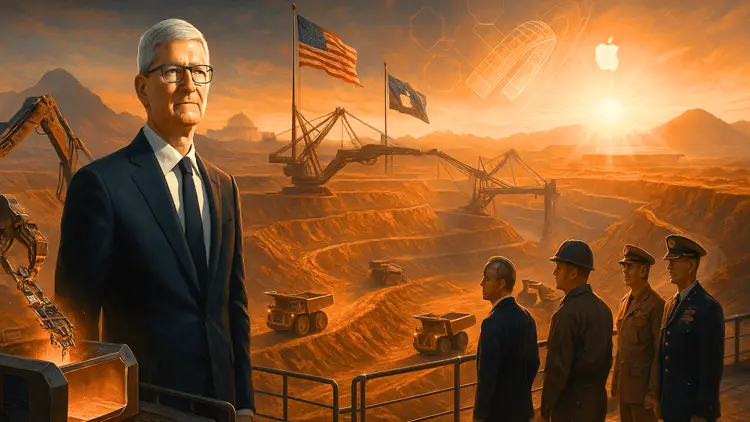
In a move that signals a seismic shift in the global rare earths supply chain, Apple Inc. has secured a $500 million deal with MP Materials Corp., the only active rare earths miner in the United States. The agreement not only ensures Apple a steady stream of critical minerals vital to its ecosystem of devices but also aligns with a broader U.S. effort to wean itself off Chinese dominance in this strategically vital sector.
This partnership isn't just about raw materials. Apple and MP Materials are teaming up to build what they call a “cutting-edge rare earth recycling line” at Mountain Pass, California. The project aims to close the loop on magnet materials used in everything from iPhones and MacBooks to autonomous vehicles and renewable energy infrastructure. The collaboration will also focus on developing next-generation magnet materials and processing technologies to improve performance, reliability, and ultimately, supply security.
Tim Cook, Apple’s CEO, emphasized that the deal is part of the company’s broader mission to support domestic innovation. “American innovation drives everything we do at Apple, and we’re proud to deepen our investment in the U.S. economy,” he said in a statement Tuesday. “Rare earth materials are essential for making advanced technology, and this partnership will help strengthen the supply of these vital materials here in the United States.”
The markets responded swiftly. MP shares surged more than 8 percent in pre-market trading following the announcement. Apple’s stock remained steady, but the long-term implications of the deal stretch far beyond a single trading session.
MP Materials’ rise to strategic prominence has been nothing short of meteoric. Just last week, the U.S. Department of Defense took a $400 million stake in the company to secure domestic supplies of rare earth magnets, a move that was followed by $1 billion in financing from JPMorgan and Goldman Sachs. That capital infusion will support the development of a second rare earth processing and magnet manufacturing plant, with the location expected to be announced soon.
At the heart of this geopolitical and industrial tug-of-war lies one glaring truth. China currently controls more than 80 percent of the global rare earths supply chain. These minerals may be obscure to most, but they are crucial for making permanent magnets that power electric motors in smartphones, wind turbines, EVs, and even F-35 fighter jets. The West’s dependence on China for these materials has long been viewed as a critical vulnerability.
The issue boiled over when the Trump administration slapped 145 percent tariffs on Chinese imports, triggering retaliatory measures. China countered by choking off exports of rare earths, sending shockwaves through global manufacturing. Ford and Suzuki halted production lines. Elon Musk lamented rare earth shortages were hampering Tesla’s robotics division. Supply chains buckled and governments worldwide scrambled to secure alternative sources.
Recent trade talks in Geneva and London suggest that the United States and China may be inching toward détente. China has agreed in principle to resume shipments of rare earths, while the U.S. has offered to relax restrictions on key technologies including chip design software and components for jet engines. But the damage has already been done. Washington is no longer willing to bet its economic or military future on Beijing’s goodwill.
Enter MP Materials, backed now by Silicon Valley, Wall Street, and the Pentagon. The company operates the only rare earths mine in the U.S., at Mountain Pass, a historic site near the California-Nevada border. Once written off as obsolete, the mine is now roaring back to life as the centerpiece of America’s strategy to reclaim control over its own critical mineral resources.
The partnership with Apple marks a significant evolution for MP, which until now has primarily exported its output for processing in Asia. This deal allows the company to climb higher up the value chain, moving beyond mining into magnet manufacturing and recycling. It also signals a growing trend among U.S. tech giants to invest directly in domestic industrial capacity. As Washington ramps up efforts to decouple from Chinese supply chains, firms like Apple are seizing the opportunity to insulate themselves from geopolitical risk while aligning with federal policy.
For Apple, the deal isn’t just about resource security. It’s also about sustainability. The company has been aggressively pushing toward carbon neutrality and closed-loop recycling. By investing in a domestic rare earth recycling operation, Apple moves closer to its goal of eliminating reliance on newly mined materials.
MP’s new facilities will be designed with both economic efficiency and environmental responsibility in mind. Advanced processing technologies developed in partnership with Apple are expected to reduce waste and energy consumption, while recovering a greater proportion of rare earth elements from scrap and used devices. If successful, it could serve as a model for other companies navigating the challenges of clean technology and resource scarcity.
Meanwhile, the Pentagon’s stake in MP is the most direct intervention yet in a private-sector firm involved in rare earths. The Defense Department has long sounded the alarm over China’s ability to cut off access to materials critical for weapons systems. By underwriting MP’s expansion, the Pentagon is ensuring that fighter jets, missile guidance systems, and other military hardware remain unaffected by supply chain disruptions.
The investment reflects a shift in U.S. policy from outsourcing to re-shoring, from just-in-time to just-in-case. With growing recognition that the green energy revolution and modern warfare alike are built on mineral foundations, Washington is crafting a national industrial strategy that places rare earths at the center.
This strategy is bearing fruit. With Apple, the world’s most valuable company, now all-in on a U.S.-based rare earth supply chain, other tech firms may follow. Tesla, Microsoft, and Meta have all voiced concerns over China’s control of critical inputs. Deals like this could become the blueprint for a new era of industrial policy, where corporate giants and government align to reforge supply chains and restore economic sovereignty.
The timing is no accident. As the world barrels toward a clean energy future powered by electric vehicles, wind turbines, and battery storage, demand for rare earth magnets is expected to surge exponentially. Analysts predict global demand could triple by 2035, with the bulk of that coming from EVs and renewables. With Mountain Pass expanding and new facilities in the pipeline, MP aims to supply up to 15 percent of global demand by the end of the decade.
Apple’s investment is also a signal to Wall Street. By putting real money into domestic rare earth production, Apple is making a bet not only on national security but on the long-term profitability of a localized, resilient, and vertically integrated supply chain. Investors are taking notice. The sharp uptick in MP’s share price could be just the beginning if more Fortune 500 companies follow Apple’s lead.
As global competition for critical minerals intensifies, expect more of these high-profile partnerships. The age of rare earth dependence is coming to an end. What replaces it will be defined by companies like MP Materials and bold moves like Apple’s.
Conclusion
Apple’s $500 million deal with MP Materials isn’t just a supply agreement. It’s a declaration of independence. It’s Silicon Valley shaking hands with the Pentagon, Wall Street, and American miners to reshape the backbone of the technology economy. It’s a message to Beijing that the era of rare earth dominance is nearing its twilight. And it’s a glimpse into a future where innovation is powered by sustainability, security, and sovereignty.