
China Slams G-7 'Small Cliques' Over New Critical Mineral Export Rules
G-7 sets an aggressive 2030 deadline to shatter China's critical mineral monopoly, sparking a fierce geopolitical standoff over the future of tech and defense.
High school never really ends; it just relocates to luxury European lakeside summits.
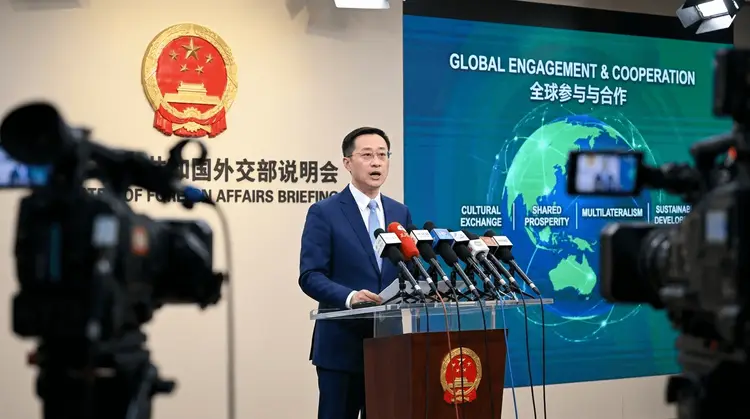
At the G-7 gathering in Évian, France, the world’s wealthiest democracies essentially formed an exclusive "no-China" club for critical minerals supply chains. Beijing, predictably, is not amused. Chinese Foreign Ministry spokesman Lin Jian openly criticized the Western alliance, telling reporters that G-7 leaders need to stop imposing the "rules of small cliques" on the global economy. The rhetorical fireworks cap a tense week of trade maneuvering, highlighting a global race to control the invisible elements that power everything from advanced defense systems to electric vehicle fleets.
The geopolitical spat was triggered by a sweeping joint declaration from G-7 leaders aimed squarely at China’s near-monopoly on rare earths and permanent magnets. Beijing currently controls roughly 70 percent of global extraction and a staggering 90 percent of processing capacity. To break this stranglehold, Western nations established a strict diversification cap, pledging to slash their single-source reliance on non-G-7 suppliers to below 60 percent by 2030, with a stretch goal of hitting 50 percent shortly thereafter. Rather than just issuing empty political promises, the alliance is introducing structured economic mechanisms to back up the target. This strategy introduces pilot transparency tracking for key battery components like lithium and nickel, builds a formalized risk alliance with the International Energy Agency, and plans to expand the program annually by adding five new minerals, all supported by co-financing for 195 new infrastructure projects globally.
China’s defense of its export control regime leans heavily on international norms. Lin Jian argued that Beijing's tight licensing restrictions, which heavily disrupted global supply chains after being rolled out against permanent magnets, are entirely legal, standard, and designed to fulfill non-proliferation obligations. The reality on the ground is more transactional. Beijing's export curbs were widely interpreted as leverage following a barrage of high-tech semiconductor restrictions and tariffs imposed by Washington. While a temporary tariff truce negotiated late last year suspended some of the most aggressive mineral restrictions, the G-7 is treating the current calm as a brief window to prepare for the inevitable next storm. Western nations are already opening their checkbooks to build cushions, with the United States recently launching its 12 billion dollar critical minerals reserve, known as Project Vault, while the European Union fast-tracks its own localized stockpiles of tungsten, gallium, and heavy rare earths.
Mining rock out of the ground is the easy part; refining it into commercial-grade material is where the West faces its steepest uphill climb. Building alternative supply chains requires massive capital expenditure that private corporations are hesitant to absorb without state-backed price guarantees. Neha Mukherjee, a research manager at Benchmark Mineral Intelligence, noted that while the G-7's statement provides a loud signal of political intent, the pace of diversification will ultimately depend on whether policy support translates into investment across the midstream and downstream parts of the value chain.
Western producers like MP Materials Corp. (NYSE: MP) in the United States and Lynas Rare Earths Ltd (ASX: LYC) in Australia are pushing ahead with processing expansions, but they are fighting an uphill battle against heavily subsidized Chinese competitors. Western governments are exploring radical economic interventions, including price-gap subsidies, quotas, and joint procurement instruments, to keep these alternative supply lines financially viable. For now, the G-7 has drawn its line in the sand, but rewriting the rules of global trade will require far more than just calling out Beijing’s "small cliques."
Sources
- The Straits Times: "China defends critical minerals export controls, calls for end to 'small cliques' after G-7 statement" (Published June 18, 2026)
- National Association of Manufacturers: "G-7 Announces Critical Minerals Alliance" (Published June 18, 2026)
- Reuters / Times of India: "'Harmonised, interoperable mechanisms': G7 takes on China’s critical minerals dominance, sets 2030 target to cut dependence" (Published June 17, 2026)
- Washington Examiner: "G7 leaders agree to plan to undo China’s dominance in critical minerals" (Published June 17, 2026)