
Saskatchewan Breaks 20-Year Resource Drought with Historic Copper and Uranium Milestones
How Eldorado Gold and Denison Mines are shattering a two-decade resource dry spell to anchor North America's clean energy supply chain.
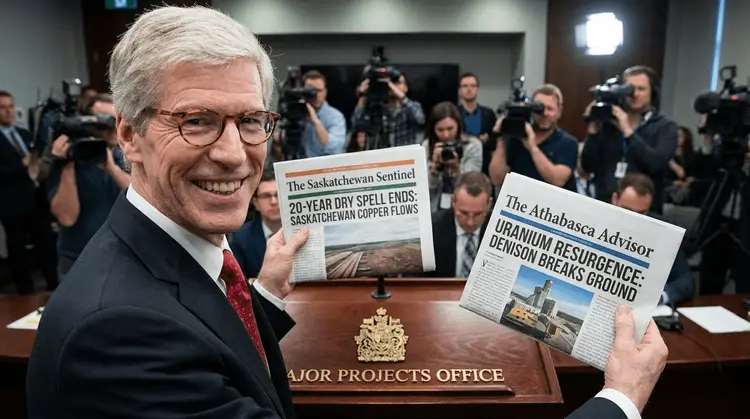
Saskatchewan is quietly staging a heavy-metal comeback that would make an arena rock band jealous, completely redefining its footprint in the global clean energy race. For more than two decades, the province’s vast underground caches of copper and uranium remained largely dormant or locked behind administrative tape.
That long dry spell officially evaporated this week with a spectacular double-header of industrial breakthroughs that federal Minister of Energy and Natural Resources Tim Hodgson has compared to the breakneck infrastructure buildouts of World War II. By transforming raw geological potential into immediate strategic assets, the province is cementing its status as North America's premier destination for the green transition.
The first seismic shift belongs to the base metals sector, where Eldorado Gold Corporation (TSX: ELD | NYSE: EGO) has successfully extracted its first copper concentrate from the McIlvenna Bay underground project. Tucked away in east-central Saskatchewan within the historic Flin Flon greenstone belt, this milestone marks the first time copper has been produced in the province in over twenty years.
The asset, which Eldorado Gold absorbed following its strategic acquisition of Foran Mining Corporation in April, completed its hot commissioning phase to yield its first batch of concentrate on June 7, 2026. The operations team is now aggressively ramping up processing toward a nameplate capacity of 4,900 tonnes per day, with full-scale commercial production slated for the third quarter of this year.
Chief Executive Officer George Burns highlighted that the project drastically diversifies the company’s portfolio while feeding an insatiable global appetite for electrification metals. Burns noted that achieving first concentrate at McIlvenna Bay is a significant milestone, not just for Eldorado but for Canadian mining, adding that the asset will help transform the company into a high-margin, free cash flow generating business alongside its global projects.
As the copper taps begin to flow in the east, the northern stretches of the province are simultaneously preparing to power the global nuclear renaissance. Denison Mines Corp. (TSX: DML | NYSE: DNN) has officially broken ground at its flagship Wheeler River project in the Athabasca Basin, signaling the arrival of the first large-scale Canadian uranium mine approved for construction in more than two decades.
Coming hot on the heels of formal federal approval and licensing by the Canadian Nuclear Safety Commission, the development represents a massive leap forward for domestic energy security. What makes the Phoenix deposit at Wheeler River particularly fascinating is its reliance on In-Situ Recovery mining.
This advanced technique allows Denison Mines to dissolve the high-grade uranium directly underground and pump the solution to the surface. It completely bypasses the need for conventional tailings, open pits, or massive waste rock piles that historically complicated the public perception of mining operations.
President and CEO David Cates explained that because they are not excavating the rock, the project avoids generating conventional tailings, a factor that kept the project's economics incredibly resilient even during past periods of depressed uranium markets. Cates also leaned heavily into the deep collaboration with regional First Nations and Métis communities, comparing their long-term community agreements to a successful marriage intended to generate shared prosperity and training pipelines for northern youth.
With the federal Major Projects Office actively clearing the path for these critical resource infrastructures, Saskatchewan is proving that building the future doesn't always require inventing something entirely new. Sometimes, it just requires digging a little smarter into the past.
By leveraging modern, low-emission technology and ironclad Indigenous partnerships, these projects demonstrate how Canada is seizing the moment to secure supply chains for itself and its allies. The era of bureaucratic stagnation has given way to an era of operational velocity, turning Saskatchewan into the engine room of the continent's industrial future.
Sources
- Eldorado Gold Corporation Investor Relations — Press Release: Eldorado Gold Announces First Concentrate Produced at McIlvenna Bay (Issued June 8, 2026)
- Canadian Nuclear Safety Commission — Regulatory Decision: Wheeler River Project Site Preparation and Construction Licence (Updated February 2026)
- Saskatchewan Regional Mining News — Industrial Report: Denison Mines Breaks Ground on Historic Athabasca Basin Uranium Project (Issued June 7, 2026)