
Washington Drops $1.6 Billion to Build America's Rare Earth Fortress
Washington triggers a $1.6 billion CHIPS funding package to reshore the critical mineral supply chain from Texas soil straight to American manufacturing plants.
The periodic table has officially been weaponized, and Washington just placed a massive financial bet to ensure it holds the winning hand. For decades, Western tech and defense sectors have quietly agonized over their absolute reliance on foreign single-sources for the critical minerals that power the modern world. That anxiety is finally being met with an aggressive counteroffensive. USA Rare Earth, Inc. (NASDAQ: USAR) has locked down a definitive agreement with the U.S. Department of Commerce, triggering a $1.6 billion funding package through the CHIPS Program designed to build a completely self-sustaining, domestic tech supply chain from scratch.
This isn’t a standard government handout; it is a meticulously structured play for equity and execution. The deal unloads up to $277 million in direct federal grants alongside a staggering $1.3 billion in senior secured loan capacity. In exchange for the capital, the U.S. Government is securing a literal piece of the action, taking 16.1 million shares of common stock and roughly 17.6 million warrants. Backed by the financial structuring of Moelis & Company (NYSE: MC) and the legal architecture of Latham & Watkins LLP, this federal injection brings the company's total war chest to an impressive $3.5 billion, heavily padded by a $1.5 billion private capital PIPE transaction completed earlier this year.
The massive capital stack exists to solve a terrifyingly simple problem: the West cannot build advanced technology without asking permission from overseas adversaries. Michael Blitzer, Chairman of the Board of USA Rare Earth, Inc. (NASDAQ: USAR), framed the agreement not just as a corporate milestone, but as an urgent national necessity.
"This partnership with the U.S. Government is the largest of its kind in our industry and provides the necessary capital to build the only global platform across light and heavy rare earth mining and processing, metal and alloy making, as well as magnet manufacturing - for the benefit of the United States and its allies," Blitzer stated. "This landmark collaboration reflects the scale and urgency of securing critical supply chains for technologies essential to long-term economic growth. We are grateful for the leadership shown across government in moving with speed and conviction. Our focus now is execution and generating industry-leading returns for both our shareholders and the U.S. Government."
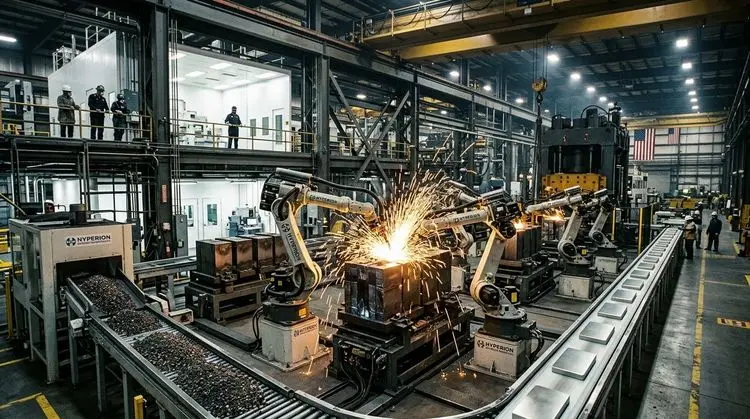
Turning that high-level strategy into physical infrastructure requires a logistical gauntlet that spans from deep Texas soil to advanced manufacturing plants. The operational roadmap kicks off at the Round Top deposit in Hudspeth County, Texas, a project involving a strategic consolidation with Texas Mineral Resources Corp. (OTCMKTS: TMRC), with commercial mining slated for 2028. From there, the material will bypass traditional foreign bottlenecks entirely. Processing and separation facilities will feed the company’s UK-based subsidiary, Less Common Metals, to reshore 10,000 tons per annum of heavy rare earth metal-making and strip-casting capabilities that currently do not exist anywhere in America. Finally, the loop closes by pumping out 10,000 tons of neodymium-iron-boron magnets annually across dedicated facilities in Stillwater, Oklahoma, and Blacksburg, South Carolina, while the company eyes further global mining expansion through a pending deal with the Serra Verde Group and midstream asset collaboration with Carester SAS.
Chief Executive Officer Barbara Humpton made it clear that the signing of these definitive agreements marks the precise moment the company moves from theoretical planning to genuine industrial output.
"Today marks the moment we move from intent to execution alongside the United States Government," Humpton noted. "With the definitive agreements, USAR is positioned to accelerate the building of a global mine-to-magnet value chain that will supply the materials, metals, and magnets that industrial customers depend upon. From defense, aerospace, semiconductors, and data centers to physical AI, energy, mobility, and healthcare, our integrated value chain is designed to power the technology and innovations of the 21st Century. We look forward to our partnership with the United States Government."
While rare earth elements are often talked about in the context of electric vehicle batteries or military hardware, Washington’s CHIPS Program Office is eyeing a much more immediate microchip crisis. Bill Frauenhofer, the Executive Director of Semiconductor Investment and Innovation, detailed the exact chemical vulnerabilities this deal is engineered to cure, proving that software sovereignty means nothing without hardware security.
"The CHIPS Program’s $277 million funding and $1.3 billion loan will be instrumental for the construction of a domestic integrated supply chain for critical minerals and NdFeB magnets which are essential for semiconductor chip manufacturing," Frauenhofer explained. "Yttrium, gallium, dysprosium and the other 9 critical and strategic minerals that will be mined in Texas, along with the domestic metal and magnet production, provides United States semiconductor companies a reliable domestic source and removes choke points in their manufacturing supply chain that enable chemical vapor deposition, high-k materials, compound semiconductors, dopants and other foundational applications."
Even with broader market headwinds causing a momentary dip in the company's stock price on the day of the announcement, the overarching narrative remains unchanged. By backing a single player to control everything from raw Texas earth to high-end magnets, the United States is finally building a supply chain that can't be turned off by foreign decree.
Source
- USA Rare Earth, Inc. (Nasdaq: USAR) Investor Relations & Press Release Distribution: "USA Rare Earth Finalizes Definitive Agreements with U.S. Department of Commerce, Unlocking Access to Up to $1.6 Billion to Advance the Leading Rare Earth Value Chain," published June 3, 2026.