
What Evy Hambro and Jamie Dimon See in the Next Tech Resource Race: The West's Wake-Up Call
As Wall Street titans quietly corner the market on critical tech and defense metals, Europe’s institutional lag threatens its geopolitical future in the age of artificial intelligence.
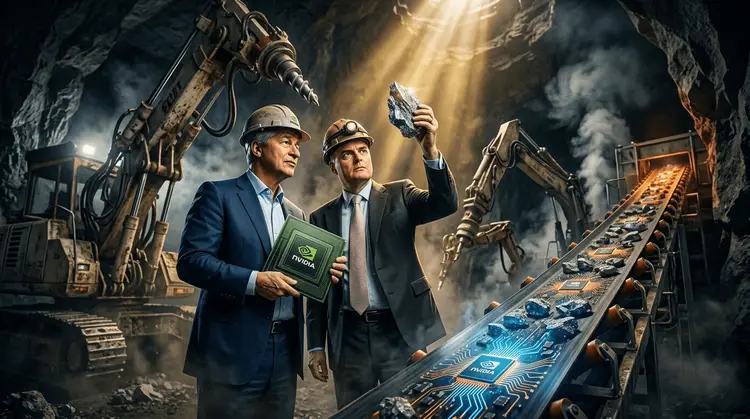
Artificial intelligence is devouring the electrical grid, and the world's biggest asset managers have finally realized that clouds are actually made of heavy metal.
Evy Hambro, Global Head of Thematic and Sector Investing at BlackRock (NYSE: BLK), recently laid out a compelling thesis: the artificial intelligence revolution is triggering a massive new commodities supercycle. While retail investors and tech executives are busy chasing the next software startup, the real smart money is quietly securing the physical materials needed to keep next-generation data centers from melting down.
Case in point is the strategic accumulation of a relatively obscure flame-retardant and defense metal. Recent regulatory filings reveal that BlackRock (NYSE: BLK) has scooped up over 9.3 million shares, a passive stake of roughly 6.5 percent, in United States Antimony Corp (NYSE American: UAMY).
Antimony is the geopolitical bottleneck you have probably never heard of, essential for everything from advanced semiconductor manufacturing to hardening military munitions. With adversarial nations tightening their grip on global supply, the sudden institutional interest in the only fully integrated antimony producer operating entirely outside of Chinese and Russian borders is far from coincidental. It is a highly calculated bet on physical infrastructure and domestic supply chain survival.
Across the Atlantic, the scramble is even more desperate. Military Metals Corp (CSE: MILI | OTCQB: MILIF) recently caught the attention of Bloomberg reported by Jenny Leonard, which highlighted the company's massive Trojárová project in Slovakia. This asset officially stands as the largest modern antimony resource in the European Union. Yet, despite having a critical mineral lifeline sitting right in their own backyard, European bureaucrats are characteristically dragging their feet.
While the United States is aggressively deploying capital to revive domestic critical minerals, the EU is still trapped in endless committee meetings, apparently hoping their defense systems and renewable grids will magically fortify themselves without domestic supply. Their institutional inertia on defense-critical materials is a spectacular masterclass in how to lose a geopolitical resource race.
This fractured, disorganized approach to securing the future is exactly what titans of Wall Street are warning against.
Jamie Dimon, CEO of JPMorgan Chase & Co. (NYSE: JPM), has consistently stressed in his shareholder letters and public appearances that the West must unite its economic and strategic fronts to counter rising global tensions. When the world's most powerful banker says the free world needs to align its interests, and the world's largest asset manager starts buying up niche critical minerals, the writing is unequivocally on the wall. The future of technology, energy, and global security will not be won by whoever has the smartest algorithms, but by whoever controls the rocks in the ground required to run them.
Sources:
Information regarding institutional ownership was verified via recent SEC Form 13G/A filings for United States Antimony Corp (NYSE American: UAMY). Coverage of Military Metals Corp (CSE: MILI) and the European critical minerals supply chain was sourced from Bloomberg market reports. Statements on geopolitical alignment and the West uniting were referenced from Jamie Dimon's Annual Shareholder Letters at JPMorgan Chase & Co. (NYSE: JPM). Insights regarding the AI-driven commodity supercycle were drawn from public commentary and thematic investing outlooks provided by Evy Hambro at BlackRock (NYSE: BLK).
Disclaimer:
This article mentions Military Metals Corp. The author holds shares in Military Metals Corp and may buy or sell at any time. This article is for informational purposes only, was prepared independently without company involvement, and utilized AI assistance. It is not investment advice. Consult a qualified financial advisor before making investment decisions.