SPONSORED

What Factors Are Driving the Unprecedented Surge in Cocoa Prices?

Navigating the Turbulent Waters of the Cocoa Market: Understanding the Impact of Supply Shortages and Price Volatility
•• 3 Min
What Factors Are Driving the Unprecedented Surge in Cocoa Prices?

Cocoa, often dubbed as the "food of the gods," continues its upward trajectory in the global commodity market, reaching yet another milestone amidst persistent supply challenges in West Africa. This article delves into the factors driving cocoa prices to new heights and the far-reaching implications for stakeholders across the supply chain.

Factors Contributing to Cocoa Price Surge

The surge in cocoa prices can be attributed to a confluence of factors, primarily stemming from the West African region, which accounts for a significant portion of global cocoa production. Adverse weather conditions, including erratic rainfall patterns and prolonged dry spells, have wreaked havoc on cocoa plantations, exacerbating the impact of crop diseases such as swollen shoot virus and black pod disease. These challenges have severely hampered cocoa yields, leading to a supply-demand imbalance and driving prices upward.

Moreover, the cocoa market has been roiled by increasing margin calls and diminishing open interest, amplifying market volatility and exacerbating price fluctuations. As speculative trading activity intensifies, market participants are bracing themselves for heightened turbulence in the cocoa futures market.
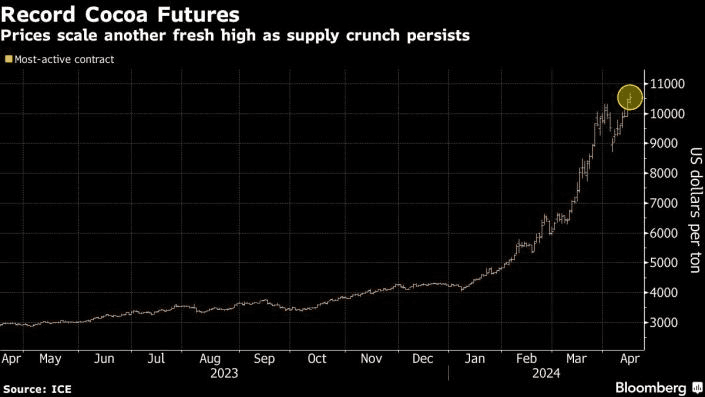
image (14).png

Cocoa Arrivals to Ivory Coast Ports

The latest figures on cocoa arrivals to Ivory Coast ports paint a grim picture of the ongoing supply woes. According to reports, cocoa arrivals stand at 1.31 million tons so far this season, marking a staggering 30% decline compared to the previous year. This sharp decline underscores the severity of the supply crunch gripping the world's leading cocoa-producing country and has reverberations throughout the global cocoa supply chain.

The ramifications of dwindling cocoa arrivals extend beyond Ivory Coast, sending shockwaves across the chocolate industry's heartlands, notably in Germany and Switzerland. Chocolatiers, grappling with the prospect of dwindling cocoa supplies and soaring prices, are faced with the daunting task of navigating through turbulent market conditions while ensuring the continuity of their operations.

Impact on Chocolatiers

The ripple effects of the cocoa supply crisis are keenly felt by chocolatiers, who rely heavily on a steady and affordable supply of cocoa beans to sustain their production processes. With prices soaring to unprecedented levels, chocolatiers are confronted with mounting production costs and shrinking profit margins. In response, some chocolatiers have resorted to innovative strategies, such as hedging against price volatility and diversifying their cocoa sourcing channels, to safeguard their businesses from the adverse effects of supply disruptions.

Price Movement in the Cocoa Market

Against the backdrop of supply constraints and heightened market uncertainty, cocoa futures have surged to new highs in the New York market. Prices soared by as much as 2.2% to reach an all-time high of $10,702 per ton for the most-active contract, underscoring the relentless upward momentum in cocoa prices. The sharp ascent in cocoa prices reflects the market's apprehensions regarding the adequacy of global cocoa supplies to meet growing demand, particularly in light of the persistent supply challenges in West Africa.

Outlook for the Cocoa Market

Looking ahead, the outlook for the cocoa market remains fraught with uncertainties as stakeholders brace for continued volatility and supply disruptions. While efforts are underway to mitigate the impact of adverse weather conditions and crop diseases in West Africa, the long-term sustainability of cocoa production hinges on implementing robust agronomic practices and investing in research and development to develop disease-resistant cocoa varieties.

In the interim, market participants are advised to adopt a prudent approach to risk management and explore innovative solutions to navigate through the choppy waters of the cocoa market. Collaboration among industry stakeholders, including cocoa producers, traders, and chocolatiers, will be pivotal in addressing the structural challenges facing the cocoa supply chain and ensuring its resilience in the face of future shocks.

Conclusion

The cocoa market finds itself at a crossroads, grappling with unprecedented supply challenges and heightened market volatility. As cocoa prices soar to new heights, stakeholders across the supply chain must collaborate and innovate to navigate through these turbulent times. By fostering resilience and adaptability, the cocoa industry can weather the storm and emerge stronger, ensuring the continued availability of this beloved commodity for generations to come.

Most Popular News

  1. SpaceX’s $8B Spectrum Deal Sends AT&T, Verizon, and T-Mobile Plummeting
  2. Is Project Vault Securing America’s Supply Chain or Squeezing It to the Breaking Point?
  3. Why Gautam Lohia Shifted from Global Consulting to Reboot a $20M Tech Micro-Cap
  4. Everyday Luxury, Unstoppable Scale: Aritzia Delivers 44% Net Revenue Growth
  5. Can Navy SEAL Leadership and Big Tech Scale Revolutionize Airborne Threat Detection?

Disclaimer


This report should not be viewed as investment advice or as an offer to buy or sell any securities or as an invitation or solicitation of an offer to buy or sell any securities. Neither the author of this report, its publisher, nor any other person associated with the publication of this report, are registered brokers, investment dealers, investment advisers, or financial advisers. The information in this report has not been tailored to the particular needs or circumstances of readers and should not be relied upon as investment advice or recommendations to purchase or sell any of the securities presented in this report. Readers seeking investment advice should contact qualified and registered brokers, investment dealers, investment advisers, or financial advisers prior to making any decision to buy or sell any of the securities referred to in this report. The information in this report should not be construed as investment, legal, or tax advice. No recommendation is made as to whether an investment in the presented securities is suitable for any reader in light of the reader’s particular circumstances.

Readers are cautioned that the publisher of this report covers exclusively securities that carry a high degree of volatility. Investing in such securities is highly speculative and carries a high degree of risk. Investors in such securities could lose all or a substantial portion of their investment. Only those investors who can afford to lose all or a substantial portion of their investment should consider investing in the securities referred to in this report.

This report may include information obtained from publicly available sources, including third-party reports or analysis. Neither the author nor publisher of this report, nor www.juniorstocks.com or its owners, have undertaken any independent investigation into the factual information used in this report, and the information in this report is provided without any warranty of any kind. No representations or warranties are provided regarding the accuracy or completeness of the information provided in this report. Statements of opinion or belief are those of the authors and/or publisher of this report. These statements of opinion or belief are expressions of the author’s and/or publisher’s judgment, and there is no guarantee that those judgments will turn out to be correct. No inference should be drawn that the author and/or publisher have any special or greater knowledge about the presented companies or their securities, or any particular expertise in the industries or markets in which the company operates. Readers should conduct their own due diligence and seek professional advice prior to investing in any securities presented on Juniorstocks.com.

Certain statements in this report constitute “forward-looking” statements. Forward-looking statements often, but not always, are identified by the use of words such as “seek,” “anticipate,” “believe,” “plan,” “estimate,” “expect,” “targeting,” and “intend” and statements that an event or result “may,” “will,” “should,” “could,” or “might” occur or be achieved and other similar expressions. Forward-looking statements express or involve discussions with respect to predictions, expectations, beliefs, plans, projections, objectives, goals, assumptions, or future events or performance; they are not statements of historical facts and should not be viewed as any guarantee of any future result. Forward-looking statements are based on expectations, estimates, and projections at the time the statements are made that involve a number of risks and uncertainties which could cause actual results or events to differ materially from those presently anticipated. The author and/or publisher of this report disclaims any obligation to update the forward-looking statements in this report, whether as a result of new information, future events, or results or otherwise. There is no assurance that forward-looking statements will prove to be accurate, as actual results and future events could differ materially from those anticipated in such statements. Accordingly, readers should not place undue reliance on forward-looking statements.

The information provided in this report is not intended for distribution to, or use by, any person or entity in any jurisdiction or country where such distribution or use would be contrary to applicable law or regulation, or would subject the author or publisher of this report to any registration requirement in such jurisdiction or country.

Information about the editor of this publication:
Juniorstocks.com is a service provided by Piccadilly Capital Group, Office 66, 101 Clapham High Street, London, SW4 7TB, UK. Piccadilly Capital Group is not the publisher of this report and was not paid for the publication of this report. Piccadilly Capital Group seeks to generate web traffic and a growing number of followers through the publication of articles or reports. Directors, officers, and other insiders of the publisher own an interest in Piccadilly Capital Group. Piccadilly Capital Group does not endorse or recommend the business, products, services, or securities of any company mentioned on www.juniorstocks.com. Piccadilly Capital Group will not share your information with any outside third parties. Due to the new data protection basic regulation, we ask you to read our data protection declaration carefully.

Note on copyright:
The contents published on this website and on connected media (e.g., e-mail, X, Facebook) are subject to applicable copyright and ancillary copyright laws. Any use not permitted by applicable copyright and ancillary copyright laws requires the prior written consent of the provider or the respective rights holder. In particular, this applies to the duplication, editing, translation, storage, processing, or reproduction of content in databases or other electronic media and systems. Contents and rights of third parties are marked as such. Unauthorized reproduction or transmission of individual contents or complete pages is not permitted and is punishable by law. Only the production of copies and downloads for personal, private, and non-commercial use is permitted. Links to the provider's website are always welcome and do not require the consent of the provider of the website. Photos and images on the website may not be shared unless the publisher itself has acquired the initial rights from authorized sources. The presentation of this website in external frames is only allowed with written permission. If you notice any violations, please inform us. Please note: The content of our articles, emails, or other publications or social networks such as X, LinkedIn or Facebook is exclusively intended for the designated addressee(s). If you are not the addressee of these articles, emails, or other publications in the market letter or social networks such as Twitter or Facebook or his or her legal representative, please note that any form of publication, reproduction, or distribution of the content of these articles, emails, or other publications in the market letter or social networks such as X, LinkedIn or Facebook is prohibited. Falsifications of the original content of this message during data transmission cannot be excluded in principle.