SPONSORED

“We’re Not Far Ahead of China Overall”: Jensen Huang Sounds the Alarm on the Global AI Race

Inside the CNBC interview that redefined the AI conversation — Jensen Huang explains NVIDIA’s strategy, the race with China, and why AI’s next industrial revolution has only just begun.
•• 2 Min
“We’re Not Far Ahead of China Overall”: Jensen Huang Sounds the Alarm on the Global AI Race

NVIDIA’s Jensen Huang sat down with CNBC’s Squawk Box on October 8, 2025, and offered a rare, unfiltered look at what is powering the world’s most valuable company. The conversation ranged from OpenAI and xAI to energy strategy, China, immigration, and the economics of tokens. Every reference and quotation here is sourced to CNBC’s interview and companion clips on CNBC.com.

Huang confirmed that NVIDIA’s relationship with OpenAI has shifted from primarily cloud-channel sales to direct supply. He framed the move as a natural evolution of a partnership that began when NVIDIA delivered the first DGX system to OpenAI in 2016, as he told CNBC. What makes it consequential is the scope. He described NVIDIA’s offering as full AI infrastructure, not just GPUs, but CPUs, networking, switches, and software. That matters because the company is optimizing the entire stack to push down the cost of token generation. The tone was confident and specific, and the message to investors was straightforward. NVIDIA wants to be the single vendor that can ship a turnkey AI factory.

“I’m surprised they would give away 10%” on AMD’s OpenAI deal

Asked about AMD’s equity-sweetened arrangement with OpenAI, Huang called it imaginative and surprising, adding that he would not have expected a sizable stake to be granted before the next generation product ships. The contrast with NVIDIA’s approach is telling. NVIDIA has the option to invest alongside others in model builders but does not hinge supply on exclusivity, according to Huang’s remarks to CNBC. The strategy is to keep running faster across the system, not to win on one chip alone.

Huang’s most investor-sensitive line was about unit economics. He told CNBC that NVIDIA’s roadmap aims to slash token generation costs by an order of magnitude or more versus the prior generation. He argued that Moore’s law alone would imply incremental gains, while system-level optimization can deliver step changes. If that trajectory holds, it supports the thesis that AI demand expands as capability rises and costs fall, which in turn supports data-center capex and sustained platform share.

Huang drew a line between novelty and utility. Early models generated attention. New models, he said on CNBC, reason, research, use tools, and deliver work that enterprises will pay for. He cited Cursor, an AI coding assistant he says is now used across NVIDIA engineering, and highlighted OpenEvidence for clinical workflows. His framing was expansive. Previous tech gave humans tools. This wave is the first to give technology the capacity to use tools on its own. That distinction underpins his view that we are in the buildout phase of permanent AI infrastructure.

On CNBC, Huang praised xAI and said his only regret was not investing more. He rejected the idea that such stakes are vendor financing, calling them strategic investments in future giants that will operate on NVIDIA platforms. He used similar language for CoreWeave and other ecosystem bets. The pattern is visible. Seed the demand side with capital and software, then meet it with annual leaps in systems, networking, and compilers.

“We’re not far ahead of China overall”

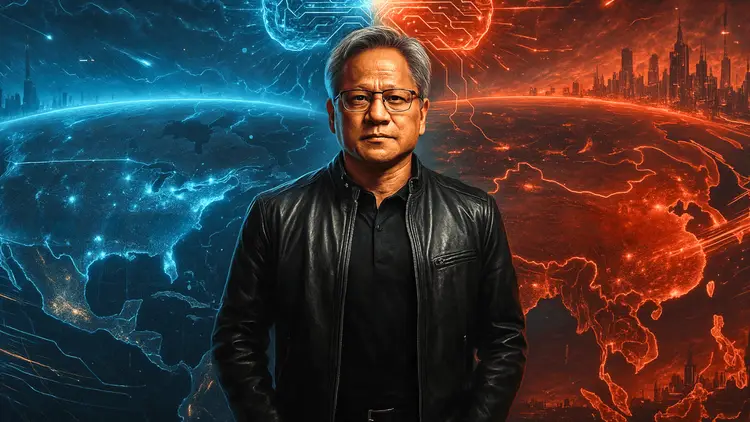
Huang’s geopolitical answer was nuanced on CNBC. He said the United States leads in chips, that China leads in energy, and that infrastructure and models are close. He warned that China’s application layer moves fast because it is less regulated at the industrial level. He argued the U.S. must remain the global standard setter by ensuring the American tech stack is adopted widely, rather than ring-fencing it. In his view, winning the AI race means powering the majority of the world’s developers and applications, not only holding the most advanced chips at home.

“Data centers should generate their own power”

Addressing concerns about rising wholesale electricity prices near AI campuses, Huang told CNBC that operators should add behind-the-meter generation, from natural gas today to nuclear over time. He praised policy that enables private generation. The subtext is practical. AI factories face both compute and power constraints. NVIDIA’s thesis is that the ecosystem must scale both at once, and that energy is part of the AI stack.

On immigration, Huang was personal. He said on CNBC that NVIDIA will pay the new H-1B fee, but warned that such a cost would have barred his own path. He called immigration the foundation of the American dream and urged pragmatic refinements that keep the world’s top talent in the United States after earning American degrees. The message fit his broader competitiveness theme. Great chips need great people.

Huang closed by telling CNBC that reasoning models are so good they demand exponentially more compute, and that demand itself is compounding. He credited NVIDIA’s culture with channeling new wealth into purpose. Employees, he said, keep showing up because the work feels consequential. If token costs fall while utility rises, he believes this buildout becomes a durable industrial platform.

Conclusion

The CNBC conversation distilled NVIDIA’s edge into three ideas. Own the system, not a part. Collapse token costs every year to unlock new utility. Seed and standardize the global AI stack so developers and enterprises build on it. Huang did not claim a victory lap. He offered a roadmap. Cheaper tokens, smarter agents, faster energy and networking, broader diffusion. If those dominos fall in sequence, the company’s ambition to supply AI factories at global scale becomes more than plausible. It becomes the default setting for the next decade of computing.

Nvidia

Most Popular News

  1. SpaceX’s $8B Spectrum Deal Sends AT&T, Verizon, and T-Mobile Plummeting
  2. Is Project Vault Securing America’s Supply Chain or Squeezing It to the Breaking Point?
  3. Why Gautam Lohia Shifted from Global Consulting to Reboot a $20M Tech Micro-Cap
  4. Everyday Luxury, Unstoppable Scale: Aritzia Delivers 44% Net Revenue Growth
  5. Can Navy SEAL Leadership and Big Tech Scale Revolutionize Airborne Threat Detection?

Disclaimer


This report should not be viewed as investment advice or as an offer to buy or sell any securities or as an invitation or solicitation of an offer to buy or sell any securities. Neither the author of this report, its publisher, nor any other person associated with the publication of this report, are registered brokers, investment dealers, investment advisers, or financial advisers. The information in this report has not been tailored to the particular needs or circumstances of readers and should not be relied upon as investment advice or recommendations to purchase or sell any of the securities presented in this report. Readers seeking investment advice should contact qualified and registered brokers, investment dealers, investment advisers, or financial advisers prior to making any decision to buy or sell any of the securities referred to in this report. The information in this report should not be construed as investment, legal, or tax advice. No recommendation is made as to whether an investment in the presented securities is suitable for any reader in light of the reader’s particular circumstances.

Readers are cautioned that the publisher of this report covers exclusively securities that carry a high degree of volatility. Investing in such securities is highly speculative and carries a high degree of risk. Investors in such securities could lose all or a substantial portion of their investment. Only those investors who can afford to lose all or a substantial portion of their investment should consider investing in the securities referred to in this report.

This report may include information obtained from publicly available sources, including third-party reports or analysis. Neither the author nor publisher of this report, nor www.juniorstocks.com or its owners, have undertaken any independent investigation into the factual information used in this report, and the information in this report is provided without any warranty of any kind. No representations or warranties are provided regarding the accuracy or completeness of the information provided in this report. Statements of opinion or belief are those of the authors and/or publisher of this report. These statements of opinion or belief are expressions of the author’s and/or publisher’s judgment, and there is no guarantee that those judgments will turn out to be correct. No inference should be drawn that the author and/or publisher have any special or greater knowledge about the presented companies or their securities, or any particular expertise in the industries or markets in which the company operates. Readers should conduct their own due diligence and seek professional advice prior to investing in any securities presented on Juniorstocks.com.

Certain statements in this report constitute “forward-looking” statements. Forward-looking statements often, but not always, are identified by the use of words such as “seek,” “anticipate,” “believe,” “plan,” “estimate,” “expect,” “targeting,” and “intend” and statements that an event or result “may,” “will,” “should,” “could,” or “might” occur or be achieved and other similar expressions. Forward-looking statements express or involve discussions with respect to predictions, expectations, beliefs, plans, projections, objectives, goals, assumptions, or future events or performance; they are not statements of historical facts and should not be viewed as any guarantee of any future result. Forward-looking statements are based on expectations, estimates, and projections at the time the statements are made that involve a number of risks and uncertainties which could cause actual results or events to differ materially from those presently anticipated. The author and/or publisher of this report disclaims any obligation to update the forward-looking statements in this report, whether as a result of new information, future events, or results or otherwise. There is no assurance that forward-looking statements will prove to be accurate, as actual results and future events could differ materially from those anticipated in such statements. Accordingly, readers should not place undue reliance on forward-looking statements.

The information provided in this report is not intended for distribution to, or use by, any person or entity in any jurisdiction or country where such distribution or use would be contrary to applicable law or regulation, or would subject the author or publisher of this report to any registration requirement in such jurisdiction or country.

Information about the editor of this publication:
Juniorstocks.com is a service provided by Piccadilly Capital Group, Office 66, 101 Clapham High Street, London, SW4 7TB, UK. Piccadilly Capital Group is not the publisher of this report and was not paid for the publication of this report. Piccadilly Capital Group seeks to generate web traffic and a growing number of followers through the publication of articles or reports. Directors, officers, and other insiders of the publisher own an interest in Piccadilly Capital Group. Piccadilly Capital Group does not endorse or recommend the business, products, services, or securities of any company mentioned on www.juniorstocks.com. Piccadilly Capital Group will not share your information with any outside third parties. Due to the new data protection basic regulation, we ask you to read our data protection declaration carefully.

Note on copyright:
The contents published on this website and on connected media (e.g., e-mail, X, Facebook) are subject to applicable copyright and ancillary copyright laws. Any use not permitted by applicable copyright and ancillary copyright laws requires the prior written consent of the provider or the respective rights holder. In particular, this applies to the duplication, editing, translation, storage, processing, or reproduction of content in databases or other electronic media and systems. Contents and rights of third parties are marked as such. Unauthorized reproduction or transmission of individual contents or complete pages is not permitted and is punishable by law. Only the production of copies and downloads for personal, private, and non-commercial use is permitted. Links to the provider's website are always welcome and do not require the consent of the provider of the website. Photos and images on the website may not be shared unless the publisher itself has acquired the initial rights from authorized sources. The presentation of this website in external frames is only allowed with written permission. If you notice any violations, please inform us. Please note: The content of our articles, emails, or other publications or social networks such as X, LinkedIn or Facebook is exclusively intended for the designated addressee(s). If you are not the addressee of these articles, emails, or other publications in the market letter or social networks such as Twitter or Facebook or his or her legal representative, please note that any form of publication, reproduction, or distribution of the content of these articles, emails, or other publications in the market letter or social networks such as X, LinkedIn or Facebook is prohibited. Falsifications of the original content of this message during data transmission cannot be excluded in principle.