SPONSORED

Nvidia Buys Into Intel to Forge Next-Gen Chip Partnership

A $5 billion wager reshapes alliances in the chip world, positioning Nvidia and Intel as unlikely partners in the AI age.
•• 1 Min
Nvidia Buys Into Intel to Forge Next-Gen Chip Partnership

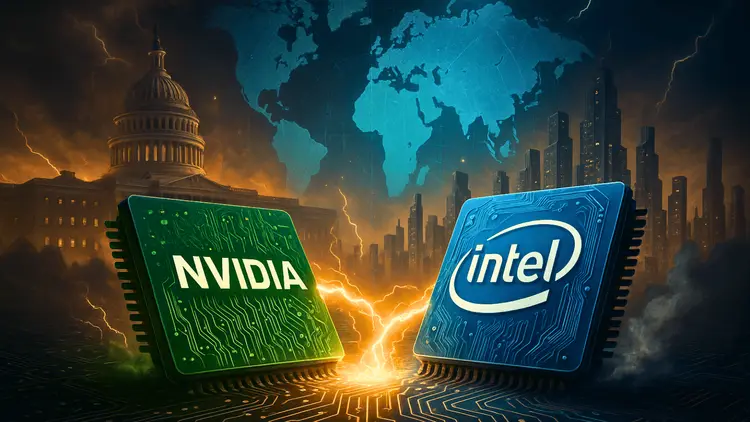
The global chip industry has a new alliance reshaping the balance of power. Nvidia, the reigning titan of artificial intelligence hardware, is taking a bold gamble on Intel with a $5 billion investment that immediately makes it one of the struggling company’s largest shareholders. The move goes beyond money. It signals a strategic partnership that could redraw lines across AI servers, data centers, and the consumer PC market.

Nvidia’s purchase of a 4 percent stake in Intel at $23.28 per share comes at a time when Intel has been scrambling for relevance after years of failed turnarounds. For Nvidia, flush with cash from its AI dominance, the deal provides political capital and a new operating partner in critical U.S. markets. For Intel, the investment is a validation that it can still matter in an industry where Taiwan’s TSMC and Nvidia itself have taken the spotlight.

The move follows Washington’s unusual decision just weeks ago to take a 10 percent government stake in Intel, a sign of how central the company is to America’s technological and national security ambitions. Together with SoftBank’s $2 billion injection earlier this year, Intel now has billions in fresh backing to reinvent itself.

Beyond Money: The Product Pact

The heart of the deal is not simply capital but a collaboration. Nvidia and Intel plan to co-develop multiple generations of PC and data center chips. At the center of this roadmap is proprietary technology that allows Intel CPUs and Nvidia GPUs to communicate at speeds never seen before. These faster links are crucial in AI servers, where thousands of chips must act as one brain to crunch massive data sets.

For consumers, Intel will gain access to a custom Nvidia graphics chip bundled with its PC processors, potentially giving it an edge over AMD in laptops and desktops. For data centers, Intel will design custom CPUs packaged with Nvidia’s AI chips, creating servers that could rival anything AMD or Broadcom are building.

The timing is just as important as the technology. Nvidia has been under fire over its strained business in China, where U.S. restrictions have throttled sales of its advanced H20 chips. The company even agreed to a deal brokered by President Donald Trump, giving Washington a 15 percent cut of any sales to China in exchange for limited export licenses.

By aligning itself with Intel and indirectly with the U.S. government’s industrial policy, Nvidia gains political cover at home. CEO Jensen Huang, seen alongside Trump during his state visit to the United Kingdom, is betting that this partnership could ease tensions with regulators who are wary of America’s AI crown jewel doing too much business with Beijing.

Pressure on Rivals

The losers in this pact are clear. AMD, which has been chipping away at Intel’s share of both PCs and data centers, now faces the specter of Intel leveraging Nvidia’s technology to claw back customers. AMD shares fell sharply after the news. Broadcom, which supplies chip-to-chip connection technology to hyperscalers like Google, could also see Nvidia and Intel squeeze into its turf.

Yet the bigger risk may fall on TSMC, which manufactures Nvidia’s current flagship processors. While the deal does not involve Intel’s foundry making Nvidia chips, analysts believe the possibility looms. If Nvidia ever shifts production from Taiwan to U.S. soil, it would deal a seismic blow to TSMC’s dominance and reshape the geopolitics of chip supply.

Intel’s New Philosophy

The partnership comes under the stewardship of Intel’s new CEO, Lip-Bu Tan, who took the reins in March. His early tenure has been turbulent, facing political scrutiny over his ties to China and calls for his resignation from Trump himself. But with government and corporate backing now secured, Tan has vowed to slim down operations and only build factory capacity when there is demand to match.

That pragmatic approach aligns with Nvidia’s strategy. The AI leader does not need Intel’s fabs immediately but values the potential of an onshore partner down the road. For now, the deal is about design, collaboration, and speed, not manufacturing.

Market Reaction

The markets spoke quickly. Intel shares soared more than 26 percent to over $31, while Nvidia gained 2 percent on the day. AMD fell nearly 5 percent, reflecting investor fears of a two-front war with both Intel and Nvidia aligned. Broadcom ticked higher as traders speculated it might win new business from hyperscale customers hedging against the Nvidia-Intel axis.

The partnership has not yet produced a release timeline, but Wall Street views the long-term implications as massive. By pooling Nvidia’s GPUs with Intel’s CPUs, the companies are building platforms designed to dominate the most lucrative sector of all—AI infrastructure.

Still, risks abound. Regulatory scrutiny will be fierce, given both the U.S. government’s stake in Intel and the geopolitical weight of semiconductors. Nvidia’s China troubles remain unresolved. And execution risk is real. Merging two product roadmaps, cultures, and technologies into seamless offerings will test both companies.

Yet the symbolism of this partnership is powerful. America’s most valuable chipmaker is betting that Intel, the once-proud giant, can rise again as its partner in the AI age. If successful, this $5 billion wager could mark the beginning of a new era in silicon, one where old rivals become allies to secure technological dominance.

Conclusion

Nvidia’s $5 billion stake in Intel is more than a financial bet. It is a strategic realignment that touches politics, technology, and global markets. For Intel, it represents hope and validation. For Nvidia, it provides political backing and a fresh partner in the AI wars. For competitors from AMD to TSMC, it is a warning shot. The deal underscores that in the semiconductor world, alliances shift quickly, and the battle for the future of computing is only getting started.

NvidiaIntel

Most Popular News

  1. SpaceX’s $8B Spectrum Deal Sends AT&T, Verizon, and T-Mobile Plummeting
  2. Is Project Vault Securing America’s Supply Chain or Squeezing It to the Breaking Point?
  3. Why Gautam Lohia Shifted from Global Consulting to Reboot a $20M Tech Micro-Cap
  4. Everyday Luxury, Unstoppable Scale: Aritzia Delivers 44% Net Revenue Growth
  5. Can Navy SEAL Leadership and Big Tech Scale Revolutionize Airborne Threat Detection?

Disclaimer


This report should not be viewed as investment advice or as an offer to buy or sell any securities or as an invitation or solicitation of an offer to buy or sell any securities. Neither the author of this report, its publisher, nor any other person associated with the publication of this report, are registered brokers, investment dealers, investment advisers, or financial advisers. The information in this report has not been tailored to the particular needs or circumstances of readers and should not be relied upon as investment advice or recommendations to purchase or sell any of the securities presented in this report. Readers seeking investment advice should contact qualified and registered brokers, investment dealers, investment advisers, or financial advisers prior to making any decision to buy or sell any of the securities referred to in this report. The information in this report should not be construed as investment, legal, or tax advice. No recommendation is made as to whether an investment in the presented securities is suitable for any reader in light of the reader’s particular circumstances.

Readers are cautioned that the publisher of this report covers exclusively securities that carry a high degree of volatility. Investing in such securities is highly speculative and carries a high degree of risk. Investors in such securities could lose all or a substantial portion of their investment. Only those investors who can afford to lose all or a substantial portion of their investment should consider investing in the securities referred to in this report.

This report may include information obtained from publicly available sources, including third-party reports or analysis. Neither the author nor publisher of this report, nor www.juniorstocks.com or its owners, have undertaken any independent investigation into the factual information used in this report, and the information in this report is provided without any warranty of any kind. No representations or warranties are provided regarding the accuracy or completeness of the information provided in this report. Statements of opinion or belief are those of the authors and/or publisher of this report. These statements of opinion or belief are expressions of the author’s and/or publisher’s judgment, and there is no guarantee that those judgments will turn out to be correct. No inference should be drawn that the author and/or publisher have any special or greater knowledge about the presented companies or their securities, or any particular expertise in the industries or markets in which the company operates. Readers should conduct their own due diligence and seek professional advice prior to investing in any securities presented on Juniorstocks.com.

Certain statements in this report constitute “forward-looking” statements. Forward-looking statements often, but not always, are identified by the use of words such as “seek,” “anticipate,” “believe,” “plan,” “estimate,” “expect,” “targeting,” and “intend” and statements that an event or result “may,” “will,” “should,” “could,” or “might” occur or be achieved and other similar expressions. Forward-looking statements express or involve discussions with respect to predictions, expectations, beliefs, plans, projections, objectives, goals, assumptions, or future events or performance; they are not statements of historical facts and should not be viewed as any guarantee of any future result. Forward-looking statements are based on expectations, estimates, and projections at the time the statements are made that involve a number of risks and uncertainties which could cause actual results or events to differ materially from those presently anticipated. The author and/or publisher of this report disclaims any obligation to update the forward-looking statements in this report, whether as a result of new information, future events, or results or otherwise. There is no assurance that forward-looking statements will prove to be accurate, as actual results and future events could differ materially from those anticipated in such statements. Accordingly, readers should not place undue reliance on forward-looking statements.

The information provided in this report is not intended for distribution to, or use by, any person or entity in any jurisdiction or country where such distribution or use would be contrary to applicable law or regulation, or would subject the author or publisher of this report to any registration requirement in such jurisdiction or country.

Information about the editor of this publication:
Juniorstocks.com is a service provided by Piccadilly Capital Group, Office 66, 101 Clapham High Street, London, SW4 7TB, UK. Piccadilly Capital Group is not the publisher of this report and was not paid for the publication of this report. Piccadilly Capital Group seeks to generate web traffic and a growing number of followers through the publication of articles or reports. Directors, officers, and other insiders of the publisher own an interest in Piccadilly Capital Group. Piccadilly Capital Group does not endorse or recommend the business, products, services, or securities of any company mentioned on www.juniorstocks.com. Piccadilly Capital Group will not share your information with any outside third parties. Due to the new data protection basic regulation, we ask you to read our data protection declaration carefully.

Note on copyright:
The contents published on this website and on connected media (e.g., e-mail, X, Facebook) are subject to applicable copyright and ancillary copyright laws. Any use not permitted by applicable copyright and ancillary copyright laws requires the prior written consent of the provider or the respective rights holder. In particular, this applies to the duplication, editing, translation, storage, processing, or reproduction of content in databases or other electronic media and systems. Contents and rights of third parties are marked as such. Unauthorized reproduction or transmission of individual contents or complete pages is not permitted and is punishable by law. Only the production of copies and downloads for personal, private, and non-commercial use is permitted. Links to the provider's website are always welcome and do not require the consent of the provider of the website. Photos and images on the website may not be shared unless the publisher itself has acquired the initial rights from authorized sources. The presentation of this website in external frames is only allowed with written permission. If you notice any violations, please inform us. Please note: The content of our articles, emails, or other publications or social networks such as X, LinkedIn or Facebook is exclusively intended for the designated addressee(s). If you are not the addressee of these articles, emails, or other publications in the market letter or social networks such as Twitter or Facebook or his or her legal representative, please note that any form of publication, reproduction, or distribution of the content of these articles, emails, or other publications in the market letter or social networks such as X, LinkedIn or Facebook is prohibited. Falsifications of the original content of this message during data transmission cannot be excluded in principle.