SPONSORED

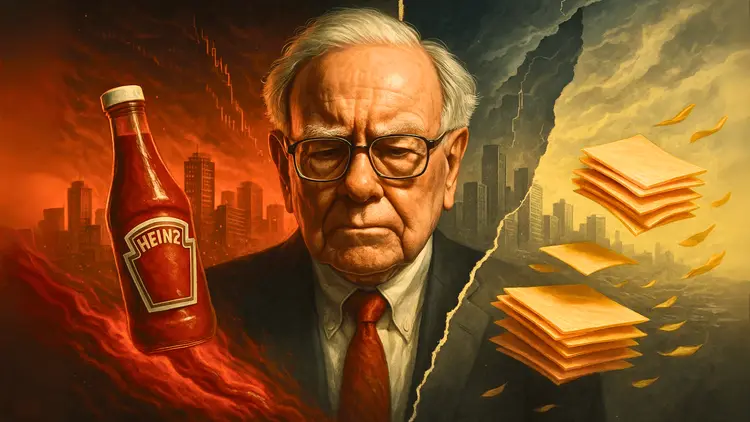
Warren Buffett’s Disappointment as Ketchup Runs One Way, Kraft Singles Another

Kraft Heinz splits into two as shifting consumer tastes force a rethink of the 2015 megamerger.
•• 1 Min
Warren Buffett’s Disappointment as Ketchup Runs One Way, Kraft Singles Another

Ten years ago, Kraft and Heinz joined forces to create one of the largest food manufacturers on the planet. The marriage of Heinz ketchup with Kraft Mac & Cheese was supposed to be unstoppable, a merger designed to dominate grocery shelves worldwide. Yet a decade later, the union has unraveled. Consumers moved on, choosing fresh, organic, and less processed options, while Kraft Heinz clung to nostalgia and scale. The company is now splitting into two entities, marking the end of a corporate experiment that never lived up to its promise.

The origins of Kraft Heinz’s megamerger trace back to Warren Buffett and 3G Capital. In 2013, they acquired H.J. Heinz for $23 billion, a deal that instantly signaled ambition. Two years later, they orchestrated a merger with Kraft, creating a $28 billion revenue powerhouse. It was hailed as the fifth-largest food and beverage company in the world, and Wall Street was dazzled. The theory was simple: cost cutting plus brand loyalty would drive lasting profits. But theories rarely hold up when tastes shift as quickly as they did in the 2010s.

A Decade of Decline

From the very start, Kraft Heinz struggled with the clash between consumer trends and its traditional offerings. Velveeta, Kool-Aid, Kraft Singles, and Oscar Mayer hot dogs no longer defined dinner tables the way they once did. Health-conscious shoppers wanted fewer preservatives and more authenticity. Store brands offered cheaper alternatives with little noticeable difference. Meanwhile, aggressive cost-cutting stripped away innovation, leaving the company unable to adapt. By 2019, Kraft Heinz was forced to slash the value of its brands by $15.4 billion, an admission that the strategy was failing.

Buffett’s Disappointment

Warren Buffett, whose Berkshire Hathaway owns a 27 percent stake, has openly admitted that he overpaid for Kraft Heinz. The deal, once celebrated, became one of his rare investment missteps. Berkshire has watched its stake lose billions in value as Kraft Heinz stock tumbled nearly 70 percent since the merger. Buffett opposed the split, frustrated both by the $300 million breakup cost and by the decision to exclude shareholders from a vote. Speaking to CNBC, Buffett put it bluntly: “It certainly didn’t turn out to be a brilliant idea to put them together, but I don’t think taking them apart will fix it.” He added that he was disappointed by the move, a rare flash of candor from one of the most patient investors in modern history.

The Breakup Plan

Kraft Heinz will divide into two companies. One, temporarily named Global Taste Elevation Co., will focus on high-growth, flavor-driven brands like Heinz sauces, Philadelphia cream cheese, and Kraft Mac & Cheese. The other, called North American Grocery Co., will oversee legacy grocery staples such as Oscar Mayer, Maxwell House, and Lunchables. Carlos Abrams-Rivera, the current CEO, will lead the North American business, while a new leader will be appointed to run the global arm. The split is expected to close in the second half of 2026, with both companies retaining headquarters in Chicago and Pittsburgh.

Kraft Heinz is not alone in its restructuring. Food giants across the industry have been breaking up, chasing agility in a marketplace that punishes sluggish conglomerates. Kellogg split into two, with Mars acquiring its snacks arm. Keurig Dr Pepper announced a similar move, dividing coffee and cold beverages. These separations reflect a broader truth: scale alone no longer guarantees success. Consumers now dictate the market with their wallets, and big food brands must move quickly or risk irrelevance.

For Kraft Heinz, the breakup represents a final attempt at reinvention. By separating high-growth brands from the slower, legacy portfolio, each company can focus on its strengths. Global Taste Elevation can chase international markets hungry for sauces and cream cheese, while North American Grocery can optimize familiar staples for cost-conscious households. Yet questions remain. Can either business reignite excitement in brands that many see as relics of another era? Or is this merely a cosmetic fix for deeper issues that money and restructuring cannot solve?

Conclusion

The undoing of the Kraft Heinz merger is more than a corporate maneuver. It’s a symbol of how quickly cultural and culinary tastes evolve, and how even the most iconic brands must keep pace. What began as a marriage of giants ends as a cautionary tale about scale, strategy, and the limits of nostalgia. Kraft Heinz’s next chapter will test whether legacy brands can be reborn or if they will remain reminders of a golden age that has long passed.

Warren BuffettKraft Heinz

Most Popular News

  1. SpaceX’s $8B Spectrum Deal Sends AT&T, Verizon, and T-Mobile Plummeting
  2. Is Project Vault Securing America’s Supply Chain or Squeezing It to the Breaking Point?
  3. Why Gautam Lohia Shifted from Global Consulting to Reboot a $20M Tech Micro-Cap
  4. Everyday Luxury, Unstoppable Scale: Aritzia Delivers 44% Net Revenue Growth
  5. Can Navy SEAL Leadership and Big Tech Scale Revolutionize Airborne Threat Detection?

Disclaimer


This report should not be viewed as investment advice or as an offer to buy or sell any securities or as an invitation or solicitation of an offer to buy or sell any securities. Neither the author of this report, its publisher, nor any other person associated with the publication of this report, are registered brokers, investment dealers, investment advisers, or financial advisers. The information in this report has not been tailored to the particular needs or circumstances of readers and should not be relied upon as investment advice or recommendations to purchase or sell any of the securities presented in this report. Readers seeking investment advice should contact qualified and registered brokers, investment dealers, investment advisers, or financial advisers prior to making any decision to buy or sell any of the securities referred to in this report. The information in this report should not be construed as investment, legal, or tax advice. No recommendation is made as to whether an investment in the presented securities is suitable for any reader in light of the reader’s particular circumstances.

Readers are cautioned that the publisher of this report covers exclusively securities that carry a high degree of volatility. Investing in such securities is highly speculative and carries a high degree of risk. Investors in such securities could lose all or a substantial portion of their investment. Only those investors who can afford to lose all or a substantial portion of their investment should consider investing in the securities referred to in this report.

This report may include information obtained from publicly available sources, including third-party reports or analysis. Neither the author nor publisher of this report, nor www.juniorstocks.com or its owners, have undertaken any independent investigation into the factual information used in this report, and the information in this report is provided without any warranty of any kind. No representations or warranties are provided regarding the accuracy or completeness of the information provided in this report. Statements of opinion or belief are those of the authors and/or publisher of this report. These statements of opinion or belief are expressions of the author’s and/or publisher’s judgment, and there is no guarantee that those judgments will turn out to be correct. No inference should be drawn that the author and/or publisher have any special or greater knowledge about the presented companies or their securities, or any particular expertise in the industries or markets in which the company operates. Readers should conduct their own due diligence and seek professional advice prior to investing in any securities presented on Juniorstocks.com.

Certain statements in this report constitute “forward-looking” statements. Forward-looking statements often, but not always, are identified by the use of words such as “seek,” “anticipate,” “believe,” “plan,” “estimate,” “expect,” “targeting,” and “intend” and statements that an event or result “may,” “will,” “should,” “could,” or “might” occur or be achieved and other similar expressions. Forward-looking statements express or involve discussions with respect to predictions, expectations, beliefs, plans, projections, objectives, goals, assumptions, or future events or performance; they are not statements of historical facts and should not be viewed as any guarantee of any future result. Forward-looking statements are based on expectations, estimates, and projections at the time the statements are made that involve a number of risks and uncertainties which could cause actual results or events to differ materially from those presently anticipated. The author and/or publisher of this report disclaims any obligation to update the forward-looking statements in this report, whether as a result of new information, future events, or results or otherwise. There is no assurance that forward-looking statements will prove to be accurate, as actual results and future events could differ materially from those anticipated in such statements. Accordingly, readers should not place undue reliance on forward-looking statements.

The information provided in this report is not intended for distribution to, or use by, any person or entity in any jurisdiction or country where such distribution or use would be contrary to applicable law or regulation, or would subject the author or publisher of this report to any registration requirement in such jurisdiction or country.

Information about the editor of this publication:
Juniorstocks.com is a service provided by Piccadilly Capital Group, Office 66, 101 Clapham High Street, London, SW4 7TB, UK. Piccadilly Capital Group is not the publisher of this report and was not paid for the publication of this report. Piccadilly Capital Group seeks to generate web traffic and a growing number of followers through the publication of articles or reports. Directors, officers, and other insiders of the publisher own an interest in Piccadilly Capital Group. Piccadilly Capital Group does not endorse or recommend the business, products, services, or securities of any company mentioned on www.juniorstocks.com. Piccadilly Capital Group will not share your information with any outside third parties. Due to the new data protection basic regulation, we ask you to read our data protection declaration carefully.

Note on copyright:
The contents published on this website and on connected media (e.g., e-mail, X, Facebook) are subject to applicable copyright and ancillary copyright laws. Any use not permitted by applicable copyright and ancillary copyright laws requires the prior written consent of the provider or the respective rights holder. In particular, this applies to the duplication, editing, translation, storage, processing, or reproduction of content in databases or other electronic media and systems. Contents and rights of third parties are marked as such. Unauthorized reproduction or transmission of individual contents or complete pages is not permitted and is punishable by law. Only the production of copies and downloads for personal, private, and non-commercial use is permitted. Links to the provider's website are always welcome and do not require the consent of the provider of the website. Photos and images on the website may not be shared unless the publisher itself has acquired the initial rights from authorized sources. The presentation of this website in external frames is only allowed with written permission. If you notice any violations, please inform us. Please note: The content of our articles, emails, or other publications or social networks such as X, LinkedIn or Facebook is exclusively intended for the designated addressee(s). If you are not the addressee of these articles, emails, or other publications in the market letter or social networks such as Twitter or Facebook or his or her legal representative, please note that any form of publication, reproduction, or distribution of the content of these articles, emails, or other publications in the market letter or social networks such as X, LinkedIn or Facebook is prohibited. Falsifications of the original content of this message during data transmission cannot be excluded in principle.