SPONSORED

US Hits Chinese Graphite With Massive 93.5% Tariff

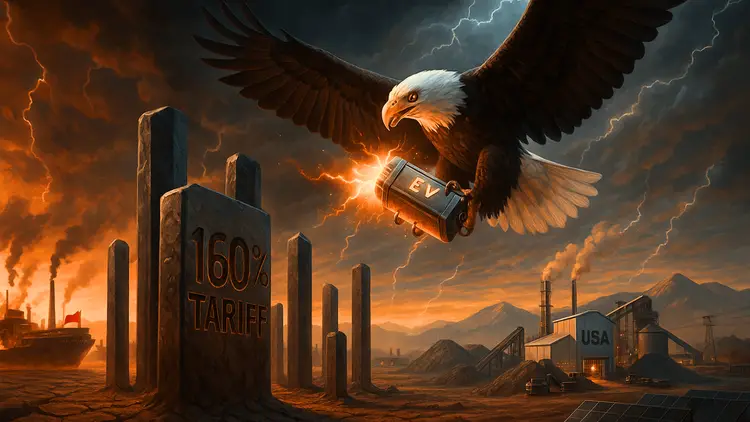
Tariff Tsunami: How a 160% Duty on Chinese Graphite Is Rewiring the EV Supply Chain and Sparking a North American Battery Boom
•• 1 Min
US Hits Chinese Graphite With Massive 93.5% Tariff

The United States has just fired a major shot in the global battery arms race. The Commerce Department announced it will impose a preliminary anti-dumping duty of 93.5% on Chinese graphite imports, a material crucial for electric vehicle batteries. When stacked on top of existing duties, the effective tariff soars to 160%. This decision, prompted by a petition from the American Active Anode Material Producers, marks a dramatic escalation in the ongoing economic contest between the US and China over control of the clean energy supply chain.

Graphite, often overlooked compared to lithium or cobalt, is the backbone of EV battery anodes. Nearly two-thirds of the 180,000 metric tons imported into the US last year came from China. Beijing’s dominance in this arena is profound, with the International Energy Agency warning that graphite is among the most vulnerable materials to supply disruptions. The US move to slap massive tariffs on Chinese graphite is more than a trade maneuver, it's a bold declaration of industrial independence and geopolitical posturing.

While the ruling provides a clear tailwind for emerging domestic producers, it simultaneously deals a body blow to EV manufacturers who depend on high-purity graphite imports. Analysts at CRU Group estimate the tariffs will add $7 per kilowatt-hour to the cost of an average EV battery cell. That figure erases up to 20% of the federal tax credits granted to automakers under the Inflation Reduction Act, and it could cripple quarterly profits for Asian battery giants like LG, SK On, and Panasonic.

Tesla, one of the loudest voices in opposition, saw its shares dip after the announcement. The company relies on Panasonic batteries, which in turn depend heavily on Chinese graphite. With few domestic alternatives meeting the quality and volume demands of mass EV production, US automakers are now staring down higher costs, possible delays, and strategic uncertainty.

But while carmakers groan, North American graphite miners are cheering. Shares of Syrah Resources, an Australian graphite producer, surged 38%, their biggest jump since 2023. Posco Future M, based in South Korea, rallied 24%. Canadian firms Nouveau Monde Graphite and Northern Graphite Corp. also saw double-digit gains, buoyed by the promise of a rebalanced supply chain less tethered to China.

Jon Jacobs, Chief Commercial Officer at Westwater Resources, framed the ruling as a turning point. His company is building a graphite processing facility in Alabama with production expected to begin next year. Backed by partnerships with Stellantis and SK On, Westwater plans to expand output from 12,500 metric tons to 50,000 by 2028. The market, he says, now has the clarity and policy support it needs to accelerate domestic capacity.

Still, not everyone in the renewable energy space is celebrating. Companies like Fluence Energy and Enphase Energy could see their input costs rise, as the graphite tariff ripples through the supply chain. Analysts at Roth Capital Partners believe this move may erode margins and slow project timelines, especially for grid-scale energy storage installations already grappling with high interest rates and complex regulatory hurdles.

Beneath the headlines, this latest move underscores a much larger strategic shift. The Biden and Trump administrations alike have embraced a more muscular industrial policy. The shift toward reshoring critical mineral supply chains is no longer a bipartisan wish list item. It is being written into law, embedded into tax codes, and enforced with the full might of trade regulations. The 160% duty on Chinese graphite isn’t just about fair pricing, it’s about reclaiming economic sovereignty in a world increasingly fractured along geopolitical lines.

Beijing has already placed export controls on several critical minerals, including gallium and germanium, and analysts expect further retaliation. Whether China will restrict graphite exports directly remains to be seen, but the risk now looms large. A tit-for-tat scenario would likely upend global EV timelines, force supply chain recalibrations, and push Western nations even faster toward domestic extraction and processing infrastructure.

According to the International Energy Agency, graphite will continue to dominate anode production until at least 2030, when silicon-based materials may start to gain market share. Until then, any choke point in graphite access spells trouble for every country betting big on a green transition. The US knows this, and its tariff announcement is as much a signal to allies and rivals as it is a policy enforcement measure. The message is loud and clear: the age of reliance on Chinese critical minerals is coming to an end.

Final decisions from the Commerce Department are expected by December 5, but the die may already be cast. Between congressional momentum, rising national security concerns, and mounting pressure from industry groups to de-risk battery supply chains, it’s unlikely Washington will reverse course. What began as a technical trade complaint has morphed into a key front in the economic war over energy dominance.

The next chapter won’t just be about tariffs. It will be about whether North America can scale its own graphite industry fast enough, clean enough, and competitively enough to match demand. Until then, automakers and battery suppliers will have to brace for volatility, cost increases, and a fundamental reshaping of their sourcing strategies.

Conclusion

This 93.5% tariff on Chinese graphite imports, with a total effective rate of 160%, is more than just a trade policy. It’s a declaration of industrial war, a reshaping of supply lines, and a new phase in the US effort to become energy-independent in the EV age. It pits domestic opportunity against global dependency, and policy clarity against market uncertainty. Whether this accelerates a new American battery boom or slows the EV revolution remains to be seen. But one thing’s clear: the graphite era just got a lot more interesting.

Most Popular News

  1. Lux Metals Ignites James Bay with 17.57 g/t Gold Intercept Over 19.5 Metres
  2. SpaceX’s $8B Spectrum Deal Sends AT&T, Verizon, and T-Mobile Plummeting
  3. Is Project Vault Securing America’s Supply Chain or Squeezing It to the Breaking Point?
  4. SSR Mining Snaps Up Roxmore Resources in $712 Million Nevada Gold Buyout
  5. Brunswick Exploration Unpacks 302-Metre Lithium Hit as Retail Traders Battle Over Valuation

Disclaimer


This report should not be viewed as investment advice or as an offer to buy or sell any securities or as an invitation or solicitation of an offer to buy or sell any securities. Neither the author of this report, its publisher, nor any other person associated with the publication of this report, are registered brokers, investment dealers, investment advisers, or financial advisers. The information in this report has not been tailored to the particular needs or circumstances of readers and should not be relied upon as investment advice or recommendations to purchase or sell any of the securities presented in this report. Readers seeking investment advice should contact qualified and registered brokers, investment dealers, investment advisers, or financial advisers prior to making any decision to buy or sell any of the securities referred to in this report. The information in this report should not be construed as investment, legal, or tax advice. No recommendation is made as to whether an investment in the presented securities is suitable for any reader in light of the reader’s particular circumstances.

Readers are cautioned that the publisher of this report covers exclusively securities that carry a high degree of volatility. Investing in such securities is highly speculative and carries a high degree of risk. Investors in such securities could lose all or a substantial portion of their investment. Only those investors who can afford to lose all or a substantial portion of their investment should consider investing in the securities referred to in this report.

This report may include information obtained from publicly available sources, including third-party reports or analysis. Neither the author nor publisher of this report, nor www.juniorstocks.com or its owners, have undertaken any independent investigation into the factual information used in this report, and the information in this report is provided without any warranty of any kind. No representations or warranties are provided regarding the accuracy or completeness of the information provided in this report. Statements of opinion or belief are those of the authors and/or publisher of this report. These statements of opinion or belief are expressions of the author’s and/or publisher’s judgment, and there is no guarantee that those judgments will turn out to be correct. No inference should be drawn that the author and/or publisher have any special or greater knowledge about the presented companies or their securities, or any particular expertise in the industries or markets in which the company operates. Readers should conduct their own due diligence and seek professional advice prior to investing in any securities presented on Juniorstocks.com.

Certain statements in this report constitute “forward-looking” statements. Forward-looking statements often, but not always, are identified by the use of words such as “seek,” “anticipate,” “believe,” “plan,” “estimate,” “expect,” “targeting,” and “intend” and statements that an event or result “may,” “will,” “should,” “could,” or “might” occur or be achieved and other similar expressions. Forward-looking statements express or involve discussions with respect to predictions, expectations, beliefs, plans, projections, objectives, goals, assumptions, or future events or performance; they are not statements of historical facts and should not be viewed as any guarantee of any future result. Forward-looking statements are based on expectations, estimates, and projections at the time the statements are made that involve a number of risks and uncertainties which could cause actual results or events to differ materially from those presently anticipated. The author and/or publisher of this report disclaims any obligation to update the forward-looking statements in this report, whether as a result of new information, future events, or results or otherwise. There is no assurance that forward-looking statements will prove to be accurate, as actual results and future events could differ materially from those anticipated in such statements. Accordingly, readers should not place undue reliance on forward-looking statements.

The information provided in this report is not intended for distribution to, or use by, any person or entity in any jurisdiction or country where such distribution or use would be contrary to applicable law or regulation, or would subject the author or publisher of this report to any registration requirement in such jurisdiction or country.

Information about the editor of this publication:
Juniorstocks.com is a service provided by Piccadilly Capital Group, Office 66, 101 Clapham High Street, London, SW4 7TB, UK. Piccadilly Capital Group is not the publisher of this report and was not paid for the publication of this report. Piccadilly Capital Group seeks to generate web traffic and a growing number of followers through the publication of articles or reports. Directors, officers, and other insiders of the publisher own an interest in Piccadilly Capital Group. Piccadilly Capital Group does not endorse or recommend the business, products, services, or securities of any company mentioned on www.juniorstocks.com. Piccadilly Capital Group will not share your information with any outside third parties. Due to the new data protection basic regulation, we ask you to read our data protection declaration carefully.

Note on copyright:
The contents published on this website and on connected media (e.g., e-mail, X, Facebook) are subject to applicable copyright and ancillary copyright laws. Any use not permitted by applicable copyright and ancillary copyright laws requires the prior written consent of the provider or the respective rights holder. In particular, this applies to the duplication, editing, translation, storage, processing, or reproduction of content in databases or other electronic media and systems. Contents and rights of third parties are marked as such. Unauthorized reproduction or transmission of individual contents or complete pages is not permitted and is punishable by law. Only the production of copies and downloads for personal, private, and non-commercial use is permitted. Links to the provider's website are always welcome and do not require the consent of the provider of the website. Photos and images on the website may not be shared unless the publisher itself has acquired the initial rights from authorized sources. The presentation of this website in external frames is only allowed with written permission. If you notice any violations, please inform us. Please note: The content of our articles, emails, or other publications or social networks such as X, LinkedIn or Facebook is exclusively intended for the designated addressee(s). If you are not the addressee of these articles, emails, or other publications in the market letter or social networks such as Twitter or Facebook or his or her legal representative, please note that any form of publication, reproduction, or distribution of the content of these articles, emails, or other publications in the market letter or social networks such as X, LinkedIn or Facebook is prohibited. Falsifications of the original content of this message during data transmission cannot be excluded in principle.