
Powell Under Pressure—Again
President Trump escalates a full-scale political attack on the Fed Chair, triggering a storm of resignations, accusations, and questions about central bank independence.
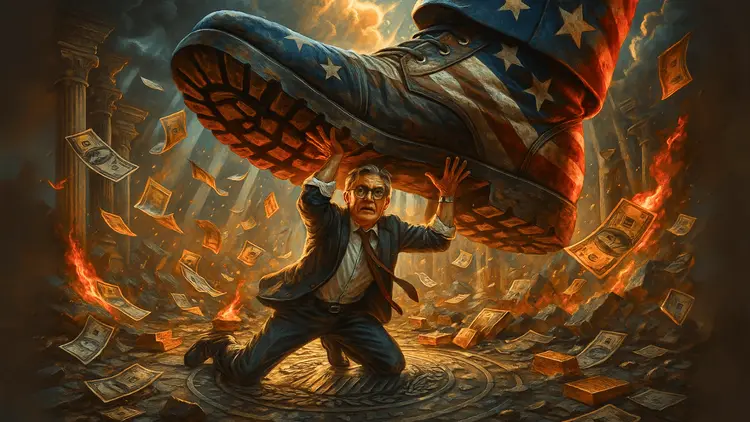
The Fed's independence faces political heat as Trump ignites a campaign against Powell
The simmering feud between Donald Trump and Federal Reserve Chair Jerome Powell has officially boiled over. In a late-night Truth Social post, President Trump didn’t mince words. “Jerome Powell should resign immediately,” Trump declared, escalating a full-blown pressure campaign that has intensified throughout the week.
It’s not the first time Trump has taken aim at the central bank’s top official, but this latest volley comes with a wave of coordinated criticism from his administration. At the heart of Trump’s frustration is the Fed’s refusal to cut interest rates more aggressively. He posted a note he personally wrote to Powell, saying “Jerome—You are, as usual, 'Too Late'” and accused him of costing the U.S. “a fortune.” The White House press secretary Karoline Leavitt even held up the note for the media to see during a briefing, underscoring the administration’s effort to make the critique impossible to ignore.
Mounting Pressure from Trump’s Inner Circle
Treasury Secretary Scott Bessent didn’t hold back either. In a round of TV interviews, Bessent likened the Fed to an elderly person afraid to fall again after a stumble. His metaphor struck a nerve, painting the Fed as paralyzed by caution while inflation, in his view, is being misinterpreted. “I guess this tariff derangement syndrome happens even over at the Fed,” Bessent quipped, referring to Powell’s concern that Trump’s tariff policies are likely to reignite inflation.
The attack wasn’t limited to economic policy. Federal Housing Finance Agency Director Bill Pulte joined the chorus, calling for a congressional investigation into Powell’s conduct and testimony regarding a costly renovation of the Fed’s Washington headquarters. Pulte accused Powell of political bias and deceptive testimony, stating his actions are grounds for removal “for cause.”
As these voices within the Trump administration grow louder, it’s becoming clear that this is more than just a policy dispute. It’s a strategic attempt to reshape the Fed’s leadership and direction ahead of a potentially transformative election year.
The Push for Powell’s Replacement Is Already Underway
Behind the scenes, discussions are already in motion about who might replace Powell once his term ends in May. A short list has emerged, featuring names like former Fed governor Kevin Warsh, National Economic Council director Kevin Hassett, Treasury Secretary Scott Bessent, former World Bank president David Malpass, and current Fed governor Christopher Waller.
Trump told reporters he had “two or three top choices,” adding to speculation that his administration is building a succession plan with urgency. One maneuver being floated would see the administration appoint a new Fed board member to fill the 14-year term being vacated by Adriana Kugler at the end of January. That appointee could then be elevated to chair when Powell’s term expires in May.
It’s a strategy that not only replaces Powell but reshapes the Fed for the long haul. But there’s a catch. Powell’s term as a member of the board of governors doesn’t end until 2028. Unless he voluntarily steps down, he could continue to influence monetary policy even without the chairmanship.
Powell’s Response: Stay the Course
For his part, Powell has remained measured, insisting he plans to complete his term as Fed chair, which ends in May 2026, and declining to say whether he would remain on the board until 2028. Speaking at a monetary policy panel in Portugal, Powell said he was focused on doing his job and dismissed the political pressure swirling around him. “The things that matter are using our tools to achieve the goals that Congress has given us—maximum employment, price stability, financial stability—and that’s what we focus on 100%,” he said.
The applause that followed his comments was telling. Despite the mounting political firestorm back home, Powell still commands respect within the global central banking community. He also addressed the issue of interest rates, noting the Fed could have already cut them if not for the inflationary pressures triggered by Trump’s own tariff regime. “We went on hold when we saw the size of the tariffs,” Powell said. “Essentially all inflation forecasts for the United States went up materially as a consequence of the tariffs.”
The Fed has already trimmed rates by a full percentage point in 2024, yet it’s held steady in 2025. Powell hinted that a rate cut at the upcoming July 28–29 meeting isn’t off the table, but added that everything depends on how inflation data evolves in the coming weeks.
The Political Stakes Are Growing
Trump has been walking a tightrope between saber-rattling and backpedaling. In April, he called for Powell’s “termination” in a furious post, only to clarify days later that he had “no intention of firing him.” That ambiguity has kept markets on edge and created a broader conversation about the independence of the central bank.
But Trump is clearly playing the long game. By mobilizing his administration against Powell and floating successors months in advance, he’s not just trying to push policy in his direction. He’s laying the groundwork for a Federal Reserve that aligns more closely with his economic vision—a vision rooted in looser monetary policy, lower rates, and a Fed that leans pro-growth even in the face of inflationary risks.
The Fed’s Independence Hangs in the Balance
The escalating pressure campaign signals a critical moment for central bank independence. The U.S. Federal Reserve, historically shielded from partisan politics, is now the epicenter of a public political battle. Trump’s unprecedented moves raise questions about how future administrations might influence Fed policy, especially if the Senate falls in line with executive preferences.
Powell, who has faced criticism from both sides of the aisle over his tenure, may now be the last line of defense against a full political takeover of U.S. monetary policy. Whether he serves out his full board term or not, his handling of this pressure will set a precedent for future Fed chairs.
For now, Powell remains focused. As he said in Portugal, “I want to hand over to my successor an economy in good shape. That’s what keeps me awake at night.”
It may not be the kind of bedtime story Trump wants to hear. But for Powell, it’s the job he signed up for—political pressure or not.
Conclusion
The clash between Trump and Powell is not just about rates, renovations, or even tariffs. It’s a high-stakes battle over control, influence, and the direction of U.S. economic policy. While Powell continues to hold the line on central bank independence, Trump is pushing hard to reshape the institution from within. The coming months could prove pivotal not just for the Fed, but for the entire financial system it anchors.