
U.S. Commits $1B to Rebuild Critical Materials Independence
A billion-dollar push to reclaim America’s mineral independence and lead the global critical materials race.
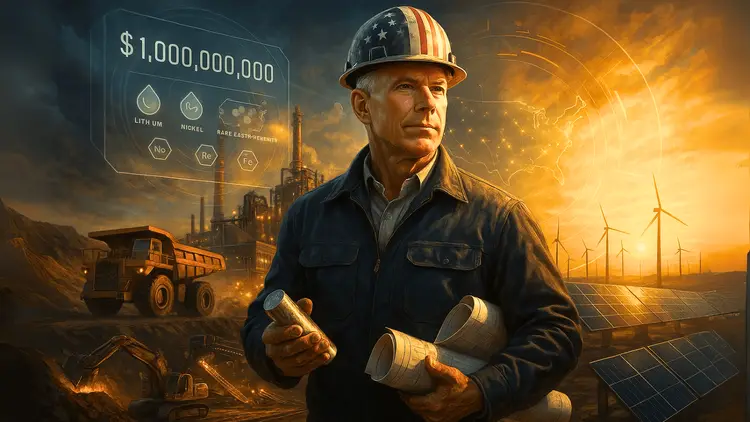
The U.S. Department of Energy has drawn a line in the sand. With a nearly $1 billion commitment to boost domestic mining, processing, and manufacturing of critical minerals, the agency is moving to end America’s deep dependence on foreign supply chains. This is not just an investment in technology; it is a strategic play to secure national security, energy independence, and industrial competitiveness for decades to come.
For too long, the United States has relied on overseas suppliers for materials vital to modern life, from rare earth elements powering defense systems to lithium in electric vehicle batteries. Secretary of Energy Chris Wright made it clear that this era of dependence is over, framing the initiative as a direct response to President Trump’s Executive Order Unleashing American Energy. The goal is to reshore the processing and production of these indispensable resources and put America back in control of its own energy future.
Four Funding Pillars to Transform the Supply Chain
The Department’s plan is anchored by four major funding opportunities that target every link of the critical minerals value chain. First is the Critical Minerals and Materials Accelerator, with up to $50 million to fast-track commercial technologies. This includes refining rare earth magnets, developing gallium and silicon carbide for semiconductors, and pushing cost-competitive direct lithium extraction methods into the market.
Second, the Mines & Metals Capacity Expansion program will inject $250 million into piloting the recovery of valuable mineral byproducts from domestic industrial operations. From coal-based industries to manufacturing plants, the aim is to turn waste into a resource stream and scale these solutions to commercial levels.
Third is the Rare Earth Elements Demonstration Facility, backed by up to $135 million to prove the viability of refining and recovering rare earths from mine tailings and waste materials on American soil. This initiative requires academic partnerships and a 50 percent cost-share, ensuring private sector skin in the game.
Finally, the largest tranche — up to $500 million — will go to the Battery Materials Processing and Recycling Program, expanding the U.S. capability to process lithium, nickel, copper, aluminum, graphite, and even rare earths found in spent batteries. This is about closing the loop, securing the front end of supply while building the recycling infrastructure to keep valuable minerals in circulation.
While mining is a cornerstone, the DOE is looking far beyond the pit. The ARPA-E RECOVER Program, with $40 million in funding, is taking aim at critical minerals hiding in plain sight — industrial wastewater. This program is designed to harvest valuable metals from what is currently discarded, creating a new, sustainable source of materials that complements traditional extraction.
Strategic Independence in a Geopolitical Race
The urgency is not just economic. Critical minerals have become a fulcrum of geopolitical leverage, with China currently dominating the global refining market. Securing domestic capacity ensures that America’s defense systems, clean energy infrastructure, and advanced manufacturing base cannot be held hostage to foreign policy shifts or supply chain disruptions.
Beyond security, the funding will drive high-tech innovation, create jobs in regions from Appalachia to the Mountain West, and inject new life into former industrial hubs. This is not just a mining policy — it is an industrial revival plan, linking resource extraction to high-value manufacturing and technology development.
The Road Ahead
These NOFOs are not simply grants; they are invitations to transform the industrial landscape of the United States. By targeting both the supply and recycling ends of the spectrum, the DOE is building a resilient, circular supply chain capable of weathering both market volatility and geopolitical storms.
In an era where the race for critical minerals is as consequential as the space race once was, this billion-dollar bet marks a turning point. The United States is signaling that it will not just compete in the global minerals market — it will lead it.
Conclusion
The Department of Energy’s sweeping funding initiatives are more than policy; they are a statement of intent. By securing critical mineral supply chains at home, America is not only safeguarding its energy future but redefining what it means to be a modern industrial power. This is the kind of decisive, long-term investment that could reshape the balance of power in both economic and security terms.