
Telecom’s New Power Couple: NVIDIA and Nokia Turn Up the Signal
NVIDIA’s $1 billion investment in Nokia sparks a new era in AI-driven telecommunications, setting the stage for America’s resurgence as a global leader in 6G innovation.
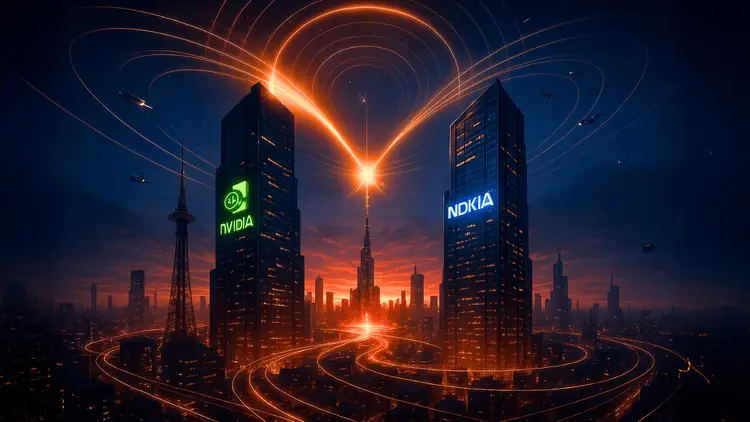
In a deal that could redefine the future of wireless communication, NVIDIA and Nokia have announced a groundbreaking strategic partnership aimed at ushering in the AI-native era of mobile networks. NVIDIA will invest $1 billion in Nokia at a subscription price of $6.01 per share to accelerate the transition from 5G to 6G through AI-driven Radio Access Networks (AI-RAN). The collaboration marks a historic moment for both companies and a potential turning point for America’s leadership in global telecommunications.
At the heart of this partnership lies a shared mission: to merge artificial intelligence and radio access infrastructure into one intelligent network fabric. NVIDIA’s newly introduced Aerial RAN Computer, or ARC-Pro, represents the foundation of this revolution. It’s a 6G-ready telecommunications computing platform that integrates connectivity, computing, and sensing into one cohesive system. Together with Nokia’s software-defined anyRAN architecture, the alliance aims to deliver a seamless upgrade path for operators transitioning from 5G to AI-native 6G networks.
NVIDIA CEO Jensen Huang captured the significance of this partnership by calling telecommunications the “digital nervous system of our economy and security.” With AI at the core of its architecture, Huang believes AI-RAN will not only redefine network performance but reassert the United States’ dominance in next-generation communications. “Built on NVIDIA CUDA and AI, AI-RAN will revolutionize telecommunications,” Huang said. “Together with Nokia and America’s telecom ecosystem, we’re igniting a revolution.”
For Nokia CEO Justin Hotard, the move is equally transformative. He described the shift not merely as an upgrade but as a complete redesign of telecommunications networks. “The next leap in telecom isn’t just from 5G to 6G—it’s a fundamental redesign to deliver AI-powered connectivity, capable of processing intelligence from the data center all the way to the edge,” Hotard said. Nokia’s first AI-RAN deployments with T-Mobile U.S. will bring these innovations to life, accelerating the rollout of AI-native mobile networks across the country.
T-Mobile’s involvement in the collaboration adds another layer of validation. John Saw, the company’s President of Technology, confirmed that field evaluations and testing will begin in 2026. Building on T-Mobile’s AI-RAN Innovation Center, these trials will assess real-world performance and efficiency gains. “Our collaboration with Nokia and NVIDIA marks an important step toward shaping the future of connectivity,” Saw said. “This initiative reinforces T-Mobile’s leadership in driving the U.S. wireless industry forward.”
Dell Technologies has also joined the effort, providing the muscle behind the machines. Its PowerEdge servers will power Nokia’s AI-RAN solution, enabling seamless scalability and software-defined upgrades. Michael Dell framed the opportunity in broader terms, emphasizing the importance of the network edge in the AI economy. “The telecommunications industry owns the most valuable real estate for AI—the edge, where data is created,” Dell said. “This AI-RAN collaboration makes that potential real.”
The implications for the industry are enormous. According to Omdia, the AI-RAN market could exceed $200 billion by 2030. By integrating AI and RAN workloads on a unified software-defined infrastructure, Nokia and NVIDIA are positioning operators to monetize AI-driven services at scale. From generative AI applications to agentic and physical AI devices, the new networks promise to handle the exponential growth in mobile AI traffic that already accounts for nearly half of ChatGPT’s 800 million weekly mobile users.
NVIDIA’s ARC-Pro platform is designed to future-proof investments. It allows network functions and AI services to coexist and evolve through software updates, ensuring continuous innovation without the need for costly hardware replacements. Nokia’s AirScale baseband architecture will also adapt to this new paradigm, supporting both Cloud RAN and purpose-built RAN environments in a hybrid model that simplifies upgrades.
This partnership is not just about faster connections or lower latency—it’s about turning every cell tower into an AI engine. By hosting distributed edge AI inference at scale, telecom operators can process intelligence closer to the source, reducing data bottlenecks while boosting performance and energy efficiency. It’s the kind of evolution that turns networks into living, learning organisms capable of adapting in real time.
In essence, NVIDIA and Nokia are laying the digital foundation for the AI-native wireless era. As Huang put it, this is a generational platform shift that empowers the United States to regain global leadership in one of the most strategic industries of the 21st century. With T-Mobile testing the first AI-RAN deployments and Dell providing the compute backbone, this alliance could redefine how intelligence moves through the airwaves.
The vision is clear: a world where your phone, car, drone, or augmented-reality glasses connect to a network that doesn’t just transmit data—it understands it. With AI-RAN at its core, 6G won’t just be faster; it will be fundamentally smarter, creating the intelligent infrastructure needed for the next decade of innovation.
Conclusion
NVIDIA’s $1 billion bet on Nokia represents more than a financial investment—it’s a national one. It signals America’s return to the forefront of telecommunications innovation through AI. With the combined strengths of NVIDIA’s computing power, Nokia’s network expertise, Dell’s infrastructure, and T-Mobile’s field leadership, this partnership sets the stage for an AI-native revolution in global connectivity. As 6G dawns, the world isn’t just getting a new generation of networks—it’s getting a new kind of intelligence woven into its very fabric.