
JP Morgan Says Gold Could Hit $8,000 by 2028: The Supercycle Awakens
JP Morgan turns ultra-bullish on gold, forecasting a record-breaking climb to $5,055 by late 2026 — and hinting at $8,000 by 2028 as central banks keep stacking bullion and investors hedge against dollar decay.
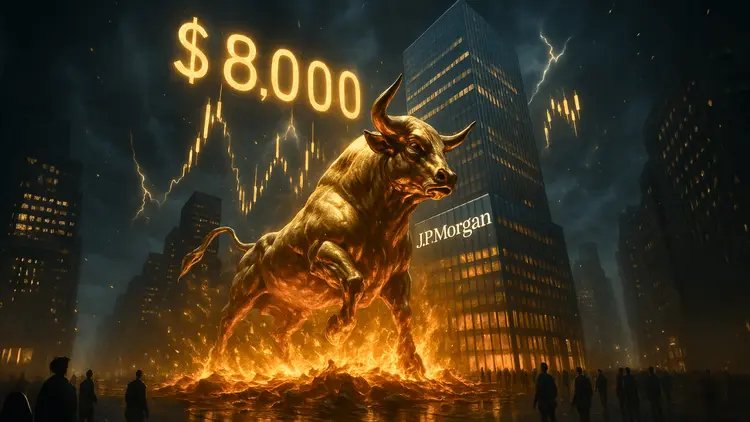
In the glittering world of commodities, gold has always been the ultimate drama queen, shining brightly in times of turmoil, then coyly retreating when the economy plays nice. But if JP Morgan's latest crystal ball gazing is anything to go by, the yellow metal is gearing up for its biggest act yet. Forget the doomscrolling headlines about a potential crash; the banking giant is betting big on gold's ascent, projecting an average price of $5,055 per ounce by the fourth quarter of 2026, fueled by relentless central bank hoarding and investors treating it like the ultimate insurance policy against stock market jitters. That's no small potatoes... we're talking a surge from today's lofty perch around $4,381 per ounce, where it's already notched a jaw-dropping 57% year-to-date gain, outpacing even the most hyped tech stocks.
Let's rewind a bit, because JP Morgan hasn't always been this bullish. Earlier in 2025, their analysts were calling for gold to hit $3,675 per ounce by the end of this year and cross the $4,000 mark by mid-2026, citing everything from U.S.-China trade tensions to a weakening dollar as rocket fuel. Fast forward to October 23, 2025, and they've upped the ante, baking in expectations of steady demand at around 566 tonnes per quarter from central banks and investors alike. Why the upgrade? Blame it on the Federal Reserve's rate-cutting spree, stagflation worries, and a subtle shift away from the almighty dollar, what JP Morgan cleverly dubs a "dollar diversification story" rather than outright de-dollarization. As Natasha Kaneva, the bank's head of Global Commodities Strategy, puts it, gold remains their "highest conviction long" as we wade into uncertain waters.
But here's where it gets spicy: whispers from JP Morgan strategists suggest gold could double in just three years, potentially eclipsing $8,000 per ounce by 2028 if investors ramp up their hedging game. That's not the base case, more like a plot twist in a bullish scenario where foreign holders trim their U.S. asset exposure from 45% to 43%, funneling even a sliver (half a percentage point) into gold. In that world, prices could sprint to $6,000 first, but with enough momentum from geopolitical risks and inflation fears, $8,000 isn't out of the question. Even CEO Jamie Dimon chimed in earlier, musing that holding gold makes "semi-rational" sense right now, with potential spikes to $5,000 or even $10,000 amid sky-high asset prices across the board.
Now, about that eye-popping $60 trillion asset valuation floating around... it's not as far-fetched as it sounds, but let's crunch the numbers with a wink. The world's above-ground gold supply hovers around 212,000 metric tons, or roughly 6.82 billion troy ounces. At today's prices, that's a cool $28-30 trillion market. Pump it up to $8,000 per ounce, and you're looking at about $54.6 trillion, close enough to $60 trillion if you factor in slight variations in supply estimates or a dash of optimism. Achieving this in three years would require sustained demand without major mining booms or shifts to rivals like Bitcoin, turning gold into a veritable trillion-dollar titan. It's the kind of forecast that makes even seasoned investors pause and polish their bullion – after all, in a world of equity risks and policy pivots, gold's timeless allure might just be the hedge we didn't know we needed.
Of course, not everyone's popping champagne. Rivals like Goldman Sachs are sticking to a more modest $4,900 per ounce by end-2026, emphasizing central bank demand but warning of profit-taking dips. And recent market jitters, including gold's biggest one-day drop in over a decade, remind us that even kings can stumble. Yet, with JP Morgan leading the charge, the narrative is clear: gold isn't just surviving; it's thriving in chaos.