
Robert Friedland Warns: The World Is Sleepwalking Into a Copper Crisis
Robert Friedland warns that the world’s energy transition is heading straight into a copper supply crunch, one that could reshape economies, politics, and the future of electrification itself.
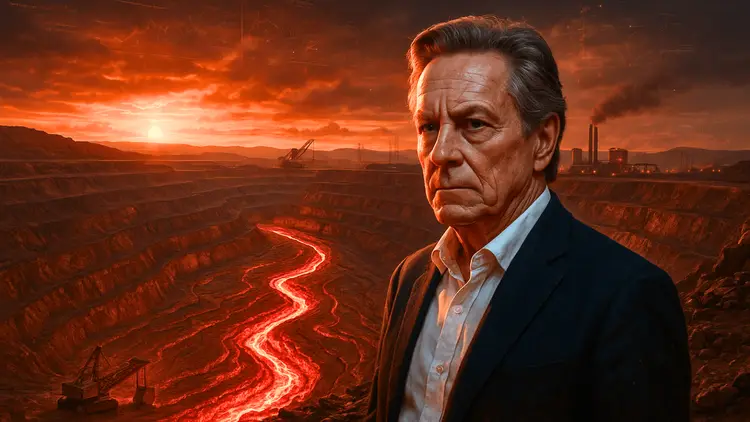
Robert Friedland, one of the most influential figures in global mining, is sounding the alarm on what he calls an unavoidable copper crunch that could reshape the entire world economy. Speaking from decades of experience building resource empires across continents, Friedland warns that the scale of demand for copper now hurtling toward the horizon dwarfs anything humanity has ever faced before. Over the next 18 years, he predicts, the world will need to mine as much copper as it has extracted throughout the past 10,000 years combined. It is, in his words, “a once-in-history challenge for civilization.”
Friedland has been preaching this message for years, and the numbers have finally caught up with his warnings. Copper, long seen as the “metal of electrification,” has become the lifeblood of global industry, woven through everything from smartphones and renewable grids to the heart of military infrastructure. The red metal now sits at the very center of both economic growth and national security.
Copper’s Surge and the Economics of Scarcity
As of October 2025, copper trades above $5 per pound, or roughly $11,130 per tonne, marking a staggering 55 percent jump from prices five years ago. Yet, according to Friedland, this is still far from enough. “Nine thousand dollars a tonne is not enough to take the risk,” he said in late 2023, insisting that copper needs to hit $15,000 per tonne to justify the immense capital costs of building new mines. Despite the rally, global production remains constrained, exploration budgets lag behind demand, and permitting delays stretch across decades.
At the heart of the crisis lies a simple equation: demand is soaring while supply can’t keep up. According to S&P Global, at current consumption rates, roughly 700 million tonnes of copper mined over the entirety of human history will need to be matched again by 2043 just to sustain modest global GDP growth of 3.5 percent annually. “This is the revenge of the old economy,” Friedland said, echoing his 2021 remarks. “For two decades, not enough capital has gone into finding the metals we need for the energy transformation.”
The mining sector’s decades-long underinvestment, paired with environmental resistance and regulatory gridlock, has built a time bomb. Friedland’s warning is not just about price but survival—about whether the global economy can continue expanding without the metal that makes modern life possible.
The Strategic Metal of the 21st Century
Copper’s importance now extends far beyond its economic value. Friedland has repeatedly emphasized its role in national defense, drawing parallels between metal scarcity and geopolitical vulnerability. In a recent appearance, he pointed to shortages of 155-millimetre artillery shells—vital to U.S. and NATO operations—as an example of how copper scarcity can impact national security. “If somebody’s pointing a gun at you, you need that copper to shoot back,” he remarked earlier this year.
That stark reality is pushing the United States and its allies to confront a painful truth: they have allowed critical mineral supply chains to atrophy. While nations like China, Chile, and the Democratic Republic of Congo dominate the copper trade, the U.S. has not opened a major new copper mine in decades. The dependence on foreign sources, many located in politically unstable regions, has become a direct threat to both economic stability and national defense.
Friedland Regains Control and Refocuses
In a strategic move that signals his long-term commitment to the sector, Friedland has regained control over a significant chunk of Ivanhoe Mines shares—his flagship company and one of the world’s premier copper producers. It’s a symbolic consolidation of power, suggesting Friedland is positioning himself for the next great wave of resource development.
Ivanhoe’s Kamoa-Kakula complex in the Democratic Republic of Congo is already one of the richest copper deposits on Earth. But even with world-class projects like that, the industry cannot bridge the coming supply gap. The pipeline of new mines remains dangerously thin, and the long lead times—from exploration to production—mean that even aggressive investment today won’t produce sufficient output for a decade or more.
Friedland’s renewed control over Ivanhoe is therefore more than corporate housekeeping. It’s a statement of belief in copper’s future and a warning that those who underestimate the looming shortage will miss the defining investment story of the next generation.
Policy Shifts and Political Will
Friedland also sees a shift in political winds, particularly in the United States, where the government is rediscovering the importance of resource security. “Speaking as a miner, we see a lot more government support,” he noted, praising the Trump administration’s renewed focus on securing domestic raw materials. “The new administration is correctly focused on making sure the world’s largest economy has stable access to raw materials at the scale of that economy.”
After decades of neglect, the message is finally resonating in Washington. Copper is no longer just a commodity—it’s a strategic asset, critical to the defense, infrastructure, and energy future of the nation. Policymakers are beginning to understand that without copper, there is no energy transition, no electrification, and no modern industry.
The Powder Keg of Demand
As copper prices climb closer to Friedland’s long-term projections, investors are starting to see what he has been warning about for years: that the demand curve for copper is almost vertical. The global race to electrify everything—from electric vehicles to renewable power grids—has created what Friedland describes as “a powder keg ready to explode.”
In his view, copper demand is “essentially infinite” because there is “no rational price for something you absolutely must have.” That perspective captures the essence of the crisis. The world’s transition to clean energy is colliding with the physical limits of extraction. Mines are deeper, grades are lower, and geopolitical tensions are rising. The result is a metal market that’s entering uncharted territory.
The Coming Era of Copper Nationalism
If Friedland is correct, the coming decade will see the rise of copper nationalism. Nations with significant deposits—like Peru, Chile, the DRC, and Canada—will find themselves at the center of a geopolitical tug-of-war. Governments may begin hoarding supply, restricting exports, or leveraging copper as a diplomatic weapon. The U.S., in turn, may have to respond with aggressive incentives for domestic mining, mirroring the industrial policies that already exist for semiconductors and batteries.
This shift could also rewire global trade patterns. Latin America, Africa, and Canada will likely become battlegrounds for capital and influence, as superpowers compete to secure future supply. Friedland’s own career, which spans multiple continents, reflects this reality. He has long operated in frontier markets others shy away from—because he understands that’s where the future will be mined.
The Verdict: A Call to Action
Robert Friedland’s message is clear and urgent. The world’s economic ambitions cannot be achieved without copper, yet humanity has failed to prepare for the scale of demand that lies ahead. Prices will rise, politics will shift, and the competition for supply will intensify. But for Friedland, this is not merely a challenge—it’s an opportunity. For investors, governments, and miners willing to act decisively, the coming copper crisis may well define the next era of global growth.
In his words, “We are entering an age where the old economy strikes back. The world is rediscovering that you can’t build an electric future without digging in the dirt.”
Conclusion
The global copper crisis Robert Friedland has long predicted is no longer theoretical. It is unfolding in real time. From rising prices to strategic realignments, the red metal’s future will shape the trajectory of nations, industries, and economies. Friedland’s foresight and influence ensure that his voice will remain central to this debate, as the world grapples with a paradox that defines our age: the cleaner the future we want, the deeper we must dig to get there.