
Pentagon Opens Military Bases for Private Critical Mineral Refining Plants
Behind the Guard Gates: How the Pentagon is Bypassing Local Red Tape and Redefining Supply Chain Sovereignty
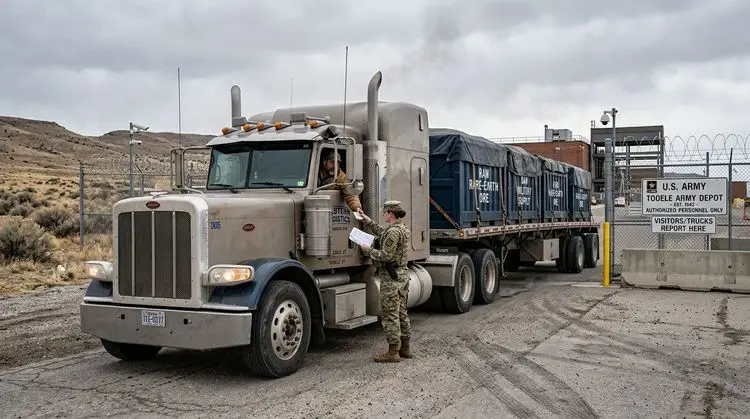
The Pentagon is opening its gates to an entirely new kind of recruit: heavy industrial processing plants. In an unprecedented strategy to circumvent local environmental red tape and shield the supply chain from overseas volatility, the US Army will allow several companies to build critical mineral facilities directly on active military installations across the country. The initiative marks a first-of-its-kind adaptation of federal property, driven by a second-term push from the Trump administration to systematically eliminate reliance on foreign mineral imports, particularly from China.
Building modern chemical and mineral processing plants is notoriously expensive, slow, and a magnet for local opposition. By shifting operations onto active military land, the federal government secures built-in security, streamlined logistical networks, and insulation from localized zoning disputes that traditionally stall industrial mining projects for a decade. This unusual real estate strategy was foreshadowed when President Donald Trump signed an executive order invoking emergency powers to accelerate the country's critical mineral manufacturing capabilities, and it is now materializing inside the fences of several secure military facilities.
A select group of companies has reached agreements with the Pentagon to set up these highly secured operations, handling graphite, rare earth minerals, lithium, and boron. These materials are absolutely essential to everything from fighter jet guidance systems and military hardware to electric vehicle batteries and everyday consumer electronics.
Among the first wave of companies setting up shop is REalloys Inc. (NASDAQ: ALOY), which plans to construct a rare-earth separation facility at the Tooele Army Depot in Utah. The output from this facility will be stockpiled directly on-site for immediate military utilization, focusing heavily on the specific rare earths required for heat-resistant permanent magnets used in defense and automobiles. This facility is moving ahead entirely via private capital rather than taxpayer funding, with the company recently raising $100 million in a private placement of common stock.
Simultaneously, Titan Mining Corp. (TSX: TI), a mining firm backed by Canadian billionaire Richard Warke with existing zinc and graphite assets in New York, will build and operate graphite purification plants across two separate bases: the Pine Bluff Arsenal in Arkansas and the Anniston Army Depot in Alabama. Graphite remains the single heaviest component in modern battery anodes, making it a critical choke point in the energy and defense sectors where China historically holds a near-monopoly.
The domestic push also extends into energy storage and advanced materials with agreements secured by Energy Exploration Technologies Inc. and Sydney-based ioneer Ltd. (NASDAQ: IONR). While Energy Exploration Technologies Inc. will focus on developing a lithium processing plant, ioneer Ltd. (NASDAQ: IONR) holds the distinction of being the sole non-US company involved in this initial cohort, tasked with constructing a boron facility. The exact base locations for these two plants are currently awaiting official public announcement.
This domestic pivot is unrolling against a backdrop of intense geopolitical friction and economic chess moves. China’s Commerce Department recently struck back by imposing rigid export controls on key American rare earth players, including MP Materials Corp. (NYSE: MP) and USA Rare Earth Inc. (NASDAQ: USAR). Prior to these restrictions, USA Rare Earth Inc. (NASDAQ: USAR) had signed an accord for $1.6 billion in funding to expand mining, processing, and magnet-making capacity. In tandem, the Group of Seven nations collectively established firm targets to systematically untangle their supply lines from Chinese imports.
To insulate the country against sudden supply shocks, the federal government revealed a blueprint to construct a massive $12 billion stockpile of critical minerals. Financing is already flowing rapidly through the Department of War’s Office of Strategic Capital, which recently approved a $725 million conditional loan to Energy Fuels Inc. (NYSE American: UUUU) alongside a $500 million conditional loan to Phoenix Tailings Inc. Armed with federal backing, Energy Fuels Inc. (NYSE American: UUUU) immediately consolidated its market position by striking a massive $1.9 billion deal to acquire the premium German rare-earth magnet supplier Vacuumschmelze GmbH & Co. This acquisition expands American influence over critical processing networks across Germany, Finland, and a newly commissioned plant in South Carolina. By nesting processing plants inside the literal walls of the US military, Washington is signaling that critical minerals are no longer just commodities, they are high-stakes national security assets.
Source Material
This article is compiled based on factual reporting published by Bloomberg News, authored by Jacob Lorinc, detailing the US Army's critical mineral base onshoring initiative.