
CIBC Joins the Gold Bulls, Forecasting a Multi-Year Run Above US$4,500
CIBC predicts gold’s bull run is far from over, forecasting a $4,500 plateau through 2027 as inflation, politics, and global uncertainty ignite a modern gold rush.
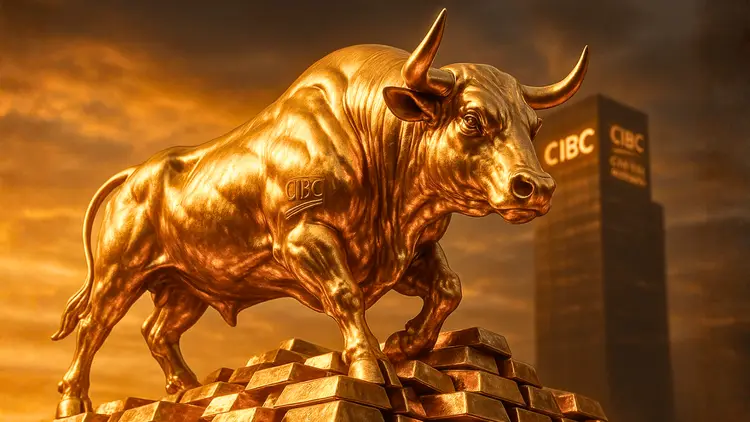
Gold’s unstoppable run has entered a new era, with CIBC Capital Markets forecasting the metal to surge to US$4,500 per ounce by 2026 and remain elevated through 2027. Following a blistering 2025 rally that has seen bullion soar more than 50% year-to-date, analysts believe the world is witnessing not just a price cycle, but a paradigm shift in global trust and monetary stability.
The Gold Rush Reborn
In early October 2025, gold futures (COMEX: GC=F) broke through the US$4,000 per ounce barrier for the first time in history. It was more than a milestone—it was a signal. From retail investors to sovereign wealth funds, capital flooded toward the yellow metal as inflation fears, political turmoil, and monetary uncertainty converged.
According to Anita Soni, analyst at CIBC Capital Markets, the metal’s trajectory isn’t a fleeting trend. In her latest research note, Soni projected gold prices would rise to US$4,500 in 2026 and 2027, before easing slightly to US$4,250 in 2028 and US$4,000 by 2029. “We continue to expect a positive macroeconomic setup for gold,” she wrote, pointing to tariff uncertainty and the delayed effects of U.S. economic slowdowns as long-term bullish drivers.
Fed, Trump, and the Inflation Dilemma
Gold’s record-breaking ascent has come amid one of the most politically charged economic environments in decades. U.S. President Donald Trump’s renewed push for aggressive rate cuts appears to have swayed the Federal Reserve, led by Chair Jerome Powell, to act sooner than markets expected. Last month, the Fed delivered its first cut since December 2024—a move that CIBC says has shifted market expectations toward another 50 basis points of easing before year-end.
“Powell seemingly yielded to Trump’s will to cut rates sooner rather than later, despite sticky inflation,” Soni observed. The implication is clear: political pressure has begun to erode the Fed’s independence, and with it, market confidence in long-term price stability.
That erosion of faith has turbocharged gold’s rise. “The parabolic shift we’re seeing,” Soni added, “reflects not just rate cuts, but deep-seated fears about inflation and the preservation of wealth.”
Inflation: The Invisible Tax That’s Back
Inflation in 2025 has become the silent enemy of the global economy. Despite cooling commodity prices in some sectors, core inflation remains uncomfortably high, gnawing away at real returns. As consumers grapple with shrinking purchasing power—exacerbated by tariffs and global supply chain friction—investors have rediscovered the enduring appeal of hard assets.
Gold, in this environment, isn’t merely a hedge. It’s a statement—a rejection of fiat fragility and political monetary management. As the U.S. government runs record deficits and the dollar’s purchasing power weakens, gold has reclaimed its ancient reputation as the one asset class that cannot be printed, sanctioned, or defaulted upon.
Geopolitics Fans the Flames
The global backdrop has done little to calm nerves. The U.S. government shutdown, unrest in France, and Russia’s ongoing war in Ukraine have all combined to push investors further into defensive positions. Add in elevated central bank gold buying—particularly by China, Turkey, and India—and you get a self-reinforcing feedback loop that keeps demand robust even as prices hit new highs.
“The world feels unstable, and when that happens, gold becomes the most rational trade on the board,” said one senior commodities trader. “It’s not speculation—it’s preservation.”
Gold Stocks Light Up the Markets
As bullion prices climb, mining equities are delivering blockbuster returns. Gold producers have become the torchbearers of the S&P/TSX Composite Index (^GSPTSE), propelling Canada’s benchmark to fresh highs.
Among CIBC’s top large-cap picks are:
- Agnico Eagle Mines Ltd. (TSX: AEM | NYSE: AEM)
- Kinross Gold Corp. (TSX: K | NYSE: KGC)
- Wheaton Precious Metals Corp. (TSX: WPM | NYSE: WPM)
- Franco-Nevada Corp. (TSX: FNV | NYSE: FNV)
These names have seen a flood of institutional inflows. Analysts point out that they combine strong balance sheets with operational leverage to gold, giving them significant upside in a sustained high-price environment.
Meanwhile, Newmont Corp. (NYSE: NEM), the world’s largest gold miner, continues to attract attention for its scale and free cash flow potential. RBC Capital Markets analyst Josh Wolfson projects both Agnico Eagle and Newmont will report record free cash flow in Q3 2025, reinforcing the sector’s newfound financial strength.
The Institutional Stampede
The rally isn’t just retail-driven. Major institutions are also climbing aboard. Goldman Sachs recently raised its 2026 target for gold to US$4,900 per ounce, up from US$4,300, while Wheaton Precious Metals’ CEO told Bloomberg that US$5,000 gold within a year is now a realistic possibility.
Once seen as a relic of the past, gold has become the backbone of modern risk management portfolios. Hedge funds, sovereign wealth funds, and even pension plans are reallocating portions of their portfolios to physical gold and mining equities, betting that inflation will prove far more persistent than policymakers admit.
Central Banks: The Quiet Accumulators
In the background, central banks are quietly reshaping the global monetary order. According to the World Gold Council, official sector demand for gold has surged to its highest level in more than 50 years. Countries are diversifying away from U.S. Treasuries, accumulating bullion as a geopolitical hedge.
This trend—especially pronounced in China and Russia—signals that the metal’s resurgence isn’t just about inflation, but also about sovereignty. Gold is once again the asset of nations, not just investors.
The Long Game: What $4,500 Gold Really Means
CIBC’s projection isn’t just a bullish bet on price—it’s a warning about the world’s economic direction. A sustained gold price of US$4,500 suggests investors have lost confidence in traditional monetary anchors. It signals a world where policy, politics, and printing presses have merged, blurring the line between economics and ideology.
If inflation remains sticky and central banks keep easing under political pressure, that forecast may even prove conservative. In that case, the next leg of the rally could be driven less by euphoria and more by necessity. Conclusion
Gold’s renaissance is both financial and philosophical. From traders in New York to miners in Nunavut, the message is the same—gold has reasserted itself as the world’s default store of value. CIBC’s call for US$4,500 gold isn’t merely about numbers; it’s about a shift in trust, power, and policy.
As the global economy walks a tightrope between inflation and instability, gold once again stands as the anchor when everything else feels adrift.