
Is Tungsten the New Lithium? Inside the 557% Market Squeeze
Chinese export controls and skyrocketing military demand have sent this super-dense critical metal into a historic squeeze, leaving Western supply chains scrambling for solutions.
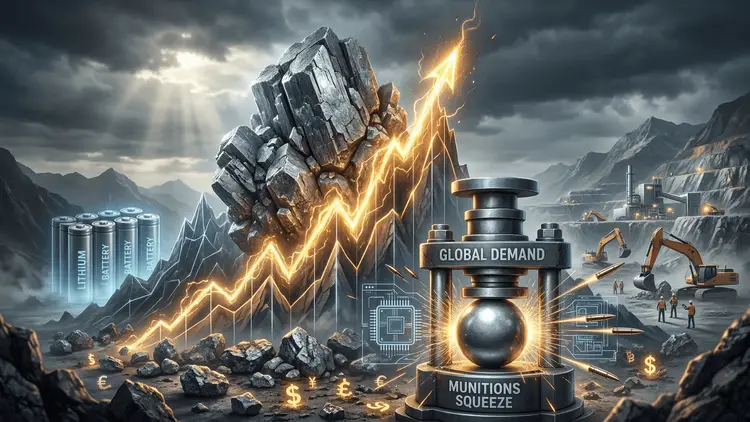
If you are looking for the hottest commodity on the market right now, you might want to stop staring at gold and copper. The undisputed heavyweight champion of the 2026 metals market is tungsten.
A super-dense material critical for both advanced semiconductors and armor-piercing weaponry, tungsten has suddenly found itself at the dead center of escalating geopolitical tensions. Driven by strict Chinese export limits and a surge in global military demand, prices have gone parabolic. According to the APT European benchmark from Fastmarkets, tungsten has more than doubled in value just this year, trading at an eye-watering $2,250 per metric ton unit. That represents a staggering 557% price rally since Beijing placed specific tungsten products on its export control list in February of last year.
The Heavyweight Squeeze
The underlying mechanics of this squeeze are as fascinating as they are frustrating for Western manufacturers. Over the last few decades, the United States and European industrial bases grew highly dependent on cheap, state-subsidized Chinese tungsten. In fact, the US has not mined the metal commercially since 2015. With China previously accounting for 79% of the 85,000 metric tons produced globally, Beijing's decision to weaponize its market dominance in ongoing trade disputes has effectively choked off global supply.
Chinese shipments of restricted tungsten products plummeted by roughly 40% last year, according to London-based research firm Project Blue. The resulting panic is palpable. George Heppel, an analyst at BMO Capital Markets, the investment banking subsidiary of Bank of Montreal (NYSE: BMO), noted that outside of the 2021 lithium frenzy, he has never seen a commodity market this tight in his 12-year career. Unlike lithium, however, tungsten does not have a massive pipeline of dormant projects ready to be swiftly switched on.
Geopolitics and the Military Spark
As buyers rapidly exhaust their stockpiles, Western governments and corporations are scrambling to reconstruct a fractured supply chain. Lewis Black, CEO of Almonty Industries Inc. (TSX: AII), described an industrial base completely desperate for material. Almonty recently fired up production at a South Korean mine in December and is actively pushing to open the first US tungsten mine in a decade. Illustrating the sheer urgency of the situation, almost half of the South Korean mine's output is already earmarked for munitions manufacturing in Pennsylvania. As the Trump administration intensifies efforts to cut reliance on Chinese supply lines, tungsten has landed squarely in the geopolitical crossfire.
Simultaneously, the modern battlefield is adding massive fuel to the demand fire. The ongoing conflict in the Middle East and the stark realities of the war in Iran underscore just how metal-intensive 21st-century combat has become. Between vast fleets of drones, helicopters, and relentless artillery fire, military-related tungsten consumption is forecasted by Project Blue to jump 12% this year alone.
Weathering the Supply Drought
Some corporate giants are managing to navigate the storm better than others by leaning heavily into the circular economy. Carbide toolmaker Ceratizit, a unit of the privately held Plansee Group, and Swedish engineering heavyweight Sandvik AB (STO: SAND) are mitigating their supply chain risks by aggressively collecting and recycling tungsten scrap. While recycling offers a vital buffer, it is merely a band-aid for a structural market deficit.
David Argyle, co-founder of Washington-based critical material investment firm Arlington Innovation Partners, views last year's export restrictions as a deliberate geopolitical jab rather than simple resource preservation. He projects that the market is currently facing a maximum 24-month window of acute frustration. While new mining operations could conceivably spin up in Spain, Brazil, Australia, and the US, bringing that Western output online will take at least two years.
Uncharted Territory
For now, the price discovery phase remains wildly unpredictable. The tungsten market, valued at around $16 billion this year, is highly opaque and does not trade on major public exchanges. With 60% of US consumption reliant on the metal for essential, everyday industrial applications like metalworking and construction wear parts, elevated prices are likely to persist until fresh supply eventually breaks ground.
Source:
- Attwood, J., Lee, A., & Lorinc, J. (2026, March 15). Munitions Metal Tungsten Outshines Gold, Copper in 557% Rally. Bloomberg.