
Operation Epic Fury and the Looming U.S. Munitions Shortage
As Operation Epic Fury intensifies, the Pentagon faces a critical shortage of multi-million dollar interceptors, forcing a tight five-week timeline before America's defensive shield runs dry.
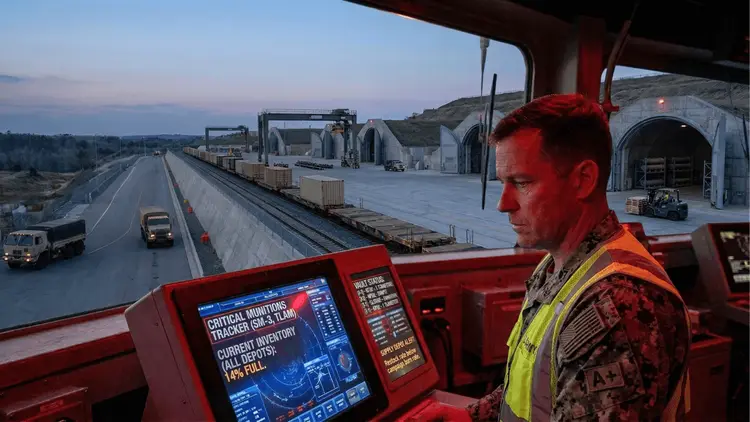
Hollywood blockbusters have conditioned us to believe that global superpowers possess a limitless, bottomless pit of advanced weaponry. The reality unfolding in the Middle East right now is considerably more sobering. As the United States and Israel push forward with the intensive air campaign dubbed "Operation Epic Fury," military planners aren't just watching the skies, they are anxiously staring at a dwindling spreadsheet of available firepower. According to recent reporting from The Wall Street Journal, the U.S. is in an absolute race against time to dismantle Iran’s missile and drone capabilities before America's own defensive shield runs completely dry.
The Brutal Arithmetic of Interceptors
To understand the current crisis, you just have to look at the math of modern warfare. In the opening 24 hours of the conflict, following the decapitation strike against Ayatollah Ali Khamenei and top leadership, allied forces pounded over 1,000 targets. However, remnants of the Iranian regime have retaliated by launching massive, sustained barrages of low-cost drones and ballistic missiles. Pre-conflict estimates from Israel suggested Iran possessed roughly 2,500 ballistic missiles. Intercepting them requires firing highly sophisticated, wildly expensive interceptors.
The core issue is that the defense industrial base cannot simply print these weapons on demand. Defense giants like Lockheed Martin (NYSE: LMT), which produces the Terminal High Altitude Area Defense (THAAD) system, and RTX Corporation (NYSE: RTX), the manufacturer behind the Standard Missile-3 (SM-3) and Patriot systems, operate on rigid, years-long production schedules. The U.S. currently produces fewer than 100 THAAD interceptors annually. Having already burned through a significant portion of its stockpile during the 12-day war in 2025, the runway is getting incredibly short. As Kelly Grieco, a senior fellow at the Stimson Center, recently warned, there is a very real risk that the United States and its partners could run out of interceptors before Iran runs out of missiles.
The Pacific Pivot and the Supply Chain Squeeze
This isn't just a Middle Eastern problem; it is a global strategic vulnerability. If the Iranian conflict stretches into a protracted war of attrition, the Pentagon will face an agonizing choice. Secretary of Defense Pete Hegseth has reportedly outlined varying timelines, but extending the war means the U.S. would likely have to tap into interceptor stockpiles currently staged in South Korea and Guam. Draining those Pacific reserves would immediately compromise America's ability to deter potential aggression from North Korea or China.
Speaking of China, Beijing finds itself in a fascinating position of immense geopolitical leverage. Rebuilding the depleted U.S. munitions stockpiles requires a massive influx of critical minerals and rare-earth elements. Currently, the global supply chain for these vital materials is overwhelmingly dominated by China. While Beijing has strong economic incentives to prevent extreme oil price spikes and a sustained disruption in the Strait of Hormuz, they also hold the keys to the very raw materials the U.S. defense sector desperately needs to restock its magazines.
The Ticking Clock
Because a prolonged occupation is financially, politically, and logistically unfeasible, the American strategy relies entirely on a compressed timeline. President Donald Trump has publicly projected that the war will conclude within four to five weeks. Economic analysts, including those tracking the conflict's global impact at VinaCapital, concur that a massive "boots on the ground" invasion is highly unlikely, predicting instead a short, sharp shock followed by a rapid de-escalation.
Ultimately, the unfolding situation is a stark reminder of the fragile nature of modern mechanized combat. It takes decades and billions of dollars to build a world-class defense network, but only a few weeks of high-intensity conflict to empty the magazine. For the U.S. military, accomplishing the mission in Iran isn't just about tactical superiority; it is about beating the buzzer before the ammunition runs out.
Sources:
- The Wall Street Journal: "U.S. Races to Accomplish Iran Mission Before Munitions Run Out" (March 2026)
- The Stimson Center: Analysis by Senior Fellow Kelly Grieco on U.S. interceptor stockpiles vs. Iranian missile reserves.
- VinaCapital: "Iran War: Modest Impact on Vietnam" (March 4, 2026), detailing the U.S. munitions constraints, Chinese rare-earth leverage, and President Trump's projected 4-to-5 week war timeline.
- Ground News: Aggregated reporting on the U.S. ballistic missile interceptor shortage and Pentagon briefings.