SPONSORED

IEA Sounds the Alarm on Imminent Copper Shortfall

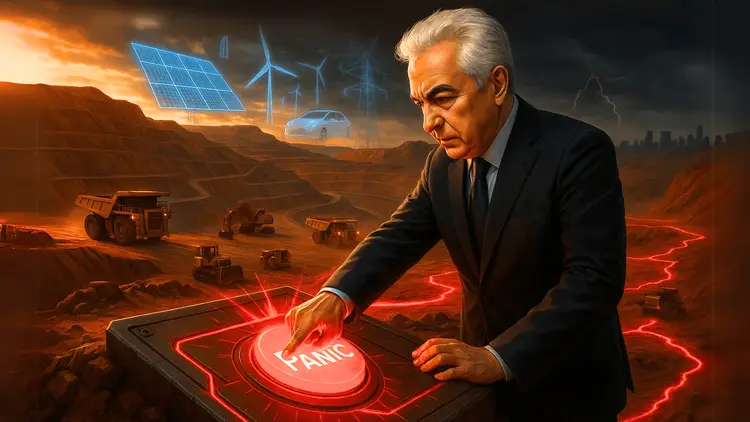
As the world races toward a low-carbon future, a looming copper shortfall threatens to derail the energy transition and shake the global economy.
•• 2 Min
IEA Sounds the Alarm on Imminent Copper Shortfall

The copper crunch is no longer a hypothetical concern—it’s a reality barreling toward the global economy. The International Energy Agency (IEA), widely regarded as the watchdog for global energy trends, has just delivered a sobering forecast: the world is heading for a dramatic shortfall in copper supply within the next decade. By 2035, demand for copper will exceed supply by as much as 30% if current trends continue.

IEA Executive Director Fatih Birol didn’t mince words. “This will be a major challenge. It’s time to sound the alarm.” And indeed, it is. As the push for a low-carbon economy accelerates, copper—already a fundamental material in every electrical system—will become even more indispensable. Yet the infrastructure needed to support this surge in demand remains vastly underdeveloped.

Why Copper is the Backbone of the Green Transition

Copper isn’t just another metal. It’s the circulatory system of our electrified world. Every solar panel, wind turbine, electric vehicle, and grid infrastructure project relies on it. From the wiring in electric cars to the transmission lines carrying renewable energy to homes and factories, copper is at the core. As nations commit to net-zero targets and green energy transitions, the strain on copper supplies will only intensify.

China’s aggressive expansion of its electricity grids and clean energy manufacturing has already driven demand through the roof. The country’s industrial appetite—paired with its dominance in refining critical minerals—has become a central pressure point in this unfolding supply crisis.

Seventeen Years to Mine, but Just Moments to Demand

Here’s the kicker: the average copper mine takes 17 years from discovery to full-scale production. Let that sink in. Seventeen years. And yet the global energy transition needs this metal now, not two decades from now. According to Birol, the bottleneck isn’t just in mining—it’s in every step of the supply chain, from exploration to processing to refining.

And therein lies the looming disaster. Even if we discover new copper deposits tomorrow, they won’t meaningfully impact supply for over a decade. Meanwhile, demand keeps climbing, driven by the electrification of transport, renewable energy projects, and digital infrastructure.

China’s Stranglehold on Refining Capacity

The IEA’s data highlights another alarming reality: China processes over 70% of the world’s top 20 critical minerals needed for clean energy technologies. That includes copper, cobalt, lithium, gallium, and manganese—all vital for batteries, semiconductors, and power systems. While these resources are mined globally—in Africa, Australia, Latin America, and beyond—they are predominantly refined in China.

This centralization of refining power creates a geopolitical vulnerability. A supply shock in one region—or a policy shift in China—could send ripples through global supply chains. With prices already volatile in the wake of the pandemic, we’ve seen what happens when the market gets nervous. A repeat could derail climate goals and send costs soaring for consumers and governments alike.

The Call for Diversification and Global Cooperation

Birol is clear: market forces alone won’t solve this problem. “Diversification is key,” he said. The IEA is calling on developed countries—like the U.S., UK, Japan, South Korea, and EU members—to invest in refining and processing infrastructure. These nations already have the technology. What’s needed now is international cooperation, especially with resource-rich regions like Africa and Latin America.

Such partnerships could reshape the global critical minerals landscape, reducing dependency on China while fostering sustainable development in emerging economies. But this vision demands decisive policy action, not just private sector ambition. Governments must step up with strategic investments, permitting reform, and support for recycling infrastructure.

Can Copper Recycling Close the Gap?

Part of the solution may lie not underground, but above it. Recycling copper from old electronics, wiring, and retired infrastructure could ease some of the pressure on virgin supply. The IEA emphasizes that ramping up copper recycling—along with substitutions using aluminum in some applications—could soften the looming supply crunch.

Still, recycling alone won’t bridge a 30% deficit. The copper already in use isn’t circulating fast enough to offset surging demand. New supply will be essential, and that means bringing new mines online—faster and more efficiently than ever before.

A Slow-Moving Crisis That Demands Fast Action

We are not powerless. The IEA insists this crisis is avoidable—if the world acts now. The roadmap is clear: accelerate permitting for new mining projects, invest in refining capacity outside of China, boost recycling, and explore substitution strategies. Yet without urgent intervention, the copper gap will widen.

Left unchecked, this supply imbalance could become the single biggest obstacle to decarbonizing the global economy. A critical minerals bottleneck in the 2030s would make the clean energy transition vastly more expensive—and potentially politically untenable.

The Real Cost of Inaction

If copper prices spike as they did in 2021, the cost of green technologies—from solar panels to EV batteries—could skyrocket. The IEA warns that a sustained supply shock in battery metals could drive global battery prices up by as much as 40-50%. That’s not just a hit to corporate margins—it’s a threat to industrial competitiveness, energy affordability, and climate resilience. Imagine trying to persuade a car buyer to pay 40% more for an electric vehicle—or convincing a government to subsidize it at scale. That’s the kind of scenario we’re courting if we ignore the copper crisis.

What Happens Next?

The copper countdown has begun. With less than a decade to prepare, governments and industries need to act with urgency and unity. The IEA’s message is blunt but hopeful: this crisis is not yet inevitable. But time is running out.

In the end, the world’s green ambitions will be measured not just by climate targets or policy pledges—but by its ability to dig deep, refine smart, and power the future without tripping over its own supply chains.

Conclusion

Copper is more than just a metal—it’s the lifeblood of the low-carbon revolution. Without it, the global clean energy transition will falter. The IEA has raised the alarm, and now it’s up to the world to respond. From new mines to smarter recycling, from global partnerships to domestic policies, the solutions are within reach—but only if we move fast. The future of energy, and perhaps even the global economy, hinges on how we handle copper today.

Most Popular News

  1. SpaceX’s $8B Spectrum Deal Sends AT&T, Verizon, and T-Mobile Plummeting
  2. Is Project Vault Securing America’s Supply Chain or Squeezing It to the Breaking Point?
  3. Why Gautam Lohia Shifted from Global Consulting to Reboot a $20M Tech Micro-Cap
  4. Everyday Luxury, Unstoppable Scale: Aritzia Delivers 44% Net Revenue Growth
  5. Can Navy SEAL Leadership and Big Tech Scale Revolutionize Airborne Threat Detection?

Disclaimer


This report should not be viewed as investment advice or as an offer to buy or sell any securities or as an invitation or solicitation of an offer to buy or sell any securities. Neither the author of this report, its publisher, nor any other person associated with the publication of this report, are registered brokers, investment dealers, investment advisers, or financial advisers. The information in this report has not been tailored to the particular needs or circumstances of readers and should not be relied upon as investment advice or recommendations to purchase or sell any of the securities presented in this report. Readers seeking investment advice should contact qualified and registered brokers, investment dealers, investment advisers, or financial advisers prior to making any decision to buy or sell any of the securities referred to in this report. The information in this report should not be construed as investment, legal, or tax advice. No recommendation is made as to whether an investment in the presented securities is suitable for any reader in light of the reader’s particular circumstances.

Readers are cautioned that the publisher of this report covers exclusively securities that carry a high degree of volatility. Investing in such securities is highly speculative and carries a high degree of risk. Investors in such securities could lose all or a substantial portion of their investment. Only those investors who can afford to lose all or a substantial portion of their investment should consider investing in the securities referred to in this report.

This report may include information obtained from publicly available sources, including third-party reports or analysis. Neither the author nor publisher of this report, nor www.juniorstocks.com or its owners, have undertaken any independent investigation into the factual information used in this report, and the information in this report is provided without any warranty of any kind. No representations or warranties are provided regarding the accuracy or completeness of the information provided in this report. Statements of opinion or belief are those of the authors and/or publisher of this report. These statements of opinion or belief are expressions of the author’s and/or publisher’s judgment, and there is no guarantee that those judgments will turn out to be correct. No inference should be drawn that the author and/or publisher have any special or greater knowledge about the presented companies or their securities, or any particular expertise in the industries or markets in which the company operates. Readers should conduct their own due diligence and seek professional advice prior to investing in any securities presented on Juniorstocks.com.

Certain statements in this report constitute “forward-looking” statements. Forward-looking statements often, but not always, are identified by the use of words such as “seek,” “anticipate,” “believe,” “plan,” “estimate,” “expect,” “targeting,” and “intend” and statements that an event or result “may,” “will,” “should,” “could,” or “might” occur or be achieved and other similar expressions. Forward-looking statements express or involve discussions with respect to predictions, expectations, beliefs, plans, projections, objectives, goals, assumptions, or future events or performance; they are not statements of historical facts and should not be viewed as any guarantee of any future result. Forward-looking statements are based on expectations, estimates, and projections at the time the statements are made that involve a number of risks and uncertainties which could cause actual results or events to differ materially from those presently anticipated. The author and/or publisher of this report disclaims any obligation to update the forward-looking statements in this report, whether as a result of new information, future events, or results or otherwise. There is no assurance that forward-looking statements will prove to be accurate, as actual results and future events could differ materially from those anticipated in such statements. Accordingly, readers should not place undue reliance on forward-looking statements.

The information provided in this report is not intended for distribution to, or use by, any person or entity in any jurisdiction or country where such distribution or use would be contrary to applicable law or regulation, or would subject the author or publisher of this report to any registration requirement in such jurisdiction or country.

Information about the editor of this publication:
Juniorstocks.com is a service provided by Piccadilly Capital Group, Office 66, 101 Clapham High Street, London, SW4 7TB, UK. Piccadilly Capital Group is not the publisher of this report and was not paid for the publication of this report. Piccadilly Capital Group seeks to generate web traffic and a growing number of followers through the publication of articles or reports. Directors, officers, and other insiders of the publisher own an interest in Piccadilly Capital Group. Piccadilly Capital Group does not endorse or recommend the business, products, services, or securities of any company mentioned on www.juniorstocks.com. Piccadilly Capital Group will not share your information with any outside third parties. Due to the new data protection basic regulation, we ask you to read our data protection declaration carefully.

Note on copyright:
The contents published on this website and on connected media (e.g., e-mail, X, Facebook) are subject to applicable copyright and ancillary copyright laws. Any use not permitted by applicable copyright and ancillary copyright laws requires the prior written consent of the provider or the respective rights holder. In particular, this applies to the duplication, editing, translation, storage, processing, or reproduction of content in databases or other electronic media and systems. Contents and rights of third parties are marked as such. Unauthorized reproduction or transmission of individual contents or complete pages is not permitted and is punishable by law. Only the production of copies and downloads for personal, private, and non-commercial use is permitted. Links to the provider's website are always welcome and do not require the consent of the provider of the website. Photos and images on the website may not be shared unless the publisher itself has acquired the initial rights from authorized sources. The presentation of this website in external frames is only allowed with written permission. If you notice any violations, please inform us. Please note: The content of our articles, emails, or other publications or social networks such as X, LinkedIn or Facebook is exclusively intended for the designated addressee(s). If you are not the addressee of these articles, emails, or other publications in the market letter or social networks such as Twitter or Facebook or his or her legal representative, please note that any form of publication, reproduction, or distribution of the content of these articles, emails, or other publications in the market letter or social networks such as X, LinkedIn or Facebook is prohibited. Falsifications of the original content of this message during data transmission cannot be excluded in principle.