
House of Grain: China Dumps Canada for a Feed Fling with New Partners
China’s Strategic Shift to Australia and India Signals a New Era in Global Agricultural Trade
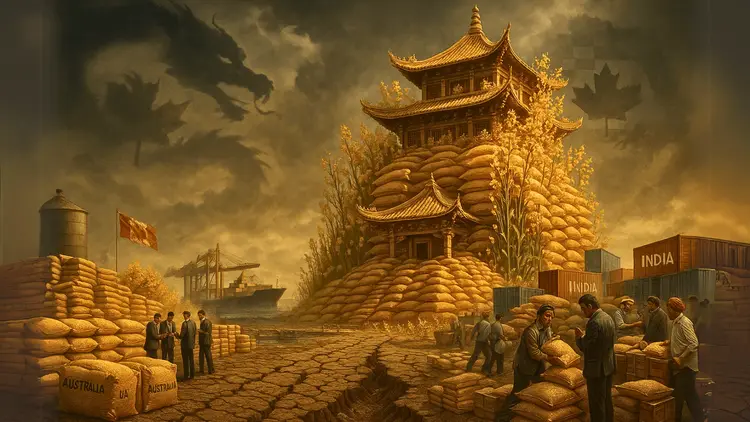
In a dramatic shake-up of global agricultural trade, China is rewriting the playbook for its animal feed supply chain, sidelining Canada in favor of fresh players like Australia and India. The move comes as Beijing’s trade spat with Ottawa escalates, with hefty tariffs on Canadian rapeseed meal and an ongoing anti-dumping probe threatening to choke off a once-thriving canola trade. Buckle up—this is a high-stakes game of geopolitics and grain, and China’s not playing nice.
The numbers tell a grim story. Canada, long a cornerstone of China’s rapeseed supply, exported over 2 million tons of rapeseed meal worth $780 million and $3.3 billion in rapeseed to China last year. But since March, when Beijing slapped steep tariffs on Canadian meal in retaliation for Canada’s duties on Chinese goods, that pipeline has all but dried up. The fallout? A gaping hole in China’s animal feed industry, which relies heavily on rapeseed meal to fuel its livestock sector.
China’s response has been swift and strategic. With Canadian canola off the menu, traders are scouring the globe for alternatives, zeroing in on Australia and India to fill the void. It’s a bold pivot, but one fraught with challenges—quality concerns, regulatory hurdles, and the ever-looming shadow of geopolitical chess moves.
Australia, once a bit player in China’s rapeseed market due to quality issues and past political tensions, is suddenly back in the spotlight. Chinese buyers are circling, eager to tap into Australia’s supply, but regulatory approvals remain a sticking point. Down under, exporters are cautiously optimistic, sensing an opportunity to carve out a bigger slice of the Chinese market.
Meanwhile, India is making a spirited bid to reclaim lost ground. The Solvent Extractors’ Association of India is lobbying hard for relaxed import rules, aiming to boost rapeseed meal exports to China from near-zero to a hefty 500,000 tons annually. Price is India’s ace card—quotes from Kandla port are a steal at $202 per ton, compared to $332 per ton from Hamburg. But Chinese buyers are wary, citing inconsistent protein levels and foreign material in Indian shipments. It’s a high-stakes gamble for India, but the potential payoff is massive.
China’s pivot isn’t just about feed—it’s a microcosm of its broader strategy to shield its economy from geopolitical turbulence. The Canada spat mirrors Beijing’s ongoing trade war with the United States, where tit-for-tat tariffs have disrupted global markets. To hedge its bets, China is cozying up to resource-rich nations beyond North America, diversifying its import portfolio to weather the storm.
At home, Beijing is pulling out all the stops to keep its economy humming. Policy rate cuts, relaxed cash reserve requirements for banks, and diplomatic overtures—like upcoming U.S.-China trade talks in Switzerland—signal a government determined to stabilize its markets amid escalating tensions. But with a slowing domestic economy and global trade uncertainties, the road ahead is anything but smooth.
For Canadian farmers, China’s tariffs are a gut punch. Already grappling with rising costs, volatile commodity prices, and erratic weather, producers now face the loss of a key market. Bill Prybylski, President of the Agricultural Producers Association of Saskatchewan, didn’t mince words: “This could ripple beyond canola, hitting other exports to China.” With canola accounting for a significant chunk of Canada’s agricultural revenue, the stakes couldn’t be higher.
As China redraws its agricultural map, the global market is bracing for turbulence. Australia and India may offer short-term relief, but scaling up to replace Canada’s supply won’t happen overnight. Quality, logistics, and regulatory hurdles loom large, and Beijing’s willingness to stick with these new partners remains an open question.
One thing’s clear: China’s sending a message. By pivoting away from Canada, Beijing is flexing its muscle, proving it can—and will—reconfigure its supply chains to navigate geopolitical storms. For traders, farmers, and policymakers worldwide, it’s a wake-up call: in the high-stakes world of global agriculture, adaptability is the name of the game.