SPONSORED

Ukraine’s Strategic Minerals: A Game-Changer for U.S. and EU Security

How Ukraine’s Resources Could Redefine Global Supply Chains and Europe’s Energy Future
•• 2 Min
Ukraine’s Strategic Minerals: A Game-Changer for U.S. and EU Security

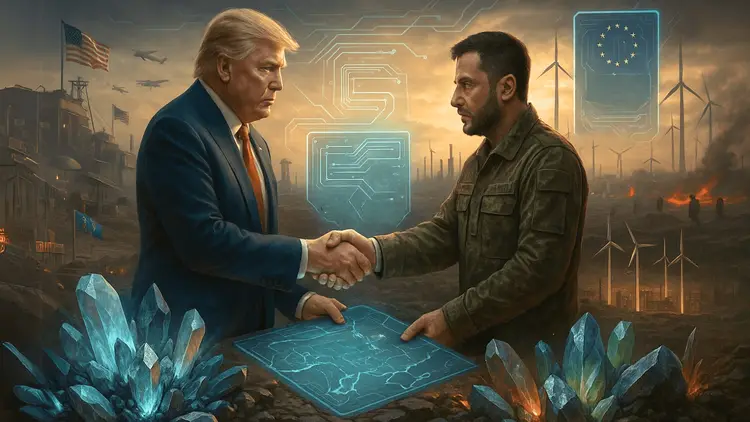
On April 30, 2025, Ukraine and the United States inked a landmark economic partnership that could reshape global critical mineral supply chains. The agreement grants the U.S. preferential access to Ukraine’s vast reserves of lithium, graphite, titanium, and rare earth elements in exchange for a joint investment fund to fuel Ukraine’s postwar reconstruction. Championed by U.S. President Donald Trump, the deal is a bold move to secure strategic resources while bolstering Ukraine’s economy amid its ongoing conflict with Russia. Yet, as Europe grapples with its own critical mineral shortages, Ukraine’s deposits are emerging as a linchpin in the continent’s push for resource independence, raising questions about the geopolitical and economic stakes at play.

The Ukraine-USA Deal: A Game-Changer for Critical Minerals

The agreement, finalized after months of tense negotiations, positions Ukraine as a key supplier for the U.S., which seeks to reduce its reliance on China for minerals critical to electric vehicle batteries, renewable energy systems, and defense technologies. Ukraine, holding an estimated 5% of the world’s critical raw materials, boasts 22 of the 34 minerals deemed critical by the European Union, including 19 million tonnes of graphite (one-fifth of global reserves) and one-third of Europe’s lithium deposits. The deal’s structure—tying mineral access to a reconstruction fund—signals a transactional approach, with future U.S. military aid potentially counting as investment, a shift from earlier drafts demanding repayment for past support.

This partnership is not without hurdles. Many of Ukraine’s richest deposits, particularly in the Donetsk and Zaporizhzhia regions, lie in Russian-occupied territories, with estimates suggesting up to 40% of its metallic mineral wealth is currently inaccessible. The war has also decimated infrastructure, with nearly half of Ukraine’s power-generation capacity destroyed, complicating energy-intensive mining operations. Despite these challenges, the deal underscores Ukraine’s strategic importance, with the potential to generate billions for its recovery while securing U.S. mineral supplies.

Antimony: A Global Concern, but Not Ukraine’s Strength

While Ukraine’s mineral portfolio is impressive, antimony—a lesser-known but critical mineral for batteries, semiconductors, and military applications like night vision goggles—is not among its documented reserves. Globally, antimony supply is dominated by China (48% of production in 2023), with disruptions from Russia’s invasion and sanctions tightening markets. Enter Military Metals Corp (OTCQB: MILIF), a Canadian exploration company focused on antimony projects in Slovakia, Canada, and the USA. Their work, such as the Trojarová antimony-gold project in Slovakia, highlights the urgent need for Western supply chains to diversify away from volatile sources. Though not directly tied to Ukraine, Military Metals’ efforts reflect the broader context of the U.S.-Ukraine deal: a race to secure critical minerals in a geopolitically fraught world.

"We see this as a transformative moment for the critical minerals sector," said Scott Eldridge, CEO of Military Metals Corp. "The U.S. appears to be prioritizing partnerships with European nations like Ukraine to secure the resources needed for advanced technologies and national defense. However, it leaves the U.S. antimony deficit unresolved as Ukraine does not have any documented antimony deposits. While promising for other minerals, it does not solve the critical antimony shortage facing the U.S. Military Metals is well-positioned in western countries to support this shift, with our focus on developing high-quality mineral assets in stable jurisdictions."

Europe’s Critical Mineral Crisis

Across the Atlantic, Europe faces a stark reality: it is heavily dependent on foreign critical minerals, with China supplying 98% of its rare earth elements, 97% of its lithium, and 93% of its magnesium. These materials are vital for the EU’s green transition, powering electric vehicles, wind turbines, and digital infrastructure. The European Commission’s Critical Raw Materials Act (CRMA), enacted in March 2024, sets ambitious goals to extract 10%, process 40%, and recycle 25% of critical minerals domestically by 2030. Yet, with scattered funding and limited domestic production, the EU is turning to partnerships to bridge the gap. European Commission

Ukraine’s proximity and resource wealth make it an ideal candidate. The country’s titanium reserves, the largest in Europe, could meet U.S. and EU demand for aerospace and defense applications for over 25 years. Its graphite and lithium deposits are equally critical for Europe’s battery industry, which is racing to compete with China. However, the EU’s reliance on Ukraine is tempered by risks: occupied territories, outdated mining technology, and environmental concerns, such as unexploded ordnance, pose significant barriers to extraction.

Ukraine’s Mineral Powerhouse

Ukraine’s geological bounty is staggering. Beyond graphite and lithium, it holds 7% of global titanium production, significant uranium reserves for nuclear energy, and rare earth elements like neodymium and cerium, used in everything from wind turbines to missile systems. The Ukrainian Shield, spanning regions like Luhansk and Dnipropetrovsk, is a treasure trove, but its strategic value is double-edged: Russia’s occupation of key areas like Donetsk underscores the war’s economic dimensions. Before the 2022 invasion, Ukraine was a top supplier of noble gases and coal, and its potential to develop untapped lithium and rare earth deposits could position it as a global player.

The U.S.-Ukraine deal could catalyze European investment, aligning with the EU’s Mineral Security Partnership Forum, where Ukraine’s deputy economy minister has already engaged. By integrating Ukraine into Western supply chains, Europe could reduce its dependence on China and Russia, bolstering both economic and national security. Yet, the path forward requires stability, modernized infrastructure, and environmental safeguards to ensure sustainable extraction.

The Road Ahead

The Ukraine-USA critical minerals deal is a bold step, but its success hinges on overcoming formidable challenges. For Ukraine, it’s a chance to fund reconstruction and cement ties with the West. For the U.S., it’s a strategic counter to China’s mineral dominance. For Europe, Ukraine’s resources offer a lifeline to achieve its green and digital ambitions. As geopolitical rivalries intensify, the race for critical minerals will only grow fiercer. Ukraine, with its vast reserves and strategic position, is poised to play a pivotal role—if it can navigate the complexities of war, occupation, and global demand.

This article is based on factual reporting from reputable sources, including Reuters, CNN, the European Commission, and Military Metals Corp, ensuring accuracy and credibility.

_Disclaimer The author may own shares in any other stocks mentioned in this article. The author may choose to buy or sell shares at any time without notice. Although efforts have been made to ensure the accuracy and reliability of the information presented, readers are encouraged to conduct their own research and seek independent financial advice before making any investment decisions related to the small-cap companies mentioned. This article was written with the assistance of AI to provide information related to these companies. _

UcraineDonald TrumpAntimony

Most Popular News

  1. SpaceX’s $8B Spectrum Deal Sends AT&T, Verizon, and T-Mobile Plummeting
  2. Is Project Vault Securing America’s Supply Chain or Squeezing It to the Breaking Point?
  3. Why Gautam Lohia Shifted from Global Consulting to Reboot a $20M Tech Micro-Cap
  4. Everyday Luxury, Unstoppable Scale: Aritzia Delivers 44% Net Revenue Growth
  5. Can Navy SEAL Leadership and Big Tech Scale Revolutionize Airborne Threat Detection?

Disclaimer


This report should not be viewed as investment advice or as an offer to buy or sell any securities or as an invitation or solicitation of an offer to buy or sell any securities. Neither the author of this report, its publisher, nor any other person associated with the publication of this report, are registered brokers, investment dealers, investment advisers, or financial advisers. The information in this report has not been tailored to the particular needs or circumstances of readers and should not be relied upon as investment advice or recommendations to purchase or sell any of the securities presented in this report. Readers seeking investment advice should contact qualified and registered brokers, investment dealers, investment advisers, or financial advisers prior to making any decision to buy or sell any of the securities referred to in this report. The information in this report should not be construed as investment, legal, or tax advice. No recommendation is made as to whether an investment in the presented securities is suitable for any reader in light of the reader’s particular circumstances.

Readers are cautioned that the publisher of this report covers exclusively securities that carry a high degree of volatility. Investing in such securities is highly speculative and carries a high degree of risk. Investors in such securities could lose all or a substantial portion of their investment. Only those investors who can afford to lose all or a substantial portion of their investment should consider investing in the securities referred to in this report.

This report may include information obtained from publicly available sources, including third-party reports or analysis. Neither the author nor publisher of this report, nor www.juniorstocks.com or its owners, have undertaken any independent investigation into the factual information used in this report, and the information in this report is provided without any warranty of any kind. No representations or warranties are provided regarding the accuracy or completeness of the information provided in this report. Statements of opinion or belief are those of the authors and/or publisher of this report. These statements of opinion or belief are expressions of the author’s and/or publisher’s judgment, and there is no guarantee that those judgments will turn out to be correct. No inference should be drawn that the author and/or publisher have any special or greater knowledge about the presented companies or their securities, or any particular expertise in the industries or markets in which the company operates. Readers should conduct their own due diligence and seek professional advice prior to investing in any securities presented on Juniorstocks.com.

Certain statements in this report constitute “forward-looking” statements. Forward-looking statements often, but not always, are identified by the use of words such as “seek,” “anticipate,” “believe,” “plan,” “estimate,” “expect,” “targeting,” and “intend” and statements that an event or result “may,” “will,” “should,” “could,” or “might” occur or be achieved and other similar expressions. Forward-looking statements express or involve discussions with respect to predictions, expectations, beliefs, plans, projections, objectives, goals, assumptions, or future events or performance; they are not statements of historical facts and should not be viewed as any guarantee of any future result. Forward-looking statements are based on expectations, estimates, and projections at the time the statements are made that involve a number of risks and uncertainties which could cause actual results or events to differ materially from those presently anticipated. The author and/or publisher of this report disclaims any obligation to update the forward-looking statements in this report, whether as a result of new information, future events, or results or otherwise. There is no assurance that forward-looking statements will prove to be accurate, as actual results and future events could differ materially from those anticipated in such statements. Accordingly, readers should not place undue reliance on forward-looking statements.

The information provided in this report is not intended for distribution to, or use by, any person or entity in any jurisdiction or country where such distribution or use would be contrary to applicable law or regulation, or would subject the author or publisher of this report to any registration requirement in such jurisdiction or country.

Information about the editor of this publication:
Juniorstocks.com is a service provided by Piccadilly Capital Group, Office 66, 101 Clapham High Street, London, SW4 7TB, UK. Piccadilly Capital Group is not the publisher of this report and was not paid for the publication of this report. Piccadilly Capital Group seeks to generate web traffic and a growing number of followers through the publication of articles or reports. Directors, officers, and other insiders of the publisher own an interest in Piccadilly Capital Group. Piccadilly Capital Group does not endorse or recommend the business, products, services, or securities of any company mentioned on www.juniorstocks.com. Piccadilly Capital Group will not share your information with any outside third parties. Due to the new data protection basic regulation, we ask you to read our data protection declaration carefully.

Note on copyright:
The contents published on this website and on connected media (e.g., e-mail, X, Facebook) are subject to applicable copyright and ancillary copyright laws. Any use not permitted by applicable copyright and ancillary copyright laws requires the prior written consent of the provider or the respective rights holder. In particular, this applies to the duplication, editing, translation, storage, processing, or reproduction of content in databases or other electronic media and systems. Contents and rights of third parties are marked as such. Unauthorized reproduction or transmission of individual contents or complete pages is not permitted and is punishable by law. Only the production of copies and downloads for personal, private, and non-commercial use is permitted. Links to the provider's website are always welcome and do not require the consent of the provider of the website. Photos and images on the website may not be shared unless the publisher itself has acquired the initial rights from authorized sources. The presentation of this website in external frames is only allowed with written permission. If you notice any violations, please inform us. Please note: The content of our articles, emails, or other publications or social networks such as X, LinkedIn or Facebook is exclusively intended for the designated addressee(s). If you are not the addressee of these articles, emails, or other publications in the market letter or social networks such as Twitter or Facebook or his or her legal representative, please note that any form of publication, reproduction, or distribution of the content of these articles, emails, or other publications in the market letter or social networks such as X, LinkedIn or Facebook is prohibited. Falsifications of the original content of this message during data transmission cannot be excluded in principle.