
Goldman Sachs Dismisses the Dip: The Structural Reality Behind the $4,900 Forecast
Why massive central bank accumulation and Western fiscal anxieties mean bullion's 24% plunge is just a temporary pitstop on the way to $4,900.
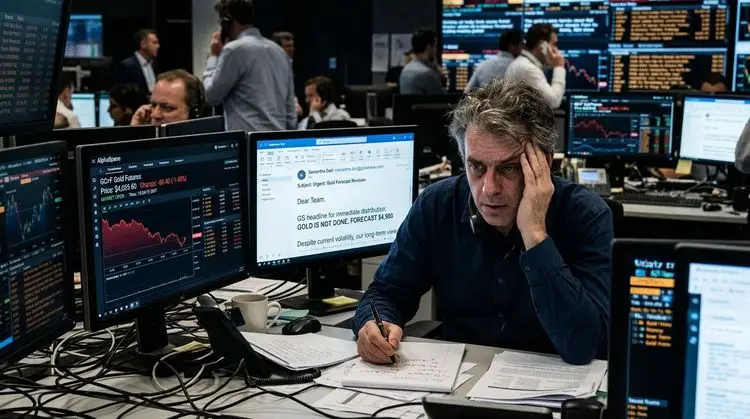
Gold bugs have spent the last four months watching their favourite safe haven take a relentless beating, but the commodities team at Goldman Sachs (NYSE: GS) insists the precious metal is simply catching its breath. Despite a brutal 24% plunge from its record high in January, the overarching message from the banking giant is clear: the historic rally is far from finished.
The recent absolute meltdown in the precious metals market managed to push spot gold down toward the $4,000 an ounce threshold. This massive correction unraveled after military conflicts involving the U.S. and Iran erupted in late February, initially triggering a flight to safety before ironically backfiring on bullion. The geopolitical friction disrupted shipping through the crucial Strait of Hormuz, sending oil prices skyrocketing and supercharging inflation data.
Consequently, investors realized that a resilient labor market and sticky consumer-price pressures mean central banks are highly unlikely to cut interest rates anytime soon. Because gold doesn't yield interest, it struggles to compete for investor dollars when yield-bearing assets like bonds offer high, steady returns.
Even with these intense cyclical headwinds, a powerful floor is keeping the metal from a total collapse. Samantha Dart, co-head of global commodities research at Goldman Sachs (NYSE: GS), highlighted that emerging market central banks are structurally altering the landscape. Ever since Western nations froze Russia’s foreign reserves in 2022, global central banks have been aggressively diversifying away from fiat currencies to avoid similar vulnerabilities.
According to data tracked by the World Gold Council, a record 45% of the 76 central banks surveyed expect to increase their own gold reserves over the next year. This relentless institutional buying acts as a permanent anchor for Goldman’s $4,900 per troy ounce end-of-2026 forecast. While retail investors might be panicking over near-term fluctuations, sovereign institutions are quietly accumulating hard assets at a discount.
"Gold is not done," Dart and her team emphasized, noting that the metal has still gained an astronomical 123% since 2022.
The current downward pressure is viewed by top analysts as a temporary cyclical bump. A hawkish Federal Reserve has managed to temporarily cool down the currency debasement narrative, dragging down rate-sensitive ETF demand. However, Goldman Sachs (NYSE: GS) economists anticipate that the central bank will hold rates steady for the remainder of the year and delay any monetary easing cycle until the latter half of next year. As those headwinds eventually peak and reverse, private wealth diversification is expected to accelerate back into gold, driven by mounting anxieties over Western fiscal sustainability and massive government deficits.
Even amid the daily market volatility, where a tanker conflict over the weekend sent oil up and spot gold sliding over 1% to $4,044.79, analysts are spotting signs of resilience. Justin Lin, an analyst at Global X ETFs Australia, noted that the metal could become increasingly immune to Middle East volatility now that fast-money investors have largely moved on and dip-buyers are aggressively defending the $4,000 line. For long-term investors tracking metrics on platforms like GuruFocus, the question isn't whether gold has lost its luster, but rather how quickly it will reclaim it.
Sources
- Yahoo Finance: "‘Gold is not done’: Goldman Sachs predicts a rise to $4,900" by Ines Ferré
- GuruFocus: "Gold Drops 23% Since February as Middle East Tensions Resurface" by Khac Phu Nguyen