
Gold Breaks Records, Analysts Break Out the Champagne
Gold’s historic rally accelerates as ETFs hit record inflows, the Fed faces new scrutiny, and Goldman Sachs lifts its price target to $4,900 amid surging investor demand.
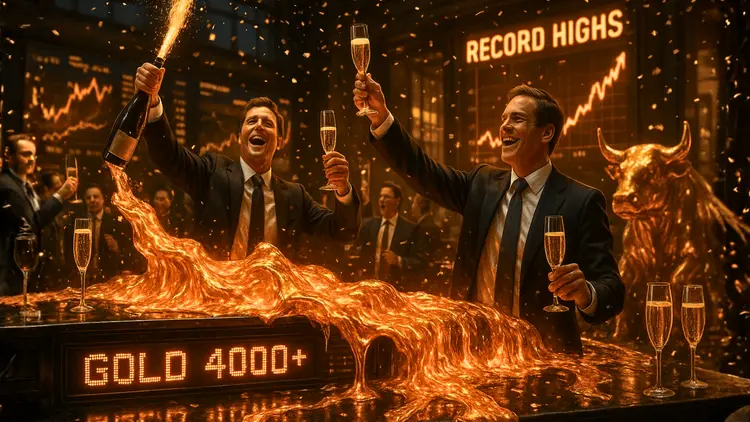
Gold has officially entered uncharted territory. Futures for the yellow metal surged past $4,000 an ounce for the first time in history, fueled by a combination of a weakening U.S. dollar, heightened geopolitical tensions, and the market’s growing conviction that the Federal Reserve will soon cut rates again. The rally marks one of the most powerful runs for gold in modern history, with prices up over 50% year-to-date—the best performance since 1979.
The surge has sparked a tidal wave of inflows into gold-backed exchange-traded funds. According to the latest World Gold Council report, global ETFs recorded their largest quarterly inflows on record, jumping 23% to $26 billion in the three months ending September. North American funds led the charge, with European and Asian investors not far behind. The message is clear—investors are rushing toward safety, and gold is once again the world’s favorite refuge.
This rally hasn’t just been about fear. It’s also been about momentum. Trading activity in gold markets has exploded, with daily volumes up 34% month-over-month. Prices shattered record after record, hitting 13 new all-time highs in September alone. The excitement is palpable, and Wall Street isn’t hiding its enthusiasm. Goldman Sachs called gold its “highest-conviction long recommendation,” a rare public show of confidence from one of the world’s largest investment banks.
Adding to the bullish narrative, Goldman Sachs raised its gold price target to $4,900 this week, citing “durable demand between central banks and Western investors.” The bank believes the rally is not a speculative frenzy but a structural shift in how global capital views the yellow metal. In a report covered by Yahoo Finance’s Ramzan Karmali, Goldman pointed to consistent central bank accumulation and the shift of institutional portfolios into hard assets as the foundation for its revised outlook. Still, not everyone is convinced—some billionaire investors are warning that the record-breaking rally could be overheating.
As Karmali reported on Yahoo Finance’s Market Sunrise, while institutional appetite remains strong, skeptics argue that such rapid gains could trigger sharp corrections if global rate expectations or fiscal narratives shift. That cautionary tone hasn’t cooled enthusiasm yet, but it highlights the tension between long-term conviction and short-term exuberance.
JPMorgan, meanwhile, has weighed in with historical context. Their analysts noted that past pullbacks following the first Fed rate cut typically offer golden opportunities for investors. Historically, dips that occur two to three months after the initial cut have been ideal moments to buy back in. That pattern could be playing out again now, as traders position for further upside into 2026.
Behind the bullish sentiment lies a deeper unease about the stability of U.S. monetary policy. Concerns over the Federal Reserve’s independence have intensified after President Trump’s push to remove Fed Governor Lisa Cook. JPMorgan’s team warned that if those fears are realized, confidence in U.S. Treasuries could erode quickly, driving capital away from government debt and into hard assets like gold. The implications of that shift could be seismic. In their words, even “relatively meager rotations” away from Treasuries could push gold well above $5,000 per ounce within two quarters.
It’s not just central bank drama fueling the rally. Persistent geopolitical risks, trade tensions, and policy uncertainty have all kept investors on edge. The world feels increasingly fragile, and in times like these, gold thrives. It’s the ultimate hedge against chaos—a tangible store of value when faith in paper assets wavers.
Looking ahead, most analysts agree that the fundamental setup remains overwhelmingly bullish. With inflation expectations sticky and the Fed seemingly boxed in between recession fears and fiscal instability, the stage appears set for another leg higher. JPMorgan’s base case sees gold holding above $4,000 through early 2026, while the more aggressive forecasts suggest a march toward $5,000 could arrive sooner than expected if macro pressures intensify.
For investors, the question is no longer whether gold belongs in their portfolios—it’s how much exposure is enough. With ETFs attracting record inflows and central banks continuing to expand their gold reserves, the yellow metal’s narrative has evolved from safe haven to power play. This isn’t just a defensive trade anymore; it’s a statement on where global confidence lies.
As the dust settles on this extraordinary run, one thing is clear. Gold has reclaimed its throne as the world’s ultimate asset of trust. And if the forecasts hold, the next chapter of this rally could redefine what “safe haven” truly means.
Conclusion
Gold’s historic surge past $4,000 has transformed the market landscape. The combination of aggressive ETF inflows, record-breaking futures activity, and deepening macro uncertainty has created a perfect storm for the precious metal. With Goldman Sachs’ $4,900 target now setting the tone, the debate shifts from whether gold can rise higher to how far it can go before the next great correction. Whether it’s a short-term frenzy or the beginning of a generational supercycle, one thing is certain—the world is watching gold’s renaissance in real time.