
US Gold Reserves Break $1 Trillion as Prices Hit Record Highs
America’s century-old gold hoard crosses the trillion-dollar threshold, reigniting debates over revaluation, deficits, and the future of safe-haven assets.
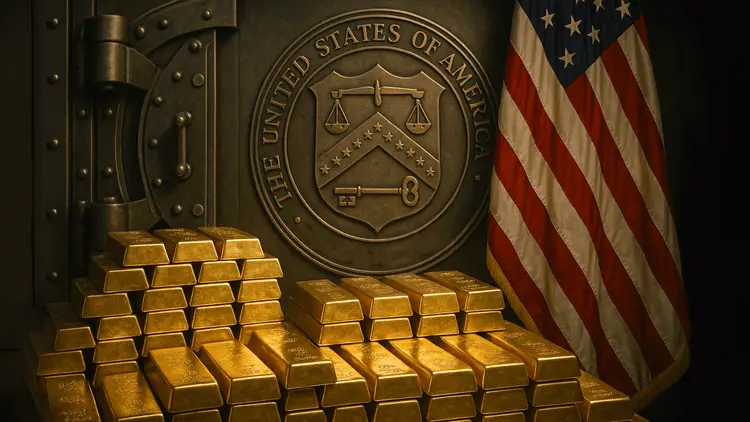
The United States has officially crossed a threshold few thought possible. Its vast hoard of gold reserves has surged past the $1 trillion mark in value, thanks to an unprecedented rally that has seen bullion prices rocket 45 percent this year. Gold now trades at more than $3,824 an ounce, shattering record after record, as investors around the globe pile into the yellow metal seeking shelter from uncertainty. This moment does not just represent a market milestone—it underlines gold’s enduring role as the ultimate hedge in times of economic stress.
On paper, the US government’s balance sheet still values its gold stash at a paltry $42.22 per ounce, the price Congress fixed back in 1973. That outdated metric pegs the official value of the nation’s 261.5 million ounces at just over $11 billion. In reality, the market says it is worth more than ninety times that figure. The discrepancy highlights how government accounting rules clash with market dynamics, leaving an untapped mountain of wealth locked in vaults beneath Fort Knox, West Point, Denver, and Manhattan.
Why Gold Is Soaring
The rally has not come out of nowhere. Markets are gripped by turbulence: trade wars, geopolitical flashpoints, and a government funding crisis at home. Investors have turned to gold as a safe harbor. At the same time, exchange-traded funds have funneled billions into bullion, magnifying the surge. The Federal Reserve’s renewed push to cut rates has further fueled the momentum, as lower yields make holding gold more attractive. Each new crisis adds oxygen to the fire, propelling gold to heights once dismissed as fantasy.
Earlier this year, a casual remark from Treasury Secretary Scott Bessent ignited speculation that Washington might mark its gold reserves to market. Such a move could, in theory, unleash close to $1 trillion into the Treasury’s coffers overnight, covering about half of this fiscal year’s nearly $2 trillion budget deficit. While Bessent quickly tamped down the idea, the notion has not gone unnoticed. Germany, Italy, and South Africa have all revalued their reserves in the past. For the US, doing the same could reshape the fiscal landscape—but at the cost of shaking the financial system to its core.
Fort Knox and the Nation’s Hoard
Just over half of America’s gold rests deep beneath Fort Knox in Kentucky, a fortress built in the 1930s to secure the metal from foreign threats. The rest lies in Denver, West Point, and an underground vault 80 feet below the New York Federal Reserve. These locations are shrouded in both reverence and suspicion. Conspiracy theories swirled earlier this year after former President Donald Trump and billionaire Elon Musk openly questioned whether the gold was truly there. Trump even quipped about marching into Fort Knox to “make sure.” The mystique of America’s stash remains as strong as ever.
Gold’s trillion-dollar milestone is not just a story for the US. The surge has rattled global markets, boosting miners and reshaping reserve strategies worldwide. Central banks from Asia to Europe have been accumulating bullion at a record pace, seeking insurance against the dollar’s volatility and the geopolitical fractures widening across continents. The US, sitting atop the world’s largest pile, now finds itself in a unique position. Whether it chooses to unlock that wealth or keep it frozen in time will have consequences far beyond its borders.
Conclusion
America’s gold reserves hitting $1 trillion is more than a headline—it is a signal of shifting tides in global finance. While the Treasury keeps its official books stuck in the 1970s, markets are screaming a different truth: gold matters, perhaps now more than ever. The temptation to revalue is clear, the risks are enormous, and the political intrigue is bound to deepen. One thing is certain—the story of gold is not finished, it is only entering its next golden chapter.