
Stefan Müller Exposes the Fatal Flaw in Europe’s Critical Raw Materials Strategy
Why judging public raw materials funds on financial profit misinterprets the true goal: sovereign economic security.
When you buy a house, you do not calculate the return on investment of your fire insurance. You simply want the policy to pay out when the kitchen goes up in flames.
Yet, when it comes to securing the vital metals needed for electric vehicles, wind turbines, and advanced defense tech, European governments are seemingly obsessed with getting a financial return on their geopolitical premiums.
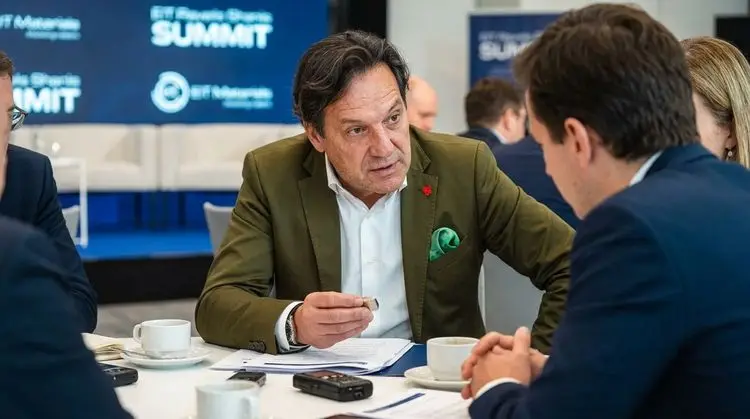
According to Stefan Müller, CEO of DGWA, this mindset is entirely backward. Speaking at the EIT RawMaterials Summit 2026, Müller pointed out that Europe is finally putting serious public cash on the table for critical raw materials. New investment vehicles like Germany's KfW-backed Rohstofffonds, Italy's Fondo Nazionale del Made in Italy, and France's InfraVia Critical Metals Fund are actively entering the fray. These funds rightly recognize that secure access to raw materials is a bedrock issue for both economic security and industrial survival. But as these entities begin deploying capital, grading them on their quarterly profit margins misses the point entirely. Private capital already chases commercially viable mining projects, and it does so quite efficiently. If a project makes perfect financial sense, the free market will fund it. Public capital, however, has a completely different mandate: to finance strategically critical operations that pure capitalism simply will not touch.
The crux of the problem is that the global critical minerals arena has not functioned like a normal free market for decades. China has methodically built a dominant, vertically integrated empire across mining, processing, and refining. This monopolistic stranglehold allows them to artificially suppress prices well below the break-even point for Western producers, systematically starving competitors of oxygen. Consequently, mining and refining projects that are existentially necessary for Europe often look like terrible investments on a spreadsheet. They are not poorly managed; they are simply trying to play fair in a heavily distorted market.
For a private investor, running away from a lopsided market makes total sense. For a government, it is a dereliction of duty. Public funds must weigh whether an investment preserves sovereign capabilities, keeps domestic production breathing, and mitigates the risk of relying on foreign suppliers who have a documented history of weaponizing trade.
The collateral damage of applying strict commercial logic to strategic assets is already littered across the European continent. Since the energy price spikes of 2021, Europe has watched nearly half of its primary aluminum smelting capacity permanently flatline. Lead and antimony smelters, critical cogs for defense supply chains, are facing similar existential threats. Once these heavy industrial facilities go dark, they almost never come back online. The skilled labor evaporates, supply networks dissolve, and institutional knowledge is lost to history. A government might eventually recover lost capital, but resurrecting dead industrial capability is nearly impossible.
Müller draws a sharp line between an investment failure and a strategic failure. Governments should not be in the business of propping up every money-losing venture, but they must intervene when genuine strategic capability is at stake. Take, for instance, Europe's first industrial-scale rare earth magnet factory in Narva, Estonia, pioneered by Neo Performance Materials (TSX: NEO). The facility churns out materials absolutely essential for green energy and defense technologies. However, because it competes directly with a Chinese monopoly, it required public backing to get off the ground. The missing profit margin was not a flaw in the project's design; it was simply the cost of admission to compete in a manipulated global market.
To truly secure its supply chain future, Europe also needs to stop treating raw materials partnerships as mere diplomatic photo-ops. Trusted allies like Australia and Canada already have decades of reps under their belts when it comes to supporting strategic mining operations with public capital. Instead of duplicating years of exhausting technical due diligence, Europe should be co-investing alongside these partners. Sharing the risk, capital, and expertise is the fastest way to turn political declarations into tangible supply chains.
Ultimately, public investment funds must be judged by the purpose they were born to serve. If they are graded on a curve of financial yield, they will simply morph into private equity clones, redundantly funding the exact same safe bets the market was already handling. The true return on strategic public investment is resilience. It is an insurance policy for a continent's industrial future, and insurance is measured by the protection it offers when the world gets volatile.
Source
- Adapted from Stefan Müller (CEO, DGWA), "The return on critical minerals investment should be resilience, not profit," EIT RawMaterials Summit, Jul 30, 2026.
Disclaimer
Neither the author of this article nor JuniorStocks holds equity, stock options, or any other financial positions in Neo Performance Materials (TSX: NEO) or any other companies, funds, or entities mentioned in this publication. This content is published by JuniorStocks strictly for informational purposes, was prepared independently without company compensation, and utilized AI assistance for text editing and formatting. While critical minerals and European supply chain resilience represent an important economic and geopolitical issue, this article does not constitute investment or financial advice. Investors are strongly advised to conduct their own thorough, independent due diligence and consult with a qualified financial professional before making any investment decisions.