SPONSORED

Bitcoin’s Big Drain: Where Did $3.5 Billion Just Go?

Bitcoin ETFs Hit a Breaking Point as Institutions Pull Back and Market Volatility Tightens Its Grip
•• 2 Min
Bitcoin’s Big Drain: Where Did $3.5 Billion Just Go?

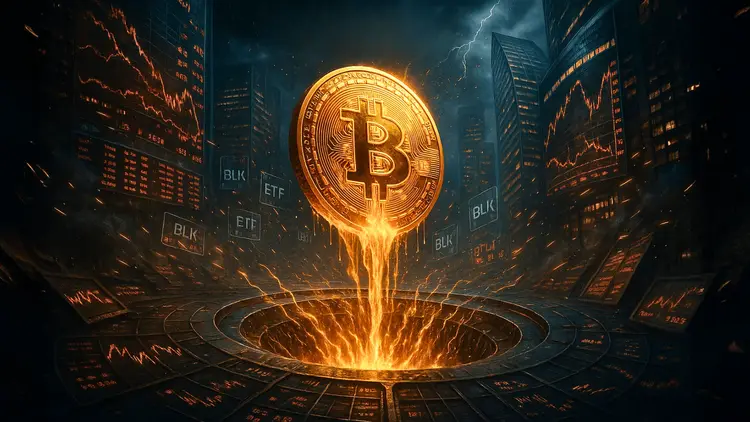
Exchange-traded funds tied to Bitcoin are staring down their most punishing month since the products first hit U.S. exchanges nearly two years ago, and the mood across the crypto market reflects the bruising. Investors have withdrawn $3.5 billion from U.S.-listed Bitcoin ETFs in November alone, almost matching the record $3.6 billion exodus last February. The sharp retreat underscores one thing clearly. The euphoria that once powered Bitcoin’s rise has evaporated, leaving a market searching for conviction while volatility creeps back in.

At the center of the storm sits BlackRock’s IBIT, the largest of the Bitcoin ETF cohort with roughly 60 percent of total assets. Once hailed as a long-awaited gateway for institutional capital, IBIT is on pace for its worst month so far, bleeding $2.2 billion in redemptions. Without a sudden reversal, November will cement itself as the biggest shakeout in Bitcoin’s ETF era. For many investors, the story is less about a weak month, and more about a structural shift in how institutions view risk, liquidity and the future of speculative assets.

Bitcoin’s Slide Exposes Deeper Fragility

The pressure on funds isn’t happening in isolation. Bitcoin itself is heading toward its worst monthly performance since the 2022 collapse of the crypto industry, a period tarnished by scandal, insolvency and the fall of Sam Bankman-Fried’s FTX. The token dipped to $80,553 on Friday before bouncing back slightly over the weekend, trading near $85,951 on Monday morning in New York. Even with the modest rebound, Bitcoin remains down 8 percent this year, a sharp contrast to the expectations set at the beginning of 2025 when digital assets were projected to benefit from regulatory breakthroughs and institutional momentum.

In truth, the pullback reveals a market that had been running on fumes. Policy wins in Washington and abroad were supposed to provide tailwinds. Instead, broader risk aversion has overwhelmed sentiment. Nick Ruck of LVRG Research puts it plainly. The euphoria that once pushed Bitcoin ETFs into mainstream portfolios has been fully exhausted, leaving uncertainty in its place.

The ETF Feedback Loop Tightens

Spot Bitcoin ETFs redefined crypto’s relationship with Wall Street when they debuted in January 2024. For the first time, traditional capital was able to flow seamlessly in and out of Bitcoin without investors needing to touch an exchange wallet or navigate crypto infrastructure. But that convenience came with consequences. Bitcoin ETFs became a mirror of investor psychology and a powerful amplifier of price moves.

Citi Research has quantified the effect. Every $1 billion pulled from Bitcoin ETFs results in a roughly 3.4 percent drop in Bitcoin’s price. It works in reverse too. When inflows accelerate, the token tends to climb as momentum feeds on itself. The problem today is obvious. Instead of new money entering the market, billions have poured out of ETF structures, exerting added pressure on spot prices. Alex Saunders of Citi Research, who recently issued a bear-case target of $82,000 for year-end assuming zero inflows, now finds himself looking at outflows instead, raising the potential for even deeper declines.

This dynamic is especially potent during periods of volatility. When markets drop, outflows pick up. When outflows pick up, prices fall further. Bitcoin is caught in this loop once again, and unless the direction reverses, there may be more pain to come.

Institutional Behavior Is Shifting

The flight from Bitcoin ETFs is not entirely about panic. Some of the movement reflects hedge funds unwinding a popular strategy called the basis trade, which exploits the difference between spot and futures pricing. Traders also use ETFs to hedge derivative positions or capture short-term volatility, meaning not every redemption reflects lost confidence. But a pattern is emerging. Institutional appetite for speculative assets has waned across the board.

Friday delivered a particularly dramatic moment. Bitcoin ETFs recorded a staggering $11.5 billion in trading volume, the highest on record. IBIT alone accounted for $8 billion of that figure and still ended the session with $122 million in outflows. For analysts like Nick Ruck, the message is unmistakable. Elevated trading volume typically hints at renewed interest, but the continued redemptions tell a different story, one where investors are shifting away from the once-dominant category leader. BlackRock declined to comment, but the numbers themselves outline a clear trend.

Crypto Isn’t the Only Risk Trade Under Pressure

The downturn extends far beyond digital assets. Some of the riskiest corners of the market are flashing similar stress signals. AI stocks, meme-driven names and high-momentum tech trades have all cooled. Even the S&P 500 is poised for its worst month since March. In this climate, Bitcoin’s correlation with tech stocks hit a record earlier this month, tightening the link between the cryptocurrency and broader risk assets.

For Raphael Thuin of Tikehau Capital, this is no coincidence. Shifting narratives around technology valuations, especially concerns surrounding AI and robotics, have filtered into investor psychology. The risk-off tone is widespread, and Bitcoin ETFs have become one of the clearest gauges of how much appetite remains for speculative bets. When uncertainty rises, liquidity typically flows to safer assets, and Bitcoin is rarely considered safe.

A Market Searching for Direction

The crypto market finds itself in a period of consolidation, the kind that reshapes portfolios and forces investors to reassess the balance between risk and conviction. Thuin notes that these rotations tend to heighten market sensitivity, often triggering sudden losses for those who are overexposed. After years of extreme swings, regulatory drama and liquidity crunches, this year was supposed to mark Bitcoin’s transition into a more mature phase. Instead, the asset is once again riding a wave of volatility that threatens to undermine the institutional optimism cultivated over the past two years.

The months ahead will reveal whether this downturn is a temporary setback or the beginning of a deeper reset. With outflows accelerating, ETF dynamics growing heavier and correlations with equity markets strengthening, Bitcoin’s next move hinges on one thing. Confidence must return, and in today’s climate of caution, confidence is the one commodity in short supply.

Conclusion

Bitcoin ETFs are experiencing their most severe bout of outflows since launch, reflecting not just weakness in the crypto market but broader shifts in institutional sentiment. With $3.5 billion already pulled in November and pressure mounting across risk assets, the market is stepping into unfamiliar territory. Bitcoin’s role as a barometer of speculative appetite has never been clearer, and until inflows resume, the asset remains vulnerable to deeper price declines. Whether confidence returns will depend on how investors interpret volatility, risk and the evolving landscape of digital assets heading into year-end.

Bitcoin

Most Popular News

  1. SpaceX’s $8B Spectrum Deal Sends AT&T, Verizon, and T-Mobile Plummeting
  2. Is Project Vault Securing America’s Supply Chain or Squeezing It to the Breaking Point?
  3. Why Gautam Lohia Shifted from Global Consulting to Reboot a $20M Tech Micro-Cap
  4. Everyday Luxury, Unstoppable Scale: Aritzia Delivers 44% Net Revenue Growth
  5. Can Navy SEAL Leadership and Big Tech Scale Revolutionize Airborne Threat Detection?

Disclaimer


This report should not be viewed as investment advice or as an offer to buy or sell any securities or as an invitation or solicitation of an offer to buy or sell any securities. Neither the author of this report, its publisher, nor any other person associated with the publication of this report, are registered brokers, investment dealers, investment advisers, or financial advisers. The information in this report has not been tailored to the particular needs or circumstances of readers and should not be relied upon as investment advice or recommendations to purchase or sell any of the securities presented in this report. Readers seeking investment advice should contact qualified and registered brokers, investment dealers, investment advisers, or financial advisers prior to making any decision to buy or sell any of the securities referred to in this report. The information in this report should not be construed as investment, legal, or tax advice. No recommendation is made as to whether an investment in the presented securities is suitable for any reader in light of the reader’s particular circumstances.

Readers are cautioned that the publisher of this report covers exclusively securities that carry a high degree of volatility. Investing in such securities is highly speculative and carries a high degree of risk. Investors in such securities could lose all or a substantial portion of their investment. Only those investors who can afford to lose all or a substantial portion of their investment should consider investing in the securities referred to in this report.

This report may include information obtained from publicly available sources, including third-party reports or analysis. Neither the author nor publisher of this report, nor www.juniorstocks.com or its owners, have undertaken any independent investigation into the factual information used in this report, and the information in this report is provided without any warranty of any kind. No representations or warranties are provided regarding the accuracy or completeness of the information provided in this report. Statements of opinion or belief are those of the authors and/or publisher of this report. These statements of opinion or belief are expressions of the author’s and/or publisher’s judgment, and there is no guarantee that those judgments will turn out to be correct. No inference should be drawn that the author and/or publisher have any special or greater knowledge about the presented companies or their securities, or any particular expertise in the industries or markets in which the company operates. Readers should conduct their own due diligence and seek professional advice prior to investing in any securities presented on Juniorstocks.com.

Certain statements in this report constitute “forward-looking” statements. Forward-looking statements often, but not always, are identified by the use of words such as “seek,” “anticipate,” “believe,” “plan,” “estimate,” “expect,” “targeting,” and “intend” and statements that an event or result “may,” “will,” “should,” “could,” or “might” occur or be achieved and other similar expressions. Forward-looking statements express or involve discussions with respect to predictions, expectations, beliefs, plans, projections, objectives, goals, assumptions, or future events or performance; they are not statements of historical facts and should not be viewed as any guarantee of any future result. Forward-looking statements are based on expectations, estimates, and projections at the time the statements are made that involve a number of risks and uncertainties which could cause actual results or events to differ materially from those presently anticipated. The author and/or publisher of this report disclaims any obligation to update the forward-looking statements in this report, whether as a result of new information, future events, or results or otherwise. There is no assurance that forward-looking statements will prove to be accurate, as actual results and future events could differ materially from those anticipated in such statements. Accordingly, readers should not place undue reliance on forward-looking statements.

The information provided in this report is not intended for distribution to, or use by, any person or entity in any jurisdiction or country where such distribution or use would be contrary to applicable law or regulation, or would subject the author or publisher of this report to any registration requirement in such jurisdiction or country.

Information about the editor of this publication:
Juniorstocks.com is a service provided by Piccadilly Capital Group, Office 66, 101 Clapham High Street, London, SW4 7TB, UK. Piccadilly Capital Group is not the publisher of this report and was not paid for the publication of this report. Piccadilly Capital Group seeks to generate web traffic and a growing number of followers through the publication of articles or reports. Directors, officers, and other insiders of the publisher own an interest in Piccadilly Capital Group. Piccadilly Capital Group does not endorse or recommend the business, products, services, or securities of any company mentioned on www.juniorstocks.com. Piccadilly Capital Group will not share your information with any outside third parties. Due to the new data protection basic regulation, we ask you to read our data protection declaration carefully.

Note on copyright:
The contents published on this website and on connected media (e.g., e-mail, X, Facebook) are subject to applicable copyright and ancillary copyright laws. Any use not permitted by applicable copyright and ancillary copyright laws requires the prior written consent of the provider or the respective rights holder. In particular, this applies to the duplication, editing, translation, storage, processing, or reproduction of content in databases or other electronic media and systems. Contents and rights of third parties are marked as such. Unauthorized reproduction or transmission of individual contents or complete pages is not permitted and is punishable by law. Only the production of copies and downloads for personal, private, and non-commercial use is permitted. Links to the provider's website are always welcome and do not require the consent of the provider of the website. Photos and images on the website may not be shared unless the publisher itself has acquired the initial rights from authorized sources. The presentation of this website in external frames is only allowed with written permission. If you notice any violations, please inform us. Please note: The content of our articles, emails, or other publications or social networks such as X, LinkedIn or Facebook is exclusively intended for the designated addressee(s). If you are not the addressee of these articles, emails, or other publications in the market letter or social networks such as Twitter or Facebook or his or her legal representative, please note that any form of publication, reproduction, or distribution of the content of these articles, emails, or other publications in the market letter or social networks such as X, LinkedIn or Facebook is prohibited. Falsifications of the original content of this message during data transmission cannot be excluded in principle.