SPONSORED

The Big Short 2.0: Trump’s Tweet Triggers Crypto’s Collapse

Crypto’s wild rally meets a geopolitical reality check as Trump reignites the U.S.–China trade war, triggering over $6 billion in liquidations and sending shockwaves across global markets.
•• 1 Min
The Big Short 2.0: Trump’s Tweet Triggers Crypto’s Collapse

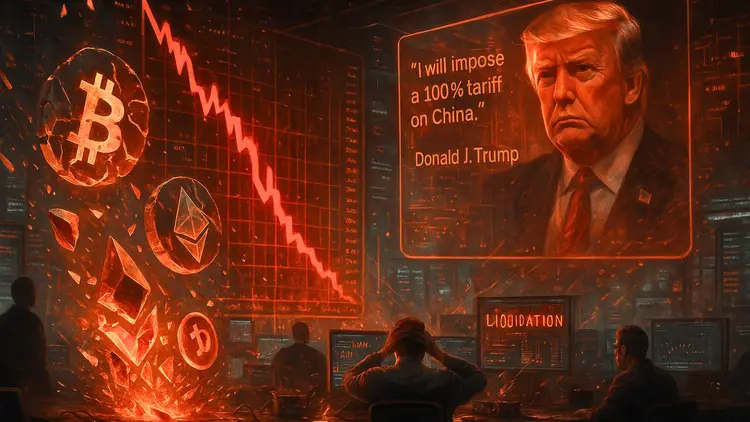
Markets don’t crash quietly. On October 10, 2025, chaos hit the crypto world with the force of a thunderclap after U.S. President Donald Trump announced plans to impose an additional 100% tariff on China and tighten export controls on key technologies. Within an hour, more than $6 billion in leveraged crypto positions vanished into thin air. The market’s euphoric rally screeched to a halt as traders watched Bitcoin, Ethereum, and a host of altcoins tumble in unison.

Bitcoin, which had just been flirting with a new all-time high of $126,250 earlier in the week, plunged over 12% after Trump’s Truth Social post blindsided investors. The world’s largest cryptocurrency briefly stabilized around $112,000, but the damage was done. According to data from Coinglass, more than $7.4 billion in bets on digital assets were wiped out within 24 hours, including $6.7 billion in long positions and another $695 million in shorts. It was the largest liquidation event since April.

Ravi Doshi, co-head of markets at FalconX, summed up the sentiment perfectly. “A renewed trade war between China and the U.S. erupted on Friday, causing uncertainty in markets and a rout in risk assets,” he said, noting that FalconX’s derivatives desk saw heavy demand for downside protection throughout the day. That demand wasn’t misplaced. Within hours, crypto markets had gone from exuberant to defensive as traders scrambled to unwind leveraged bets.

The shockwave didn’t stop at Bitcoin. Ethereum was battered even harder, sliding more than 17%. XRP and Dogecoin — the poster children of speculative trading — each cratered over 30%. The selling was indiscriminate. Liquidity vanished. Bid-ask spreads widened. Smaller tokens that had surged during the recent bull run were suddenly untradeable as exchanges struggled to handle the flood of liquidations.

It wasn’t just crypto that felt the heat. The flare-up in U.S.–China tensions sent tremors through global markets. Stocks fell sharply, oil prices tumbled, and investors rushed into traditional safe havens like Treasuries and gold. Risk assets were being dumped across the board. By midday, the S&P 500 was down more than 3%, crude oil slipped below $70 a barrel, and gold surged past $2,600 an ounce. Traders weren’t taking chances — not with another full-blown trade war on the horizon.

Trump’s announcement marked a dramatic escalation in the simmering standoff between Washington and Beijing. The president accused China of weaponizing its export dominance in rare earth minerals — materials critical for electric vehicles, semiconductors, and defense technologies. Beijing’s recent export controls, which extended to rare earth technologies and production licensing abroad, had already rattled industrial supply chains. Trump’s response, however, took things to another level. His post called China’s actions “hostile” and “sinister,” adding that there was “no reason” to follow through with a planned meeting with Xi Jinping at the APEC summit in South Korea later this month.

For crypto investors, the timing couldn’t have been worse. Market optimism had been running high all week. Traders were piling into everything — equities, bonds, and digital assets — in a broad risk-on rally. The idea was that global growth was stabilizing, inflation was cooling, and the Federal Reserve might even begin easing policy sooner than expected. Bitcoin’s surge above $120,000 was being hailed as proof that institutional money was finally all in. Then, with one Truth Social post, the narrative flipped on its head.

The psychology of the crypto market has always been fragile, and Friday’s events laid that bare. Leveraged longs were wiped out in minutes. Liquidations cascaded across exchanges, triggering margin calls and forced selling that fed into the panic. Exchanges like Binance, Bybit, and OKX saw record trading volumes — not from new inflows, but from traders desperately trying to close positions before the next margin call hit.

Even as Bitcoin tried to recover, analysts warned the damage could linger. Liquidity providers, burned by the scale of the drawdown, may stay cautious. Market makers are likely to widen spreads, reducing efficiency in the short term. And with geopolitical risk suddenly back on the table, appetite for speculative assets could cool fast.

Still, not everyone is panicking. Some see the selloff as a stress test for a maturing market. Volatility, after all, is nothing new for crypto. Bitcoin has weathered Chinese bans, exchange collapses, and global financial shocks before. The asset’s ability to rebound from violent corrections has long been part of its mythos. As FalconX’s Doshi noted, “Periods like this separate the traders from the tourists.”

Yet, the broader implications go beyond crypto. The renewed U.S.–China conflict is threatening to reshape global trade once again, from semiconductors to commodities. A 100% tariff would upend existing supply chains and could ignite another inflationary wave — something the Federal Reserve has worked tirelessly to contain. For risk assets already priced for perfection, that’s a dangerous setup.

In the hours after Trump’s announcement, gold and Treasuries rallied sharply. The 10-year Treasury yield dropped below 3.8% as investors sought safety, while gold surged to record highs. The dollar index strengthened too, reflecting a rush for liquidity. In contrast, the Nasdaq and S&P 500 both endured their sharpest intraday declines in months, underscoring how fragile confidence remains when geopolitics enters the equation.

As markets digest the fallout, traders are bracing for what comes next. If the trade war rhetoric escalates, risk assets could see more pain ahead. But in the unpredictable world of crypto, reversals can be just as fast as selloffs. Bitcoin has already clawed back partial losses in post-announcement trading, suggesting that dip buyers haven’t completely disappeared.

For now, the $6 billion liquidation stands as a stark reminder of crypto’s volatility — and its entanglement with global politics. What began as a digital revolution detached from traditional finance has now become deeply intertwined with it. Bitcoin no longer moves in isolation; it reacts to policy, politics, and power plays just like any other asset. Friday’s crash wasn’t just about margin calls — it was a geopolitical tremor felt through the digital bloodstream of global markets.

Conclusion

The latest crypto wipeout is more than just a correction. It’s a reflection of how vulnerable even the most decentralized markets are to political shocks. As the trade tensions between Washington and Beijing escalate, investors across all asset classes are being forced to recalibrate. For now, crypto’s believers will call this a temporary storm. But even they know that in markets as fast and fragile as these, every headline can become a hurricane.

BitcoinDonald Trump

Most Popular News

  1. SpaceX’s $8B Spectrum Deal Sends AT&T, Verizon, and T-Mobile Plummeting
  2. Is Project Vault Securing America’s Supply Chain or Squeezing It to the Breaking Point?
  3. Why Gautam Lohia Shifted from Global Consulting to Reboot a $20M Tech Micro-Cap
  4. Everyday Luxury, Unstoppable Scale: Aritzia Delivers 44% Net Revenue Growth
  5. Can Navy SEAL Leadership and Big Tech Scale Revolutionize Airborne Threat Detection?

Disclaimer


This report should not be viewed as investment advice or as an offer to buy or sell any securities or as an invitation or solicitation of an offer to buy or sell any securities. Neither the author of this report, its publisher, nor any other person associated with the publication of this report, are registered brokers, investment dealers, investment advisers, or financial advisers. The information in this report has not been tailored to the particular needs or circumstances of readers and should not be relied upon as investment advice or recommendations to purchase or sell any of the securities presented in this report. Readers seeking investment advice should contact qualified and registered brokers, investment dealers, investment advisers, or financial advisers prior to making any decision to buy or sell any of the securities referred to in this report. The information in this report should not be construed as investment, legal, or tax advice. No recommendation is made as to whether an investment in the presented securities is suitable for any reader in light of the reader’s particular circumstances.

Readers are cautioned that the publisher of this report covers exclusively securities that carry a high degree of volatility. Investing in such securities is highly speculative and carries a high degree of risk. Investors in such securities could lose all or a substantial portion of their investment. Only those investors who can afford to lose all or a substantial portion of their investment should consider investing in the securities referred to in this report.

This report may include information obtained from publicly available sources, including third-party reports or analysis. Neither the author nor publisher of this report, nor www.juniorstocks.com or its owners, have undertaken any independent investigation into the factual information used in this report, and the information in this report is provided without any warranty of any kind. No representations or warranties are provided regarding the accuracy or completeness of the information provided in this report. Statements of opinion or belief are those of the authors and/or publisher of this report. These statements of opinion or belief are expressions of the author’s and/or publisher’s judgment, and there is no guarantee that those judgments will turn out to be correct. No inference should be drawn that the author and/or publisher have any special or greater knowledge about the presented companies or their securities, or any particular expertise in the industries or markets in which the company operates. Readers should conduct their own due diligence and seek professional advice prior to investing in any securities presented on Juniorstocks.com.

Certain statements in this report constitute “forward-looking” statements. Forward-looking statements often, but not always, are identified by the use of words such as “seek,” “anticipate,” “believe,” “plan,” “estimate,” “expect,” “targeting,” and “intend” and statements that an event or result “may,” “will,” “should,” “could,” or “might” occur or be achieved and other similar expressions. Forward-looking statements express or involve discussions with respect to predictions, expectations, beliefs, plans, projections, objectives, goals, assumptions, or future events or performance; they are not statements of historical facts and should not be viewed as any guarantee of any future result. Forward-looking statements are based on expectations, estimates, and projections at the time the statements are made that involve a number of risks and uncertainties which could cause actual results or events to differ materially from those presently anticipated. The author and/or publisher of this report disclaims any obligation to update the forward-looking statements in this report, whether as a result of new information, future events, or results or otherwise. There is no assurance that forward-looking statements will prove to be accurate, as actual results and future events could differ materially from those anticipated in such statements. Accordingly, readers should not place undue reliance on forward-looking statements.

The information provided in this report is not intended for distribution to, or use by, any person or entity in any jurisdiction or country where such distribution or use would be contrary to applicable law or regulation, or would subject the author or publisher of this report to any registration requirement in such jurisdiction or country.

Information about the editor of this publication:
Juniorstocks.com is a service provided by Piccadilly Capital Group, Office 66, 101 Clapham High Street, London, SW4 7TB, UK. Piccadilly Capital Group is not the publisher of this report and was not paid for the publication of this report. Piccadilly Capital Group seeks to generate web traffic and a growing number of followers through the publication of articles or reports. Directors, officers, and other insiders of the publisher own an interest in Piccadilly Capital Group. Piccadilly Capital Group does not endorse or recommend the business, products, services, or securities of any company mentioned on www.juniorstocks.com. Piccadilly Capital Group will not share your information with any outside third parties. Due to the new data protection basic regulation, we ask you to read our data protection declaration carefully.

Note on copyright:
The contents published on this website and on connected media (e.g., e-mail, X, Facebook) are subject to applicable copyright and ancillary copyright laws. Any use not permitted by applicable copyright and ancillary copyright laws requires the prior written consent of the provider or the respective rights holder. In particular, this applies to the duplication, editing, translation, storage, processing, or reproduction of content in databases or other electronic media and systems. Contents and rights of third parties are marked as such. Unauthorized reproduction or transmission of individual contents or complete pages is not permitted and is punishable by law. Only the production of copies and downloads for personal, private, and non-commercial use is permitted. Links to the provider's website are always welcome and do not require the consent of the provider of the website. Photos and images on the website may not be shared unless the publisher itself has acquired the initial rights from authorized sources. The presentation of this website in external frames is only allowed with written permission. If you notice any violations, please inform us. Please note: The content of our articles, emails, or other publications or social networks such as X, LinkedIn or Facebook is exclusively intended for the designated addressee(s). If you are not the addressee of these articles, emails, or other publications in the market letter or social networks such as Twitter or Facebook or his or her legal representative, please note that any form of publication, reproduction, or distribution of the content of these articles, emails, or other publications in the market letter or social networks such as X, LinkedIn or Facebook is prohibited. Falsifications of the original content of this message during data transmission cannot be excluded in principle.