
US Trade Chief Says Allies Must Pay a 'National Security Premium' to Break China's Mineral Monopoly
USTR Jamieson Greer declares the era of bargain-bin geopolitics over, demanding Western partners embrace price floors for rare earth elements to break Chinese supply chain dominance.
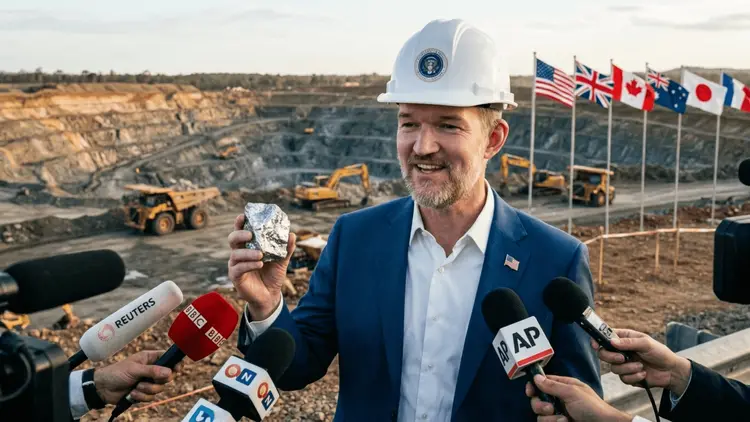
The era of bargain-bin geopolitics is officially over, and the United States trade office is sliding the receipt across the table to its allies. If Western nations want secure access to the critical materials that power modern technology, defense systems, and electric vehicles, they are going to have to pay what is now being dubbed the "national security premium."
That is the unapologetically blunt message from US Trade Representative Jamieson Greer, who recently told the Financial Times that allied nations must stop prioritizing pure cost efficiency over supply chain resilience. For decades, the global market for essential resources, including cobalt, copper, graphite, lithium, platinum, uranium, and especially rare earth elements, has been dominated by Chinese suppliers capable of consistently undercutting Western competitors. Now, Washington is aggressively drafting a blueprint for a coalition of trading partners in Europe, the Americas, and Australia to source these minerals internally, deliberately bypassing cheaper Chinese alternatives.
Greer’s stance is remarkably unsentimental regarding the corporate bottom line. When international trading partners inevitably raise concerns about the economic strain of proposed price floors and minimum guaranteed pricing mechanisms, his response is a swift geopolitical reality check. He explicitly blames the West's relentless fixation on cost efficiency for the precarious situation it currently finds itself in. The implication from the USTR is crystal clear: the artificially cheap prices enjoyed by manufacturers in the past were secretly subsidized by a massive strategic vulnerability.
This paradigm shift is poised to send shockwaves through the industrial sector, fundamentally altering the economics for domestic and allied mining operations. Companies dedicated to extracting these vital resources, such as American rare earth producer MP Materials (NYSE: MP) or lithium powerhouse Albemarle (NYSE: ALB), stand to benefit immensely from a protected, allied market that shields them from deliberately depressed global commodity pricing. Allied suppliers, like Australia's Lynas Rare Earths (ASX: LYC), could also see elevated demand as the United States attempts to fortify a closed-loop trade club.
However, the downstream consequences are understandably giving allied capitals and manufacturing boardrooms a serious case of heartburn. Artificially inflating the cost of foundational materials guarantees higher manufacturing costs for everything from wind turbines to advanced munitions. Automakers banking on an affordable electric vehicle transition, including industry heavyweights like Tesla (NASDAQ: TSLA) and Ford Motor Company (NYSE: F), will face the unenviable task of either absorbing these supply chain premiums or passing them directly on to consumers at a time when industrial inflation remains a highly sensitive economic trigger.
The United States is essentially asking its closest friends to buy into a mandatory geopolitical insurance policy. While breaking Beijing's stranglehold on the critical mineral market is a broadly shared strategic goal across the West, convincing global allies to eagerly swallow the associated price hikes remains a delicate diplomatic tightrope. The global market is about to find out exactly how much a secure supply chain is actually worth.
Source:
- Reuters / April 22, 2026 / "US trade chief says allies need to pay ‘national security premium’ for critical minerals"